
Canadian Dollar slips back on Tuesday as Crude Oil slumps, US CPI inflation meets expectations

- The Canadian Dollar sheds weight on Tuesday, walks back Monday gains.
- Economic data from Canada remains absent on the calendar.
- Crude Oil is plunging as markets reassess slowing global growth, causing demand declines to outpace production cuts.
The Canadian Dollar (CAD) fell back on Tuesday as markets shuffled their stance following US Consumer Price Index (CPI) inflation figures that exactly met market expectations, pointing to dwindling growth looking forward.
Canada sees little to no meaningful data on the economic calendar this week, leaving the CAD to get dragged around the charts by the broader market. Crude Oil markets are seeing broad declines on declining demand concerns, further pressuring the Loonie.
Daily Digest Market Movers: US CPI meets expectations, price growth slowly cools
- The Canadian Dollar sees losses across the board on Tuesday, with slight to moderate declines against all of the CAD’s major currency peers.
- The CAD’s weakest performance sees it down six-tenths of a percent against the Japanese Yen (JPY) and half a percent against the Swiss Franc (CHF).
- The Loonie’s ‘strongest’ performance is against the Australian Dollar (AUD), down around a sixth of a percent against the Antipodean, with a close second going to a fifth of a percent decline against the post-CPI US Dollar (USD).
- US Consumer Price Index (CPI) inflation met the Street’s expectations across the board, with headline annualized CPI inflation ticking down from 3.2% to 3.1% and the MoM figure ticking up slightly from a flat 0.0% to 0.1%.
- Core CPI inflation (headline inflation less volatile food and energy prices) held steady at 4% for the YoY figure, with November’s MoM Core CPI printing slightly higher at 0.3% versus October’s 0.2%.
- Crude Oil markets are taking a leg down in the face of declining price growth from the US, adding further weight to ongoing energy market concerns about declining fossil demand eclipsing global production cuts, specifically from the Organization of the Petroleum Exporting Countries (OPEC).
- US West Texas Intermediate (WTI) Crude Oil slips back to $69.00 per barrel.
- The Canadian Dollar is getting dragged down in lockstep with deflating Crude Oil bids.
- Next up for markets will be the Federal Reserve’s (Fed) Monetary Policy Statement and updates to its Interest Rate Projections, both due on Wednesday at 19:00 GMT and to be followed up by a Press Conference at 19:30 GMT.
Canadian Dollar price today
The table below shows the percentage change of Canadian Dollar (CAD) against listed major currencies today. Canadian Dollar was the strongest against the Australian Dollar.
| USD | EUR | GBP | CAD | AUD | JPY | NZD | CHF | |
| USD | -0.23% | 0.01% | 0.21% | 0.06% | -0.34% | -0.11% | -0.28% | |
| EUR | 0.23% | 0.23% | 0.46% | 0.29% | -0.14% | 0.11% | -0.06% | |
| GBP | -0.01% | -0.24% | 0.22% | 0.05% | -0.36% | -0.11% | -0.30% | |
| CAD | -0.22% | -0.44% | -0.21% | -0.14% | -0.58% | -0.34% | -0.50% | |
| AUD | -0.06% | -0.29% | -0.06% | 0.17% | -0.43% | -0.18% | -0.36% | |
| JPY | 0.34% | 0.12% | 0.36% | 0.57% | 0.43% | 0.25% | 0.07% | |
| NZD | 0.10% | -0.12% | 0.11% | 0.33% | 0.17% | -0.25% | -0.18% | |
| CHF | 0.27% | 0.06% | 0.29% | 0.51% | 0.36% | -0.08% | 0.17% |
The heat map shows percentage changes of major currencies against each other. The base currency is picked from the left column, while the quote currency is picked from the top row. For example, if you pick the Euro from the left column and move along the horizontal line to the Japanese Yen, the percentage change displayed in the box will represent EUR (base)/JPY (quote).
Technical Analysis: Canadian Dollar trips over slumping Crude Oil, sends USD/CAD back over 1.3600
The Canadian Dollar (CAD) looks for the basement on Tuesday, backsliding across the board and shedding weight against all of its major currency peers.
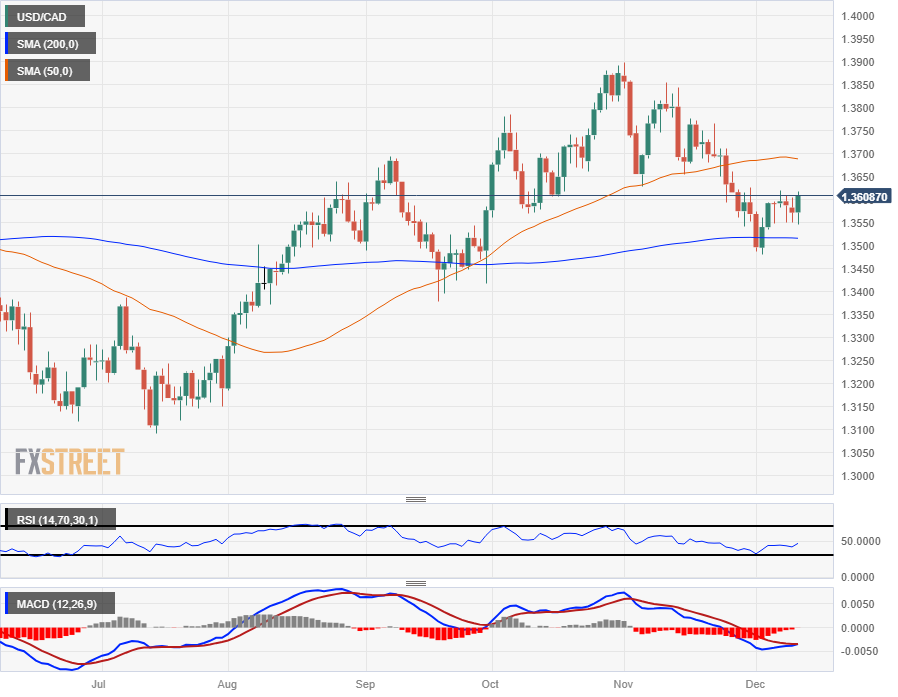
The USD/CAD has regained the 1.3600 handle after catching a topside break of consolidation between the 50-hour and 200-hour Simple Moving Averages (SMA) in the 1.3580 to 1.3560 zone.
The USD/CAD is toying with last week’s highs near 1.3620 after rebounding from familiar near-term lows at 1.3550. The pair is at risk of hardening into a sideways consolidation range, but the US Dollar (USD) is set up for further breakouts following central bank action on Wednesday.
The USD/CAD continues to hold chart territory north of the 200-day SMA just above the 1.3500 handle, keeping bids above the major moving average, but immediate topside momentum remains constrained by the 50-day SMA near 1.3700.
USD/CAD Hourly Chart
USD/CAD Daily Chart
Inflation FAQs
Inflation measures the rise in the price of a representative basket of goods and services. Headline inflation is usually expressed as a percentage change on a month-on-month (MoM) and year-on-year (YoY) basis. Core inflation excludes more volatile elements such as food and fuel which can fluctuate because of geopolitical and seasonal factors. Core inflation is the figure economists focus on and is the level targeted by central banks, which are mandated to keep inflation at a manageable level, usually around 2%.
The Consumer Price Index (CPI) measures the change in prices of a basket of goods and services over a period of time. It is usually expressed as a percentage change on a month-on-month (MoM) and year-on-year (YoY) basis. Core CPI is the figure targeted by central banks as it excludes volatile food and fuel inputs. When Core CPI rises above 2% it usually results in higher interest rates and vice versa when it falls below 2%. Since higher interest rates are positive for a currency, higher inflation usually results in a stronger currency. The opposite is true when inflation falls.
Although it may seem counter-intuitive, high inflation in a country pushes up the value of its currency and vice versa for lower inflation. This is because the central bank will normally raise interest rates to combat the higher inflation, which attract more global capital inflows from investors looking for a lucrative place to park their money.
Formerly, Gold was the asset investors turned to in times of high inflation because it preserved its value, and whilst investors will often still buy Gold for its safe-haven properties in times of extreme market turmoil, this is not the case most of the time. This is because when inflation is high, central banks will put up interest rates to combat it.
Higher interest rates are negative for Gold because they increase the opportunity-cost of holding Gold vis-a-vis an interest-bearing asset or placing the money in a cash deposit account. On the flipside, lower inflation tends to be positive for Gold as it brings interest rates down, making the bright metal a more viable investment alternative.
Read the full article here