

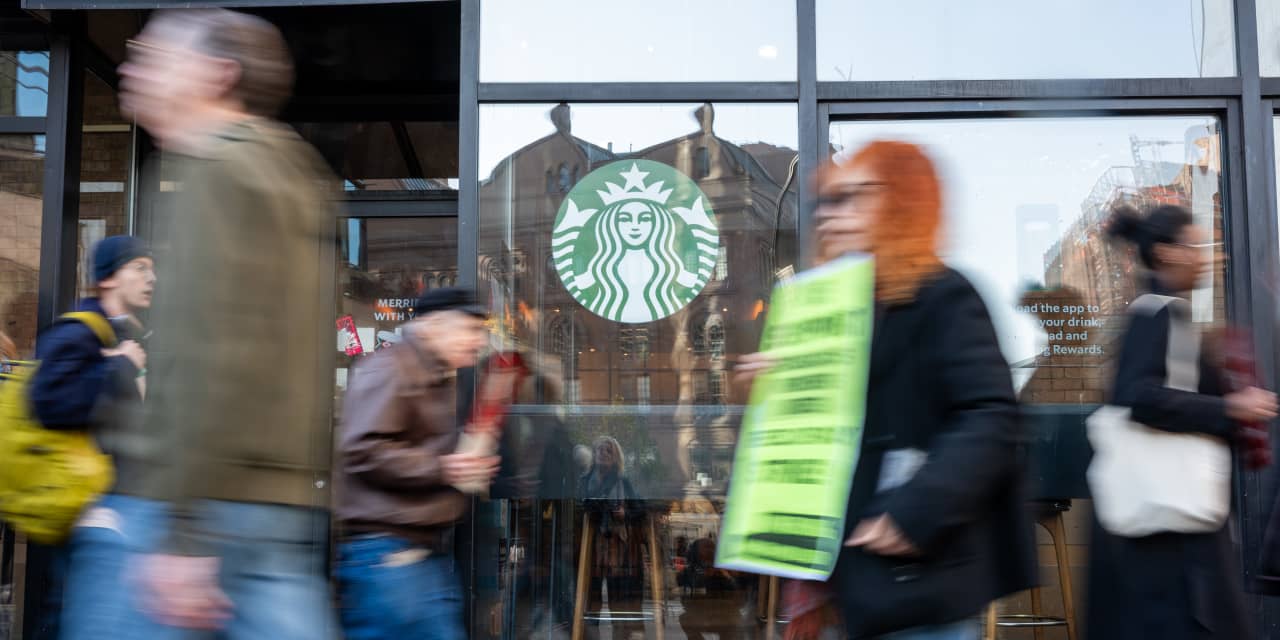
A new third-party report
Starbucks
commissioned in the face of shareholder pressure finds the coffee chain was unprepared for the unionization push at its stores and that its handling of the issue has resulted in “significant” negative consequences for the company.
But the assessment, which was written by labor relations expert Thomas Mackall, also concludes that the company did not have an “anti-union playbook” and did not purposely engage in union busting.
A campaign by Workers United that started in August 2021 in Buffalo, New York, has since spread to more than 350 Starbucks stores across the country. The organizing drive has sparked bitter fighting between the company and union organizers, a conflict that has now spanned the tenures of three Starbucks CEOs.
The report, which was released Wednesday, was prompted by a shareholder proposal earlier this year led by New York City Comptroller Brad Lander, who’s a fiduciary to city public pension funds. The proposal called for an independent assessment of worker rights at Starbucks and won majority support from investors at the company’s March 23 annual meeting.
The findings come the same week Starbucks has made new overtures to the union to restart bargaining talks. CEO Laxman Narasimhan said Monday the company has a “hopeful goal” of reaching agreements with the union in 2024.
Starbucks “did not have the internal capacity” to manage rapidly accelerating union activity, according to the report: “The consequences of this were significant.” The federal agency that oversees workers’ right to organize, the National Labor Relations Board, has filed more than 130 complaints of unfair labor practices against Starbucks, the report notes, and so far administrative law judges have ruled against the company in more than 35 decisions.
The report notes the company has “vigorously defended itself in each case, and each is under review or subject to appeal.” But its findings also paint a picture of a company that has found itself on the losing side of a publicity battle with the union organizing effort.
On Wednesday, Starbucks independent board chair Mellody Hobson said the findings show “that while Starbucks has had no intention to deviate from the principles of freedom of association and the right to collective bargaining, there are things the Company can, and should, do to improve its stated commitments and its adherence to these important principles.”
A spokesperson for Lander says: “While we continue to review the independent assessment in full, I am concerned by Starbucks’ admitted lack of understanding regarding the meaning and implementation of the policies that govern management’s engagement with workers during unionizing efforts.”
“We expect changes at Starbucks and a ‘recommitment’ that isn’t merely company speak for more of the same,” adds the spokesperson.
Starbucks Workers United union said the report “acknowledges deep problems in the company’s response to workers’ organizing—including firings, retaliation, store closings and withholding of benefits from unionized workers,” according to a statement. “The report shows Starbucks has a long way to go to shift policy and deconstruct the massive anti-union apparatus that remains in place and is active today.”
While the findings did not show evidence of intentional union busting, it does present a company that was ill prepared to confront an organizing campaign, with a response that was hampered by the belief of some inside Starbucks that union activity was isolated to Buffalo.
The idea that employees might unionize “seemed so remote to the company that it had no trained and dedicated labor relations team,” the report said.
This left Starbucks vulnerable when it sent reinforcements to stabilize operations in Buffalo. As union organizers drummed up support in Buffalo-area stores, the report said, Starbucks focused on fixing operational and management problems related to staffing issues, “substandard facilities,” training and standards.
But the focus on operations “may have taken priority over careful respect for rights” in an environment where unionizing workers have protections under federal law, according to the report. And over the course of the union campaign federal administrative law judges “have found that store-level managers or supervisors have stepped out of bounds in many instances,” says the report.
Trained union organizers know how to “recognize and report legal violations, and in some instances can even provoke them,” the report said. When charges of unlawful actions multiply, and are found to have merit by federal regulators, a union can “drive publicity and pressure against the target organization.”
That’s effectively what happened at Starbucks, the report found: “By spring 2022, press reports, reinforced by the growing volume of NLRB charges and complaints, had established a public ‘union-busting’ narrative, and the currents contributing to the scrutiny under which Starbucks is now operating were already flowing strongly.”
Write to Catherine Dunn at [email protected]
Read the full article here