

- The Canadian Dollar has slowed recent gains but tests into the high side.
- Bank of Canada Governor Macklem due to make an appearance to round out the week.
- Crude Oil bids have deflated in the American trading session as Fed comments cool market rate cut hopes.
The Canadian Dollar (CAD) has paused near the top end of the week’s chart action as market participants digest updated comments from Federal Reserve (Fed) officials strongly suggesting that market expectations may have run far ahead of the Fed’s expectations of rate cuts in 2024.
Bank of Canada (BoC) Governor Tiff Macklem spoke at the Canadian Club of Toronto, where the BoC head delivered prepared notes, stating that it’s still far too early to begin considering or discussing rate cuts. BoC Governor Macklem’s appearance marks the most (if not only) noteworthy item on the CAD’s entire economic calendar for this week.
New York Fed President John Williams splashed some cold water on hot markets Friday morning, noting that market expectations of rate cuts as soon as March are “premature” The NY Fed President revealed that discussions of rate cuts haven’t even been tabled at the Fed yet.
Daily Digest Market Movers: Canadian Dollar on the high side but gains slow
- The Canadian Dollar was one of the best performers on Friday, gaining ground against all of its major currency peers.
- The CAD is up a full percent against the Euro (EUR), seven-tenths of a percent against the Pound Sterling (GBP), and a quarter of a percent against the US Dollar (USD).
- BoC Macklem: It’s still too early to consider cutting our policy rate
- NY Fed President Williams: rate cuts aren’t being discussed yet at the Fed, market expectations of rate cuts, specifically when and how much, are “premature”; Fed is “at or near” the right place in terms of policy.
- Fed Williams’ comments caused markets to stumble after this week’s bidding frenzy following adjustments to the Fed’s dot plot of interest rate expectations, with Fed policymakers now expecting around three rate cuts for 75 basis points in 2024.
- US economic calendar figures skewed to the downside on Friday, with the NY Empire State Manufacturing Index declining unexpectedly from 9.1 to -14.5 in December, falling far past market forecasts of 2.0.
- US Industrial Production for November likewise missed the mark, rebounding to 0,2% versus the forecast 0.3%, and October’s print was also revised downwards from -0.6% to -0.8%.
- The US S&P Global Purchasing Managers’ Index (PMI) prints came in mixed, with the Manufacturing component declining from 49.4 to 48.2 MoM (forecast: 49.3), steepening a decline into contraction territory.
- The US Services PMI for December surprised to the upside, coming in at 51.3 versus November’s 50.8; markets were forecast a slight move down to 50.6.
- Crude Oil markets, always looking for a reason to dump, were knocked back after Fed Williams’ appearance on CNBC, pulled WTI down towards $70.50 before stabilizing beneath $72 per barrel, limiting CAD support on Friday.
- The Canadian Dollar heads through Friday’s last market session on the top side against the US Dollar for the week, in the green 1.7% against the Greenback from Monday’s opening bids.
Canadian Dollar price today
The table below shows the percentage change of Canadian Dollar (CAD) against listed major currencies today. Canadian Dollar was the strongest against the Euro.
| USD | EUR | GBP | CAD | AUD | JPY | NZD | CHF | |
| USD | 0.75% | 0.52% | -0.31% | -0.10% | -0.19% | -0.02% | 0.15% | |
| EUR | -0.79% | -0.23% | -1.06% | -0.89% | -0.93% | -0.82% | -0.62% | |
| GBP | -0.53% | 0.24% | -0.82% | -0.64% | -0.69% | -0.58% | -0.37% | |
| CAD | 0.28% | 1.04% | 0.79% | 0.18% | 0.12% | 0.23% | 0.44% | |
| AUD | 0.10% | 0.87% | 0.62% | -0.19% | -0.06% | 0.06% | 0.26% | |
| JPY | 0.20% | 0.93% | 0.70% | -0.13% | 0.07% | 0.09% | 0.31% | |
| NZD | 0.06% | 0.78% | 0.55% | -0.28% | -0.10% | -0.17% | 0.19% | |
| CHF | -0.16% | 0.61% | 0.38% | -0.44% | -0.27% | -0.31% | -0.20% |
The heat map shows percentage changes of major currencies against each other. The base currency is picked from the left column, while the quote currency is picked from the top row. For example, if you pick the Euro from the left column and move along the horizontal line to the Japanese Yen, the percentage change displayed in the box will represent EUR (base)/JPY (quote).
Technical Analysis: Canadian Dollar on a cautious note but drifting higher against the Greenback
The Canadian Dollar is drifting into the high side against the US Dollar on Friday, squeezing out some last-minute gains before the markets wrap up the trading week.
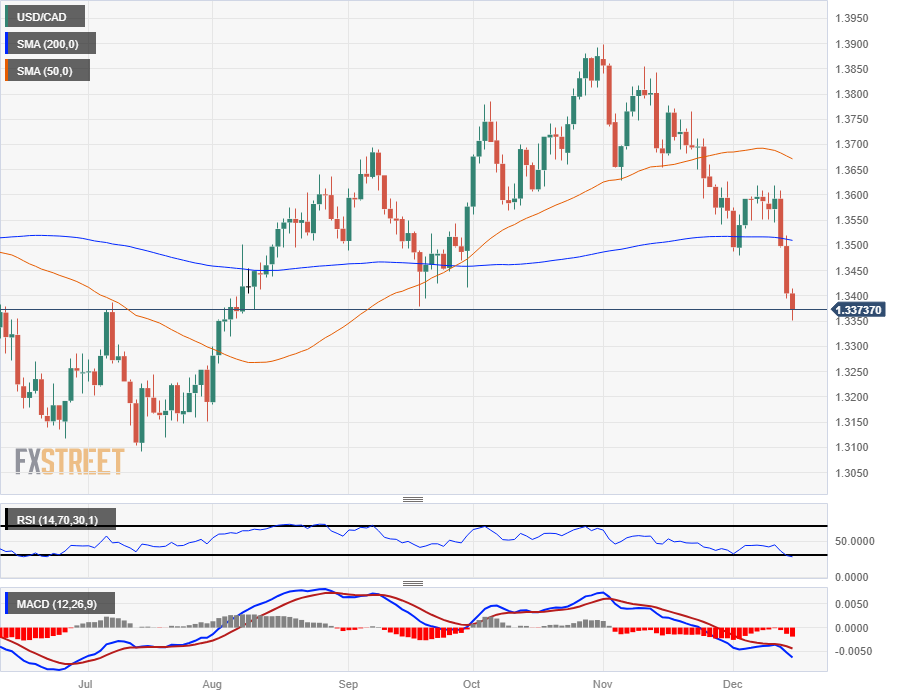
USD/CAD spent most of Friday drifting between 1.3400 and 1.3380 before settling down towards 1.3350, and the pair is down nearly two percent peak-to-trough from the week’s high bids near 1.3620.
Friday’s continued breakdown from the 1.3400 handle has the USD/CAD setting 17-week lows, setting the pair up for a challenge of July’s lows near 1.3100 as long as selling pressure holds.
A third straight day of hard declines has the USD/CAD facing its worst three-day performance since early 2020 when the pair shed nearly 500 pips in a single half-week.
USD/CAD Hourly Chart
USD/CAD Daily Chart
Bank of Canada FAQs
The Bank of Canada (BoC), based in Ottawa, is the institution that sets interest rates and manages monetary policy for Canada. It does so at eight scheduled meetings a year and ad hoc emergency meetings that are held as required. The BoC primary mandate is to maintain price stability, which means keeping inflation at between 1-3%. Its main tool for achieving this is by raising or lowering interest rates. Relatively high interest rates will usually result in a stronger Canadian Dollar (CAD) and vice versa. Other tools used include quantitative easing and tightening.
In extreme situations, the Bank of Canada can enact a policy tool called Quantitative Easing. QE is the process by which the BoC prints Canadian Dollars for the purpose of buying assets – usually government or corporate bonds – from financial institutions. QE usually results in a weaker CAD. QE is a last resort when simply lowering interest rates is unlikely to achieve the objective of price stability. The Bank of Canada used the measure during the Great Financial Crisis of 2009-11 when credit froze after banks lost faith in each other’s ability to repay debts.
Quantitative tightening (QT) is the reverse of QE. It is undertaken after QE when an economic recovery is underway and inflation starts rising. Whilst in QE the Bank of Canada purchases government and corporate bonds from financial institutions to provide them with liquidity, in QT the BoC stops buying more assets, and stops reinvesting the principal maturing on the bonds it already holds. It is usually positive (or bullish) for the Canadian Dollar.
Read the full article here