

Only 34 Maserati 5000 GT coupes (Tipo 103) were produced between 1959 and 1965. They were bodied by no less than eight Italian coachbuilders. The very first one went to the car-mad Shah of Iran, Mohammed Reza Pahlavi, who had test-driven the earlier 3500 model and wanted the company to build him something more powerful, using a modified V8 engine from the 450S racing car. Touring actually built two “Shah of Persia” cars, with the second one displayed at the 1959 Turin show.
The spirit and “Persia blu” paint color of that Maserati were recreated by the company for the Ghibli Trofeo 334 Ultima, a limited-edition car meant to celebrate the bittersweet end of V8 engine production this year, as the company transitions to electric power (as seen on the new Grecale and GranTurismo Folgores). Maserati built more than 100,000 cars with V8 engines.
The special Ghibli is complemented by the Levante V8 Ultima SUV, which will be built in a larger edition of 206. The intent is to make 103 painted Nero Assoluto and another 103 in Blu Royale.
The Ultimas were shown earlier this month to the press in the northern Italian ski town of Bormio, near the Swiss border. According to
Davide Kluzer,
product communication manager, only 103 Ghibli 334 Ultimas will be built, with extra performance achieved by, among other tweaks, a lightweight carbon-fiber package (including the rear spoiler and front bumper), and new performance tires on 21-inch wheels.
Both Ultimas feature the most potent version of the 3.8-liter twin-turbo V8, producing 572 horsepower. “The V8 engine was very important to the company, and to honor that we’ve built the fastest road-going Maserati ever,” Kluzer says of the 334 Ghibli, which can reach 60 miles per hour in 3.9 seconds and achieve a top speed of 208 mph. (The “334” refers to its top speed in kilometers per hour, up from 326). The company claims the top speed is “the fastest amongst the sedans with a combustion engine.”
The all-wheel drive Levante V8 Ultima also includes a big carbon-fiber package, including on the side skirts and both bumpers. Like the Ghibli, it features Pale Terracotta leather seats embossed with the model logo. You know it’s a special edition because it wears an “una di 103” badge on its transmission tunnel. The Ghibli 334 Ultima sells for US$165,000 and the Levante V8 Ultima for US$188,000.
Matt Rindone, the interim chief communications officer for Maserati, says lightening the Ghibli 334 Ultima by 25 kilos (or 55 pounds) contributed to the better performance and faster top speed. “A number of components were removed from the configuration to make the car more sporty as opposed to luxury oriented,” Rindone says. “We used specific compounds for the bespoke Pirelli PZero tires and 21-inch Orione rims. We also improved aerodynamics through the use of carbon-fiber components, particularly the rear spoiler.”
Fancy one of these special cars? According to Rindone, “Orders are open for both limited series models in North America–and deliveries to allocated markets/dealers are based on customer orders/demand and we will have additional information in the beginning of the new year.”
In a drive through Italian ski country (Bormio and Livigno), Maserati offered examples of the Levante, GranTurismo, Quattroporte, and Ghibli for winter driving. The day included a session at the Ghiacciodromo Livigno ice-driving school, with traction control both on and off. It proved definitively that, along with the rear-view camera, traction control, and ABS brakes are among the auto industry’s greatest innovations. With the electronics on, the cars had an uncanny ability to correct sliding by moving the power between the four wheels, a process known as torque vectoring.
Without the system at the ice-driving school’s frozen track, the cars reversed direction at will, and several had to be pulled out of snow banks. The sensation of the car going in the direction opposite to what was intended was quite unnerving.
On the road portion of the trip, the tarmac was coated in slush but with little black ice. Skiers on the road were a bigger hazard than the weather. The cars, which many owners treat as summer-only, proved their mettle under these conditions with roaring heaters, gratifyingly warmed seats and steering wheels, and effective demisting. Yes, a Maserati can be your only car, especially if it is the practical Quattroporte (“four doors”) model.
The Quattroporte goes back to 1963, when Maserati introduced it as a big luxury sedan powered by the company’s first V8 engine, a 4.1-liter unit. Despite its size, that early Quattroporte could reach 143 mph. Only 230 of that first-generation model were built through 1966. The car sold today, larger than its predecessors, is the sixth generation, introduced in 2013. The car has been sold with twin-turbo versions of both the three-liter V6 and the 3.8-liter V8 engine. Jaguar historically used a similar scheme, putting its SU-carbureted twin-cam six in both the E-Type and massive saloons like the Mark IX and Mark 10.
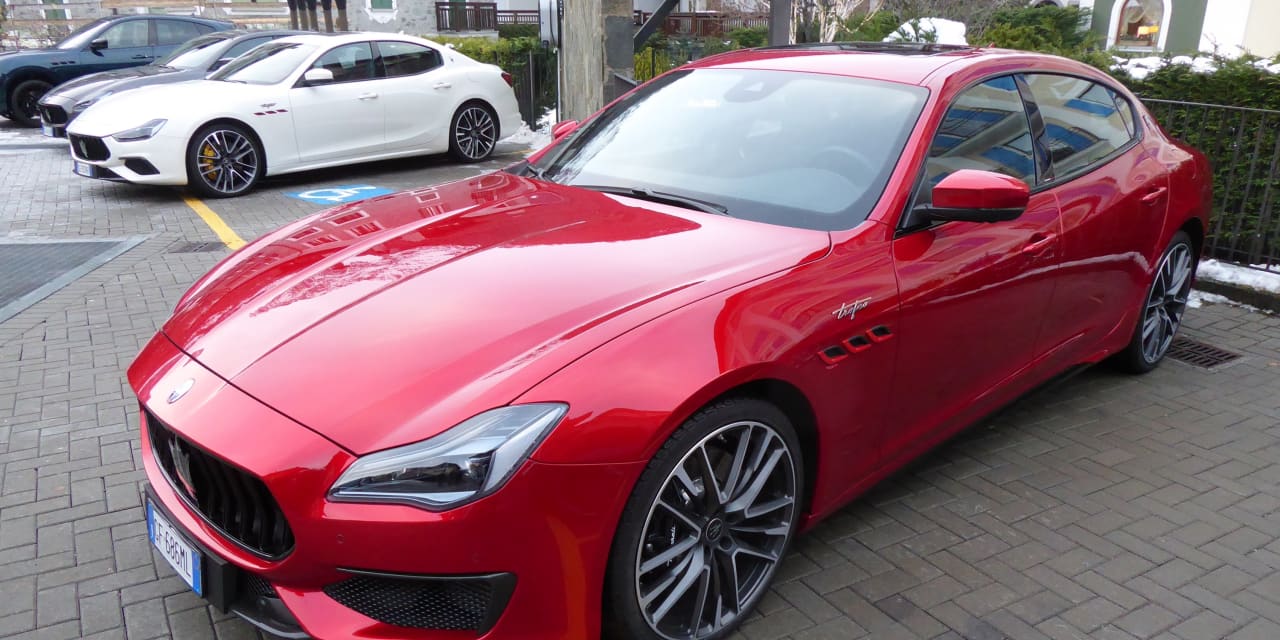
The 2023 Quattroporte with the 345-horsepower, 3-liter V6 engine and an eight-speed automatic overdrive transmission is a very sophisticated long-distance traveler for US$104,700. It’s standard with rear-wheel drive, though all-wheel drive is available. The ultimate US$157,000 Trofeo version adds the V8 and 580 horsepower, enabling a 203-mph top speed.
With cars like the relatively practical Quattroporte (a successor to the current model is in the works) and the Grecale and Levante SUVs, Maserati is doing its best to grow into a global brand (now sold in 74 countries). The EVs are also arriving, and the dealership network is expanding.
Penta also sampled the GranTurismo Trofeo sports coupe, one of the company’s prettiest cars, both in Italy and the U.S. The Trofeo is powered by two versions of Maserati’s V6, and there’s also the electric Folgore version, proving that the V8 might be missed but it’s no longer the vanguard technological solution.
The all-wheel drive GT Trofeo offers 542 horsepower and 460 pound-feet of torque from the three-liter V6, with a maximum speed of 199 mph and zero to 60 in a sprightly 3.3 seconds. It was great fun to drive and produced amazing, spicy exhaust notes that come only from Italian cars. No one’s going to say it needs a V8.
Read the full article here