

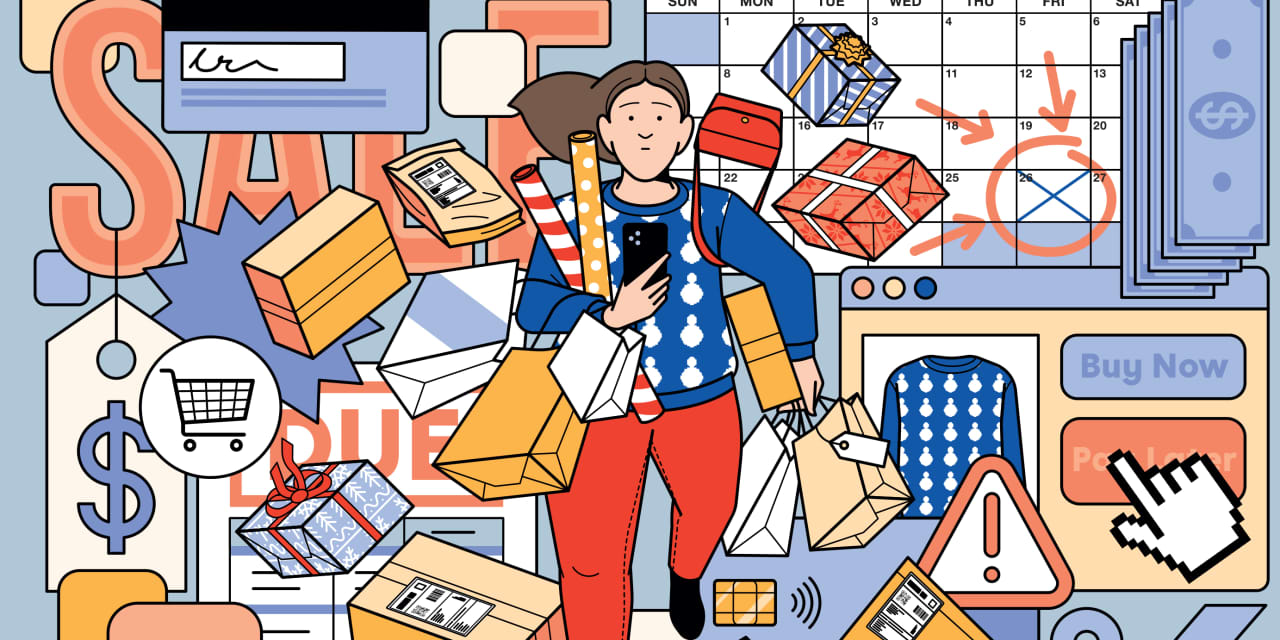
Black Friday weekend was a smashing success for retailers, with consumers flocking back to malls and shopping online at record-breaking levels.
There’s just one nagging datapoint that’s setting off alarm bells: more shoppers are relying on buy now, pay later (BNPL) tools to finance their holiday splurges. BNPL, offered by companies such as Klarna, PayPal, Affirm, and Afterpay, allows consumers to split their purchases into several, often interest-free, installments.
While BNPL has been gradually gaining ground as a popular financing form for years, especially among younger consumers, it seemed to have exploded this Black Friday weekend. Per Adobe Analytics, BNPL contributed $940 million to Cyber Monday sales alone, up 43% from a year ago and reaching a record high. Data from companies offering BNPL services paints a similar picture:
Block
saw a 19% increase in Afterpay purchases over the shopping weekend and Klarna saw 30% more orders placed on Black Friday compared with 2022.
Some investors are concerned that the high BNPL usage rates may be artificially boosting consumer spending this holiday season—and could be putting consumers in a precarious financial position heading into the new year.
“One of the things I’m worried about is that holiday spending is going to be strong, but it’s going to be a sugar rush,” says Itay Vinik, chief investment officer at Equi. “Then we’re going to pay the price for that.”
BNPL users are younger, more likely to be underbanked, and tend to have a more tenuous financial position than non-BNPL users, according to a Morning Consult survey. They’re also more likely to carry debt than the general public, and have higher credit card delinquency rates than non-BNPL users, according to the Consumer Financial Protection Bureau. That’s triggered concerns about the rise in BNPL spending, especially at a time when credit card debt is approaching record levels and delinquency rates are ticking up.
But when used correctly, BNPL can be a great addition to consumers’ financial arsenal, experts say. These service can help shoppers spread out their expenses, a potential boon for budget-savvy consumers looking for ways to mitigate the impact of inflation and rising interest rates.
“Historically, people rely on debt more around the holidays,” says Jaime Toplin, senior financial services analyst at Morning Consult. “It’s just a really big spending time of year. So BNPL has become another and larger piece of that puzzle.”
To try to piece that puzzle together, Barron’s went straight to the source, asking shoppers how—and why—they’re using BNPL for holiday shopping.
People are getting more familiar with BNPL
While the buy now play later industry has been growing at a fast clip over the past decade, it’s finally reaching maturity, Toplin says. More retailers now accept BNPL services as payment, and more consumers are aware of the tool and feel comfortable using it, she says.
The first time Ayeza Khan heard about BNPL, she was skeptical. The idea of an interest-free payment method seemed simply too good to be true, the 22-year-old student says. But last year, she caved and used Afterpay on a roughly $300 winter jacket, and it’s rapidly becoming one of her go-to payment methods.
“Anytime I buy something online and the website offers an option to BNPL I think that’s what I’m always inclined to do because it’s so much easier for me to balance that with [other] bills that I have to pay,” she tells Barron’s.
Khan has since paid off the jacket, and on Black Friday she turned to BNPL again, this time jumping on the holiday deals to cross several items off the wishlist she’s been sitting on all year, including makeup, sweaters, and a couple of gifts.
Still, she aware that the service does make it easier for her to spend money, including on items she doesn’t necessarily need. “[BNPL] creates an illusion that I’m not paying full price for these things,” says Khan.
Paying later may be good, paying late is not
Higher interest rates are one of the factors driving adoption of BNPL, say experts. That tracks for Aleah Wright, a 27-year-old freelance writer who tries to pay off her card every month to avoid racking up interest payments. So for purchases that she knows she can afford, but can’t pay off in a single month—such as Christmas gifts for her mother and brother—she uses her PayPal BNPL account.
“Instead of taking on all that extra interest every month on your credit card, [BNPL] is interest free, and you just have more time to pay it off,” she says.
Granted, many BNPL companies do charge interest, either upfront or on late payments. They can also carry hefty late fees on top of those payments—a concern for BNPL critics, given that 42% of respondents to a 2022
LendingTree
survey said they’d made at least one late payment on a BNPL charge.
Neither Khan nor Wright have missed a payment, they say. Khan has automatic payments scheduled for her Afterpay account, while Wright says she takes a “deep look” at her finances before using BNPL and budgets accordingly. “I also don’t want to bite off more than I can chew,” Wright says.
The LendingTree survey also found that nearly 70% of BNPL users admit to spending more than they would if they had to pay for everything upfront. Over Black Friday weekend, the average online BNPL order was $328, well above the $181 per order spent by shoppers who paid in full, according to data from Signifyd.
“It’s a good deal for a consumer who wants to stretch their assets,” said Howard Meitiner, managing director at Carl Marks Advisors. “But for those who are already extended, but they want to get something, it’s a very dangerous and slippery slope.”
A favorite for big, expensive buys
One of the growing trends in BNPL usage this holiday season is that consumers are using the services to buy larger, more expensive items, Toplin said.
“It’s kind of becoming a tool to manage some ballooning seasonal expenses,” she added.
Indeed, the most popular products for Klarna shoppers this Cyber Monday were things like headphones, monitors, robot vacuum cleaners, coffee makers, and home cinema systems, according to the company.
Savannah Thrower, 27, has kept her spending in check this holiday season. She didn’t buy anything on Black Friday and paid in full for all of her sons’ Christmas presents.
Bu there’s just one present missing from her list: this year, she and her husband have their eye on a Dyson vacuum, which can retail for anything from $270 to over $700, and they may use BNPL to pay for it, she said.
“Afterpay helps me maybe justify more,” she says. “Seeing it split up is just easier to be like, ‘oh, it’s not that bad.’”
Write to Sabrina Escobar at [email protected]
Read the full article here