

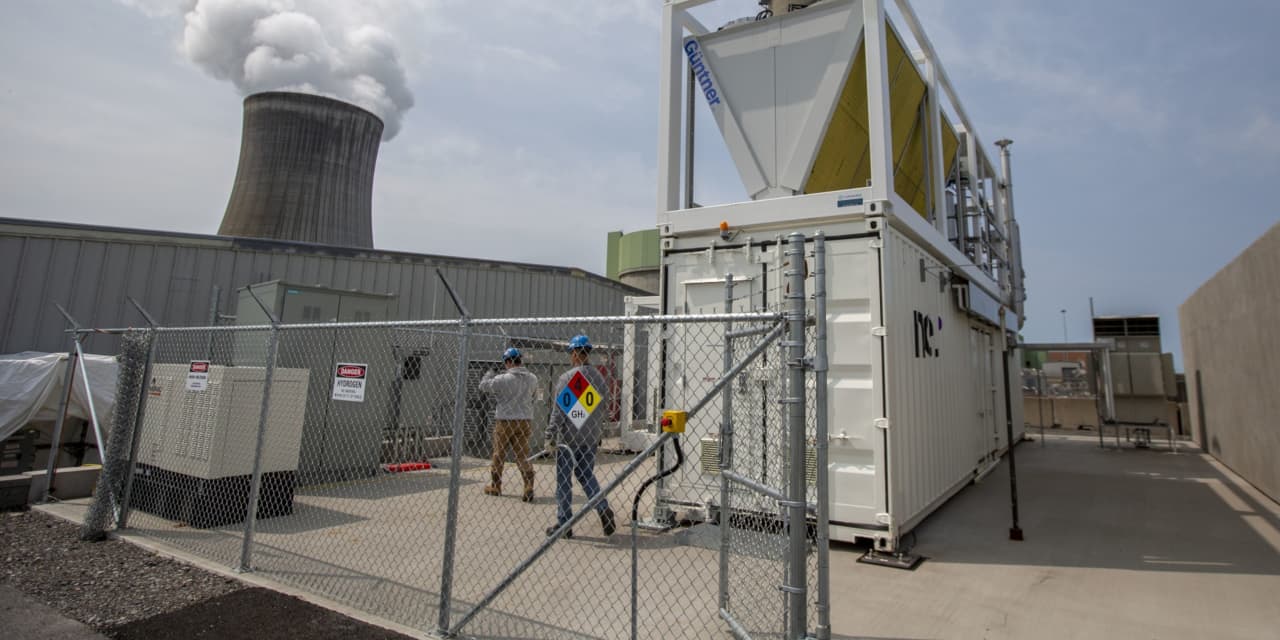
Cleanly produced hydrogen is a key element for slowing global warming and powering the billion-dollar ambitions of fuel cell suppliers like
Plug Power,
Bloom Energy,
Linde,
and
Air Products & Chemicals.
But federal tax credits for making the stuff are getting a cold reception.
On Friday, the U.S. Treasury and the Internal Revenue Service proposed rules for receiving tax credits for production of “green” hydrogen, as called for in last year’s Inflation Reduction Act. The production-tax credits are intended to spur projects that make the gas using clean energy—like solar or wind power—instead of the fossil-fueled process now prevalent. Green hydrogen-driven fuel cells would power trucks and ships that are too heavy for batteries to move.
“Today’s announcement will further unprecedented investments in a new, American-led industry as we aim to lead and propel the global clean energy transition,” said Energy Secretary Jennifer Granholm in the Dec. 22 release. “Hydrogen has the potential to clean up America’s manufacturing industry, power the transportation sector.”
Credits of up to $3 a kilogram were expected to draw investment in new hydrolyzer plants that make hydrogen. But the project eligibility rules are strict and a number of proposed plants could have trouble qualifying.
So the rules aren’t the game changer that green hydrogen promoters had expected, wrote BMO Capital Markets analyst Ameet Thakkar in a note Wednesday. “We have been skeptical of clean hydrogen economics even assuming lenient standards for [tax credit] eligibility, and now see an even more difficult road for expansion of green hydrogen production,” he wrote.
Thakkar sees the strict rules as one more negative for the financially struggling Plug Power, and a “downside risk” for Bloom Energy.
The rules set three prerequisites for hydrogen plants to claim credits. Clean power for production must come from a new source, built within three years of the hydrogen plant’s start-up. That power source must be near the hydrogen plant, to minimize transmission congestion. And starting in 2028, the power used in producing hydrogen must have been generated within the same hour it is used in hydrolysis.
The requirement for a new energy supply could pose challenges for Plug Power, which has planned projects powered by existing power sources, noted Citi analysts Vikram Bagri and Theodore Giletti, in a Friday report.
Barron’s reached out to fuel cell makers Plug and Bloom, as well as the industrial gas producers Linde and Air Products, who plan to make green hydrogen. None immediately responded with comments.
The industry has sixty days to file comments with the Treasury Department, starting from when the draft rules appeared in the Federal Register on Wednesday. That gives them until Feb. 26, 2024.
At a recent $4.74, Plug Power shares trade far below the $75 level they hit in early 2021 when the company stirred excitement with supply deals to big customers like
Amazon.com.
Already laboring under a “going concern” warning its accountants said it should issue, Plug summoned brokerage-firm analysts to a phone conference on Friday, when the Treasury rules appeared.
Plug reviewed its three main projects, which are to be powered by already-existing nuclear, hydroelectric, or wind power, reported RBC Capital Markets analyst Chris Dendrinos in a Friday note. He said that Plug hopes it can persuade the Treasury to allow those legacy power sources. Failing that, Plug would find other renewable sources.
The RBC analyst rates Plug at a “sector perform,” the equivalent to a Hold, and sees the stock fairly valued at $5.
A hydrogen solution to the climate crisis seems like it will need more help than the proposed tax credits provide.
Write to Bill Alpert at [email protected]
Read the full article here