

This year’s CES tech trade show in Las Vegas, bringing in dozens of car manufacturers and the myriad of providers of semiconductors, hardware, software, and services they rely on, comes at an odd moment for the automotive industry.
Sales of electric vehicles disappointed in 2023, as U.S. consumers showed increasing frustration with the scarcity and unreliability of the country’s network of charging stations. And the mainstream adoption of autonomous vehicles continued to be delayed by safety and regulatory concerns.
An even more important issue for the industry and related companies is that auto manufacturers have been making a gigantic bet that consumers are psyched to have their cars jammed with new tech. The thinking is that drivers want to be connected, entertained, protected, and even driven around by computers on wheels.
But what if that isn’t at all what they want?
A fascinating survey of U.S. drivers conducted by
Salesforce
and released Monday even finds confusion about what the auto industry means when it talks about “connected cars.” There is no little ambivalence about whether consumers want to pay for the cutting-edge technology.
For starters, the survey finds that more than two-thirds of drivers don’t know what a “connected car” is. Of 2,188 people surveyed, 37% had never heard the term before. Nonetheless, just under half of the respondents said they drove a connected car once the term was defined for them.
Asked about the top three considerations for when they buy their next cars, consumers listed price, reliability, and safety. Less than a quarter cited connected features as a major consideration, and only 9% named sustainability and environmental impact. It isn’t great news for makers of electric vehicles.
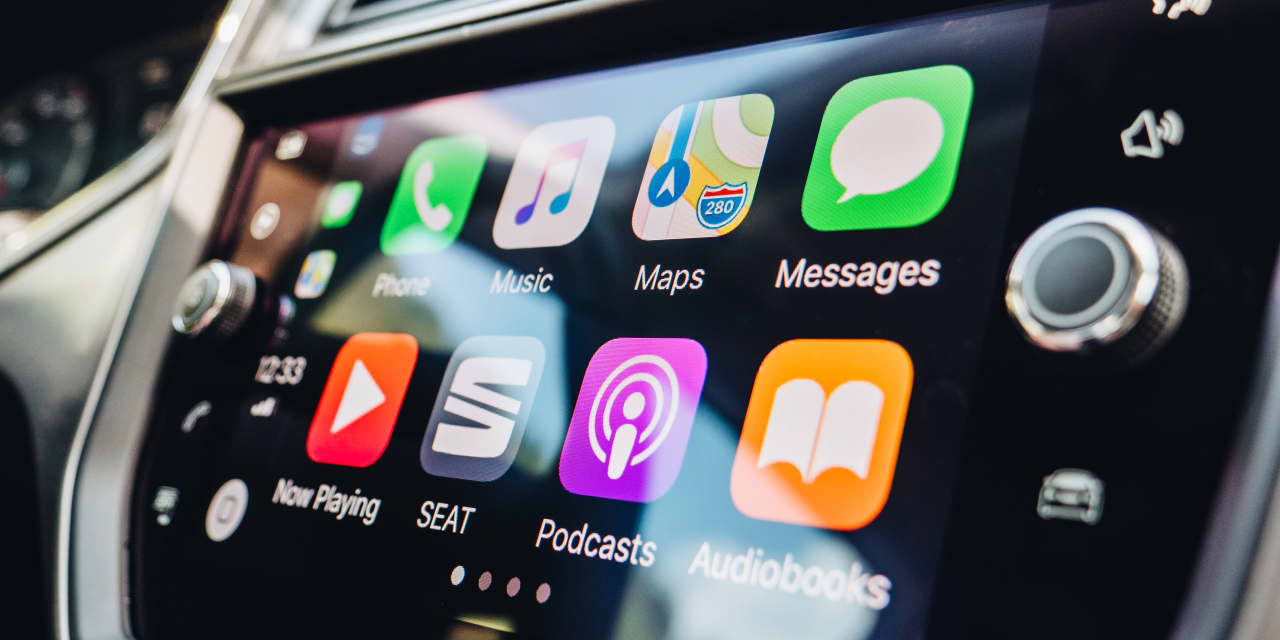
Many automakers now solve their connectivity needs by simply allowing consumers to plug their phones into their automotive entertainment systems. People can run apps for maps, music, and communications from their phones, using
Apple
CarPlay and Android Auto. In 2022, Apple said that 79% of consumers would only consider buying a new car that worked with CarPlay.
But the new Salesforce survey found that 62% of drivers either don’t have or don’t use CarPlay or Android Auto. Only 31% listed the two platforms as among the three most valuable features in a new car.
By contrast, the survey group listed driver-assist systems, such as lane-keeping and collision control, and touchscreen controls as the most valuable features in considering a new car purchase. Only 9% listed in-car apps, gaming and video features as a top consideration.
Meanwhile, as Barron’s noted in an April 2023 cover story on the future of cars, automakers are looking for ways to charge consumers additional fees for various electronic services. To what extent the public will play along remains to be proven.
The Salesforce survey found that 43% of drivers would be willing to pay for better driver-assist features, while 33% said they would pay extra for touchscreen controls; 30% would pay up for WiFi; and 26% said they’d be willing to pay for Apple CarPlay and Android Auto. Only 17% would be willing to pay extra for in-car apps, videos, and games.
The survey also found consumers were surprisingly willing to trade personal data for financial benefits or other goodies. Two-thirds of respondents said they would trade personal data for lower insurance rates, while 43% said they would share some data to get advanced personalization of features like seats, mirrors, and entertainment. A bit more than one-third of respondents, 36%, said they would give up some personal data to get enhanced safety features such as real-time monitoring of a vehicle’s condition.
But consumers also want control over whether or not data is collected: 63% of drivers said data collection should be on an opt-in basis. And 32% said car companies shouldn’t be able to collect any personal data at all.
Just over half of the survey group said they would be fine with automakers collecting vehicle diagnostic information. A bit more than one-third were fine with giving up data on seatbelt usage, and a similar number were okay with collection of vehicle speed data. Nearly as many, 31%, were willing to have automakers track location and route history.
And some people were even fine with what some people might consider aggressively intrusive data collection: 17% favored the collection of voice recordings from Siri and similar apps, 12% were fine giving up text messages and phone recordings, and 12% were comfortable with collection of in-vehicle and external video streams.
Write to Eric J. Savitz at [email protected]
Read the full article here