

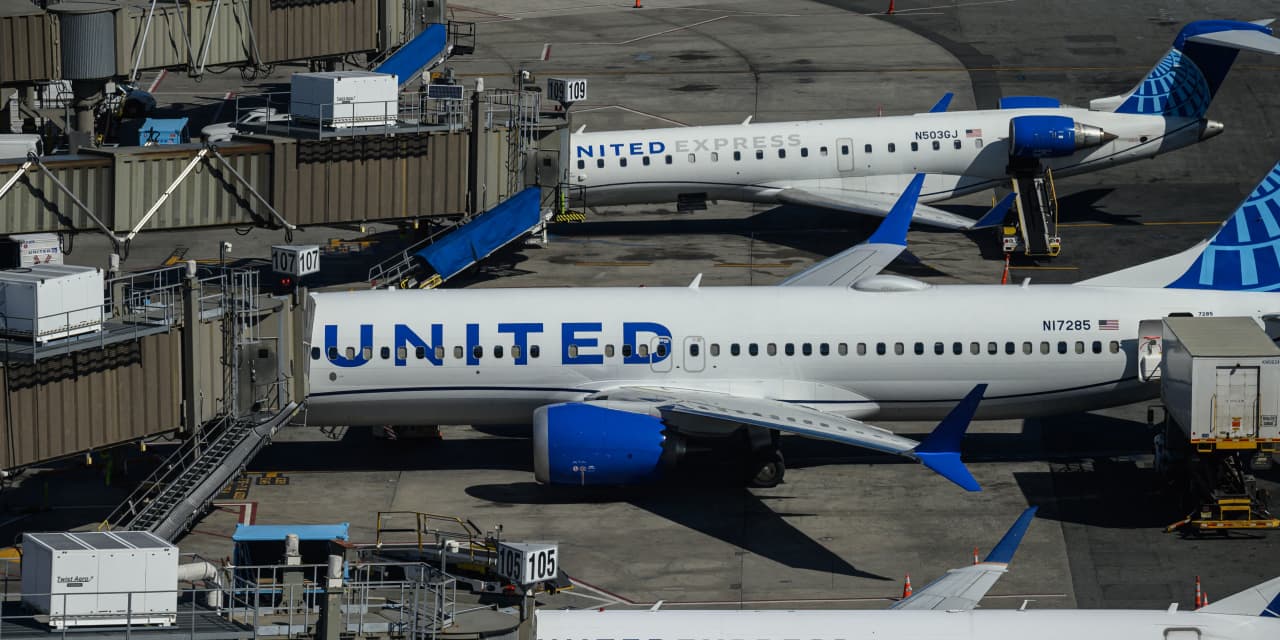
U.S. flight demand is rising nicely. For legacy airlines, first-quarter results should shine—even with Boeing’s 737 Max 9 fleet temporarily grounded after an Alaska Airlines flight deposited a door-size fuselage panel onto an Oregon backyard. The companies broadly appear poised for profitability in up cycles and down. And the shares, which lagged behind the market over the past year, including a Friday tumble after Delta lowered earnings guidance, look cheap.
United Airlines Holdings
and
American Airlines Group
attracted recent analyst upgrades.
There’s just one problem: “I’ve been doing this for 40 years, and it’s never really changed,” says Helane Becker, who covers airline shares for TD Cowen. “The movie doesn’t end well. It kind of is on repeat.”
Becker is bullish on some of the stocks, which I’ll come to, but she says that the industry is better for trading than for long-term investment, because positive investor sentiment can be short-lived. “My mom of blessed memory used to ask me why I was so negative on airlines,” she says. “And I said, ‘I’m only wrong an hour a year.’ ”
Other analysts are more open to the possibility of airlines outperforming for longer. Ravi Shanker at Morgan Stanley notes that industry profits for the largest airlines last year were down only 19% from prepandemic 2019, but that market values were down 61%. He calls that a sign that the stocks aren’t getting credit for company progress on improving profitability.
Shanker expects 2024 to be one of the most consequential years in airline history. As travel patterns return to normal following the pandemic and its aftermath, the market can “finally settle the debate on whether capacity growth can match demand or whether old bad habits will creep back in,” he wrote this past week. If management teams make good on promised restraint, as he predicts, a “broader base of investors are likely to return to the space and reward the stocks with historical multiples.”
Flight demand seems to be cooperating. During the second half of last year, it defied fears of a collapse, and instead accelerated, judging by the number of standard and expedited screenings performed by Transportation Security Administration agents. But will this year’s demand growth keep up with supply? BofA Securities says no. Its analysis of company commentary, order books, and production issues points to 4.5% more domestic capacity this year, on top of a 10% increase next year. Demand, it notes, has historically risen at 1.5 times gross-domestic-product growth, which this year is pegged at only about 1.5%. Excess supply will drive unit revenue 2% lower across the industry, BofA forecasts.
Even so, BofA just upgraded United straight to Buy from Underperform. The company outgrew the industry last year after making early bets on trans-Atlantic travel and premium seats—two areas of strength. Long term, United plans to address a key weakness—flying too many low-capacity planes—with a yearslong plane-buying spree. That is likely to improve efficiency but also to restrain free cash flow. It’s a risk, but BofA says the stock valuation, recently in the bottom 25% of its historical range, is “disconnected” from company progress.
Likewise, J.P. Morgan calls United its top pick in the sector. Its operational reliability, it points out, has eclipsed that of longtime leader
Delta Air Lines.
High reliability is prized among buyers of lucrative business flights.
Morgan Stanley recently upgraded American to Overweight from Equal Weight, with a price target that implies more than 35% upside. It has lagged behind peers on investor attention postpandemic due to its high debt, but management has made progress there, and plans to host an investor day during the first half of this year, something it hasn’t done since 2017. Morgan Stanley’s top pick is Delta, for a list of reasons, including a high mix of premium, business, and international travelers; measured growth; and a partial fuel hedge through owning a refinery.
TD Cowen’s Becker, too, calls Delta her top pick. Just as United benefited from surging travel to Europe, Delta is now poised to ride a rise in trans-Pacific travel.
Here are some other industry factors to watch: There is an extra day this quarter—Feb. 29, or leap day—and Easter is in March. That will help offset flights lost to the 737 Max 9 grounding. That loss most heavily affects
Alaska Air Group,
because the plane makes up 31% of its capacity, and it has limited ability to switch passengers to other planes. United, with 9% exposure, has more ability to switch planes. Becker calls a recent selloff in Alaska shares a buying opportunity; the company benefits from monopoly routes and plentiful pilots in its home state.
Jet fuel spiked to $4.50 a gallon in mid-2022 but averaged $2.70 last year. Aircraft back orders and shortages of pilots and air-traffic controllers should keep demand growth well short of runaway levels. The industry has split, with premium carriers mostly thriving, while most low-cost carriers were unable to post a profit even during peak travel demand last year. United calls the low-cost model unsustainable and predicts a bankruptcy this year.
JetBlue Airways
is expected to receive a ruling any day on its proposed merger with
Spirit Airlines.
J.P. Morgan sees a “low probability” of approval, and with a blockage, it predicts, Spirit’s “liquidity will be challenged by 2025, which may trigger credit-card holdbacks further straining [Spirit’s] options.” Spirit has recently issued new shares and sold and leased back aircraft to raise cash. TD Cowen’s Becker says that if the company were to enter bankruptcy, it might not return, in part because lessors would be eager to put its prized narrow-body aircraft to work in other parts of the world. Spirit didn’t return a request for comment. Chief Financial Officer Scott Haralson in an earnings call last year said, “Our team is resilient and nimble, and we are committed to returning Spirit to sustained profitability.”
Beyond the legacy players, Becker likes Panama’s
Copa Holdings,
which benefits from that country’s dollar peg and high number of multinational companies, and Minnesota’s
Sun Country Airlines Holdings,
which is an ultralow-cost carrier, but one that benefits from flying planes for Amazon.com, casinos, and college sports teams.
Write to Jack Hough at [email protected]. Follow him on Twitter and subscribe to his Barron’s Streetwise podcast.
Read the full article here