

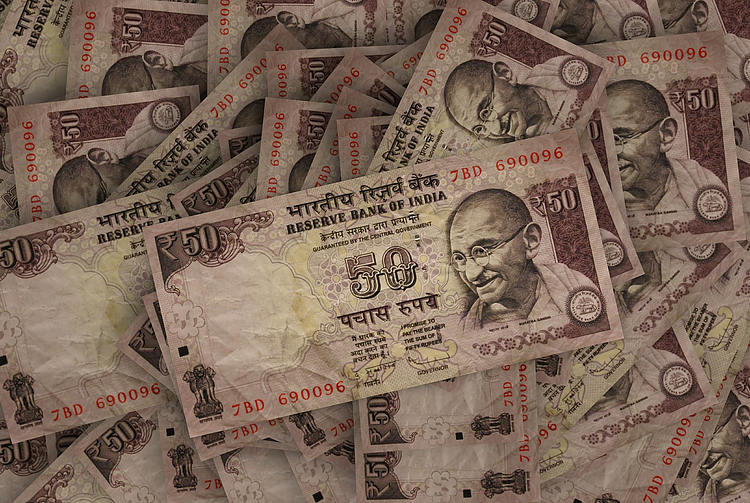
- Indian Rupee attracts some sellers amid the rising tension in the Red Sea and firmer US Dollar.
- India’s wholesale inflation rose to a nine-month high of 0.73% in December.
- The ongoing tension in the Red Sea will lead to an oil price hike in India, the world’s third biggest oil importer and consumer.
Indian Rupee (INR) loses traction on Tuesday on the stronger US Dollar (USD). India’s wholesale inflation, as measured by the Wholesale Price Index (WPI) is outside the deflationary zone for the second month in a row and reached the highest in the past nine months, primarily due to a rise in food prices.
The World Economic Forum (WEF) president Borge Brende said on Monday that Houthi attacks on commercial ships in the Red Sea would have a negative impact on the global supply chain and would lead to a $10–20 increase in oil prices. This, in turn, could have negative effects on oil-importing countries, including India. Furthermore, the escalating tension in the Red Sea boosts safe-haven assets like the Greenback and acts as a tailwind for the USD/INR pair.
Market players will keep an eye on the development surrounding the Middle East geopolitical tension. Later on Tuesday, the US NY Empire State Manufacturing Index will be due. The US Retail Sales on Wednesday will be in the spotlight, which is projected to show an increase of 0.4% in December.
Daily Digest Market Movers: Indian Rupee remains sensitive to the ongoing tensions in the Red Sea
- India’s December WPI inflation arrived at 0.73% YoY versus 0.26% prior, worse than the market expectation of 0.90%.
- India’s Wholesale Price Food Index came in at 5.39% YoY in December.
- India’s WPI Manufacturing for December Inflation fell 0.71% YoY from the previous reading of a 0.64% decline.
- India’s December goods imports totaled $58.25 billion, while its exports arrived at $38.45 billion. The country’s trade deficit decreased to $19.8 billion in December 2023 from $23.14 billion in the same month the previous year.
- The World Economic Forum (WEF) president Borge Brende expressed optimism about the Indian economy and said it was predicted to grow at 8% this year.
- The Atlanta Federal Reserve (Fed) Raphael Bostic said that rates need to stay on hold until at least summer to prevent prices from rising again.
- Bostic further stated that inflation must surely get back to the 2% target and a bad outcome could occur if policymakers start easing too fast.
Technical Analysis: Indian Rupee keeps the negative outlook in the shorter term
Indian Rupee trades weaker on the day. The USD/INR pair has remained stuck within the familiar trading band between 82.80 and 83.40 since September 2023. According to the daily chart, the further downside of USD/INR looks favorable as the pair holds below the key 100-period Exponential Moving Average (EMA). The downward momentum is backed by the 14-day Relative Strength Index (RSI) which is below the 50.0 midpoint, suggesting the sellers look to retain control in the near term.
The support-turned-resistance at 83.00 psychological mark acts as an immediate resistance level for USD/INR. The additional upside filter to watch is the upper boundary of the trading range at 83.40 and a round figure at 84.00. On the flip side, the confluence of the lower limit of the trading range and a low of September 12 at 82.80 acts as a critical contention level. A decisive break below 82.80 will pave the way to a low of August 11 at 82.60, en route to a low of August 24 at 82.40.
US Dollar price in the last 7 days
The table below shows the percentage change of US Dollar (USD) against listed major currencies in the last 7 days. US Dollar was the strongest against the Australian Dollar.
| USD | EUR | GBP | CAD | AUD | JPY | NZD | CHF | |
| USD | 0.33% | 0.50% | 0.91% | 1.60% | 1.37% | 1.42% | 1.26% | |
| EUR | -0.32% | 0.21% | 0.61% | 1.26% | 1.04% | 1.09% | 0.92% | |
| GBP | -0.51% | -0.18% | 0.43% | 1.07% | 0.85% | 0.90% | 0.76% | |
| CAD | -0.93% | -0.61% | -0.43% | 0.67% | 0.43% | 0.45% | 0.34% | |
| AUD | -1.63% | -1.28% | -1.10% | -0.68% | -0.24% | -0.21% | -0.36% | |
| JPY | -1.37% | -1.05% | -0.88% | -0.46% | 0.22% | 0.05% | -0.11% | |
| NZD | -1.44% | -1.12% | -0.93% | -0.50% | 0.17% | -0.08% | -0.14% | |
| CHF | -1.27% | -0.95% | -0.77% | -0.35% | 0.33% | 0.09% | 0.12% |
The heat map shows percentage changes of major currencies against each other. The base currency is picked from the left column, while the quote currency is picked from the top row. For example, if you pick the Euro from the left column and move along the horizontal line to the Japanese Yen, the percentage change displayed in the box will represent EUR (base)/JPY (quote).
Inflation FAQs
Inflation measures the rise in the price of a representative basket of goods and services. Headline inflation is usually expressed as a percentage change on a month-on-month (MoM) and year-on-year (YoY) basis. Core inflation excludes more volatile elements such as food and fuel which can fluctuate because of geopolitical and seasonal factors. Core inflation is the figure economists focus on and is the level targeted by central banks, which are mandated to keep inflation at a manageable level, usually around 2%.
The Consumer Price Index (CPI) measures the change in prices of a basket of goods and services over a period of time. It is usually expressed as a percentage change on a month-on-month (MoM) and year-on-year (YoY) basis. Core CPI is the figure targeted by central banks as it excludes volatile food and fuel inputs. When Core CPI rises above 2% it usually results in higher interest rates and vice versa when it falls below 2%. Since higher interest rates are positive for a currency, higher inflation usually results in a stronger currency. The opposite is true when inflation falls.
Although it may seem counter-intuitive, high inflation in a country pushes up the value of its currency and vice versa for lower inflation. This is because the central bank will normally raise interest rates to combat the higher inflation, which attract more global capital inflows from investors looking for a lucrative place to park their money.
Formerly, Gold was the asset investors turned to in times of high inflation because it preserved its value, and whilst investors will often still buy Gold for its safe-haven properties in times of extreme market turmoil, this is not the case most of the time. This is because when inflation is high, central banks will put up interest rates to combat it.
Higher interest rates are negative for Gold because they increase the opportunity-cost of holding Gold vis-a-vis an interest-bearing asset or placing the money in a cash deposit account. On the flipside, lower inflation tends to be positive for Gold as it brings interest rates down, making the bright metal a more viable investment alternative.
Read the full article here