

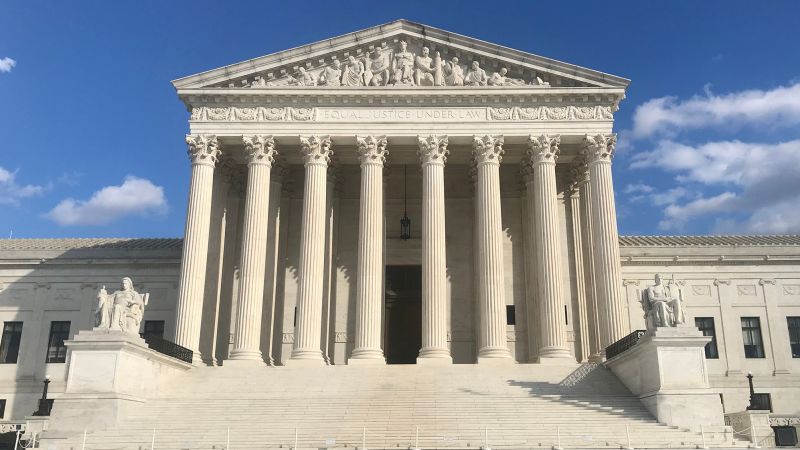
The Supreme Court’s conservative supermajority has spent several hours Wednesday attacking a longstanding legal doctrine that gives federal agencies wide latitude to create policies and regulations in various areas of life.
The justices are hearing two cases concerning the so-called Chevron deference, which emerged from a 1984 case. Oral arguments in the first case went well beyond the allotted hour, with the conservatives signaling their willingness to overturn the decades-old case and their liberal colleagues sounding the alarm on how such a reversal would upend how the federal government enforces all kinds of regulations.
Congress routinely writes open-ended, ambiguous laws that leave the policy details to agency officials. The Chevron deference stipulates that when disputes arise over regulation of an ambiguous law, judges should defer to agency interpretations, as long as the interpretations are reasonable.
Justice Neil Gorsuch, a conservative who has long expressed misgivings about the Chevron deference, at one point boiled his understanding of the doctrine down to one simple outcome when courts examine ambiguous statutes under its terms: “The government always wins.”
“Chevron is exploited against the individual and in favor of the government,” Gorsuch said.
Justice Ketanji Brown Jackson underscored the concern from her and the two other liberals on the bench that overturning Chevron would force courts to make policy decisions that they say are better left for experts employed by federal agencies.
“I see Chevron as doing the very important work of helping courts stay away from policymaking,” she said.
Fellow liberal Justice Elena Kagan later stressed that federal judges were not equipped to make decisions in some complex areas, offering artificial intelligence as one place she thought experts, not judges, should be making critical policy decisions.
“Congress knows that this court and lower courts are not competent with respect to deciding all the questions about AI that are going to come up in the future,” Kagan said. “We don’t even know what the questions are about AI, let alone the answers to them.”
Notably, the Atlantic fishery litigants at the center of Wednesday’s disputes have so far only come up a few times. Instead, the judges have focused largely on the straightforward question before them: whether they should overturn Chevron.
The pair of cases test a National Marine Fisheries Service mandate that the fishing vessels pay the cost of certain onboard observers who monitor catches. The two fisheries claim the agency lacked authority to force vessel owners to pay for third-party monitoring services.
“I think what we really care about is prospectively, both with respect to the fishing regulation here, but also with respect to other cases that come forward to the courts, making sure that courts are the ones doing the interpreting and not agencies,” Roman Martinez, an attorney for representing one of the fisheries, told the justices.
Read the full article here