

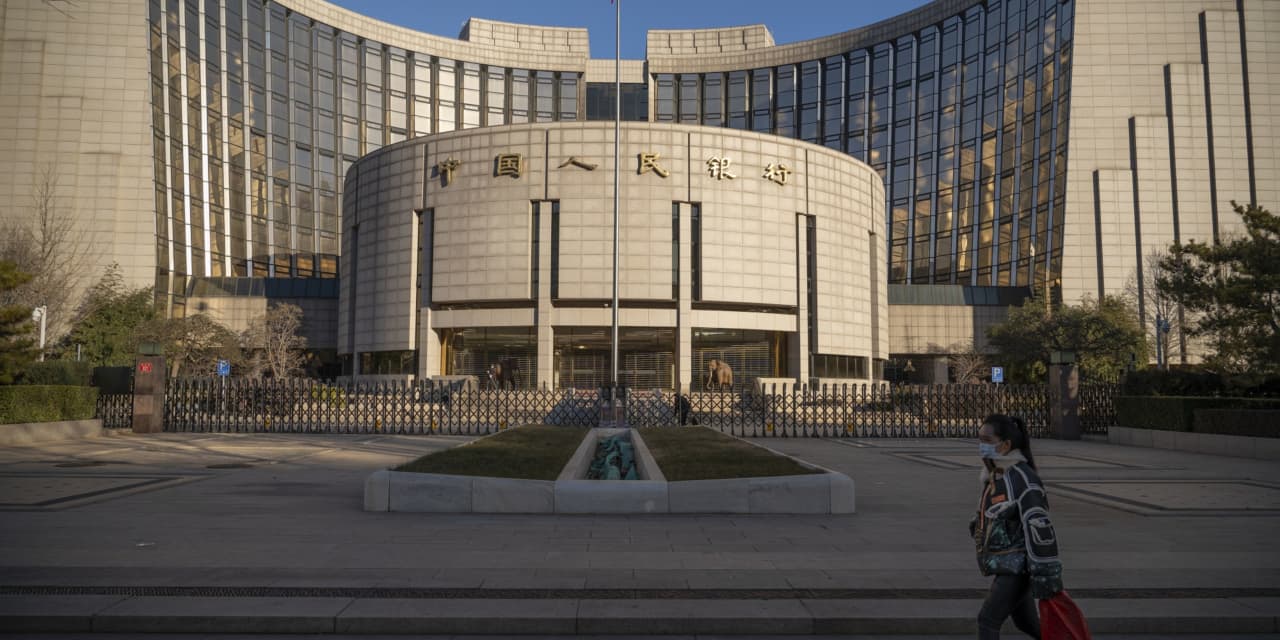
Chinese stocks surged for a second day on Wednesday, with benchmark indexes in Hong Kong and Shanghai notching their best days all year after a surprise move by Beijing to boost growth amid a slowdown in the world’s second-largest economy.
Hong Kong’s
Hang Seng Index
jumped 3.6% and the
Shanghai Composite
rose 1.8% in Wednesday trading, with widely held Chinese stocks also firmly in the green.
Alibaba
gained 1.9% in U.S. premarket trading—the stock was also benefiting from a report of insiders buying shares—with
JD.com
shares advancing 1.9% and
NIO
up 4%.
The catalyst for the move appeared to be a surprise announcement at a press conference that the People’s Bank of China (PBOC) would lower reserve ratio requirements for banks by 50 basis points—or half a percentage point—as of Feb. 5. The decision from the central bank should provide 1 trillion yuan ($141 billion) in long-term capital.
“The People’s Bank’s policy announcements today will provide only a small boost for China’s economy,” Mark Williams, the chief Asia economist at research firm Capital Economics, wrote in a Wednesday note.
“Meaningful improvements in household or corporate borrowing would require substantial rate cuts or a significant change in economic sentiment. Neither seems likely in the near future. Nor would it necessarily be welcome: much of China’s weakness is structural rather than cyclical,” Williams added.
Nevertheless, the PBOC move is a bid to increase liquidity and step up lending in China, which has seen its economy stagnate and stock markets tumble over the past year in a trend that has prompted officials to step up public assurances to global investors in recent weeks.
Chinese shares gained on Tuesday following a report that the government was considering plans to prop up the equity market by shepherding hundreds of billions of dollars from state-owned enterprises into Hong Kong stocks.
But investors may do well to hold back on betting on a recovery just yet. With Chinese stocks so thoroughly beaten down, there should still be a lot of time to wager on a rebound, and the case for long-term growth in China remains complex and clouded by demographic concerns. Stimulus moves, so far, have also left investors largely unimpressed, leading to few long-term gains despite daily upward swings on news of more support.
Write to Jack Denton at [email protected]
Read the full article here