

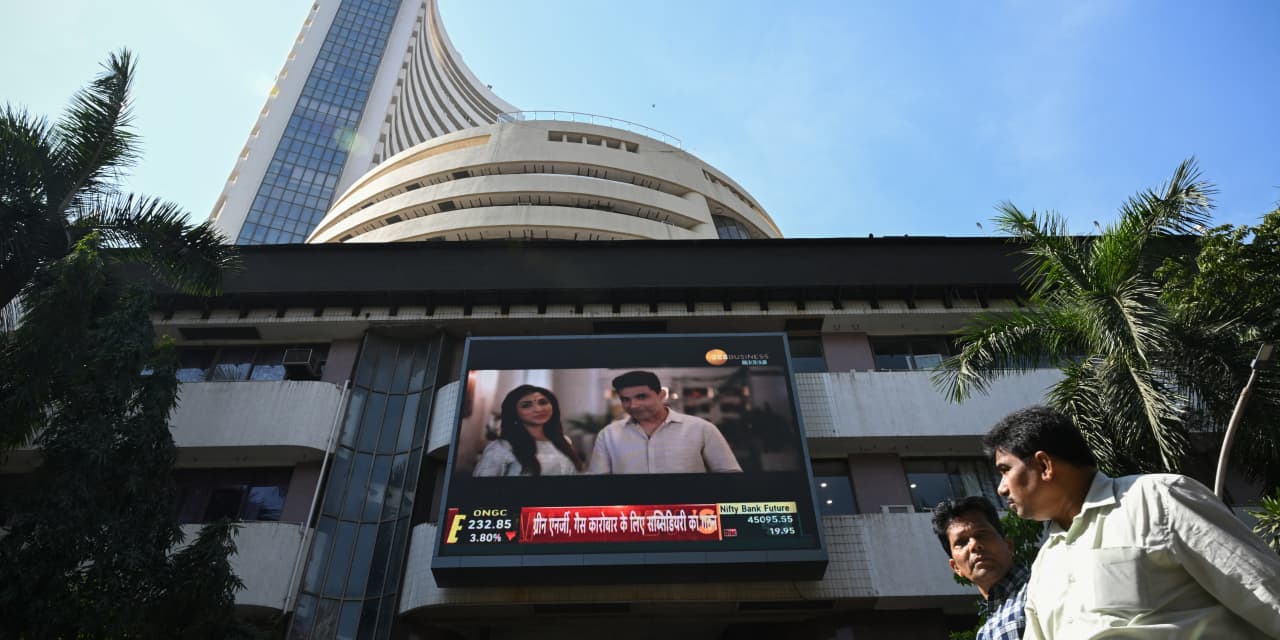
India’s stock market is ballooning thanks to rising interest from foreign investment funds and the country’s growing number of retail investors. It recently briefly passed Hong Kong to rank as the fourth-biggest equity market in the world, trailing behind only the U.S., China, and Japan.
India’s equity market has nearly doubled in size over the past four years, while Hong Kong’s has shrunk by half since its peak in 2021. At Monday’s close, shares listed on India’s two stock exchanges reached $4.33 trillion in market capitalization, according to data from Bloomberg, exceeding the $4.29 trillion market value of Hong Kong-listed stocks for the first time.
Hong Kong grabbed back the No. 4 spot on Tuesday as stocks rebounded in response to a report that Beijing is preparing a package of measures to prop up the economy and the stock market. Still, India’s rise highlights the diverging courses of the world’s two most populous countries in recent years.
Boom and Bust
Indian stocks have been on a tear. The BSE Sensex index, comprising 30 blue-chip companies on the
Bombay Stock Exchange,
gained 15% over the past 12 months, while the Nifty index, representing the 50 largest companies on the country’s National Stock Exchange, rose by 17%. Both are trading near record highs.
In contrast, stocks listed in Hong Kong, including some of China’s most influential and innovative firms, have seen a historic fall. The Hang Seng Index, which tracks the 80 largest companies trading on the Hong Kong exchange, declined 32% over the past year. It is near its lowest level in almost two decades.
The IPO Story
Tumbling stock prices are only one part of what is happening. New listings have also dried up in the city once considered Asia’s financial hub. Just a few years ago, the Stock Exchange of Hong Kong was one of the world’s busiest venues for initial public offerings.
In 2020, more than 150 companies went public in Hong Kong, raising more than 398 billion Hong Kong dollars, or roughly $50 billion, in proceeds, ranking behind only the
Nasdaq Stock Market.
Just three years later, the number of new listings dropped to 67 in 2023. The amount of money raised shrank by nearly 90% to HK$46 billion, or $5.9 billion, the lowest level in the past two decades.
Last year, Hong Kong’s IPO market was similar to India’s, which saw a total of 57 companies go public. Businesses in areas ranging from finance to pharma to kitchenware listed themselves on India’s stock market, raising a total of 494 billion rupees, or $5.9 billion.
A Tale of 2 Economies
Moves in stocks, of course, don’t happen in a vacuum. Hong Kong’s equity market has been so weak partly because the Chinese economy has been sluggish. While annual growth had been slowing for a decade, it has hit new lows as a result of regulatory crackdowns on business and the stringent lockdowns Beijing rolled out during the pandemic.
Chinese GDP expanded just 3% in 2022. And even after Beijing lifted its pandemic-era restrictions, the recovery was weaker than expected due to a real estate crisis and tensions with the West. GDP grew by 5.2% last year, compared with 6% in 2019, and economists expect the number to shrink to 4.5% in 2024.
India has taken over as the new growth engine, with GDP growing 9.1% in fiscal 2021 and 7.2% in 2022. The government expects the economy to post another strong year with growth of more than 7% in fiscal 2023, the 12 months ending in March. That would be the highest rate among any of the major global economies. The South Asian country is now the world’s fifth-largest economy, up from tenth a decade ago.
The Demographic Details
Last year, India overtook China to become the world’s most populous country, with an estimated 1.43 billion people. While much of the developed world is struggling with aging populations, India’s is relatively young, offering an abundant labor force. Over half of India’s population is below the age of 30, compared with one third of China’s.
What’s Next
As China’s economic growth slows and geopolitical risk rises, India has positioned itself as an alternative for global investors eager to seek opportunities in emerging markets. The country’s fiscal health and current-account deficit have significantly improved over the past decade. Government investments in infrastructure and policy overhauls have given overseas companies and investors new confidence.
Still, some analysts caution that the market trends that have boosted Indian stocks and hurt Hong Kong could reverse themselves. Trading at record low valuations, Hong Kong stocks are well-positioned for a bounceback. The Hang Seng Index has jumped 6% from Monday’s close through Wednesday after Bloomberg reported that Beijing is considering a package of measures worth $278 billion to boost the market.
Meanwhile, Indian stocks appear expensive now. As yields on U.S. Treasury debt have risen in recent weeks, the Indian stock market has seen net outflows of foreign funds since the start of this month. Foreign direct investment—money going into factories and machines—is also not keeping up with economic growth, raising questions of whether the momentum will hold up when government spending slows down.
Write to Evie Liu at [email protected]
Read the full article here