

Food companies have a hard choice to make when the cost of ingredients rises. They can pass on the increases to customers and preserve their margins at the risk of selling less food. Or they can absorb the higher costs, selling the same amount of food but less profitably.
But a few manage to thread the needle, demonstrating the strength of their business models by raising prices without taking a large dent in sales volume or market share. Strong brand loyalty, lack of cheaper alternatives, and low price elasticity in the demand for what they sell can make the difference. Some even manage to expand their profit margins through effective cost management.
Those are the food companies Barron’s believes investors should consider following a 20% increase in the cost of food, consumed both at home and at restaurants, over the past three years.
Barron’s looked at food companies and restaurants in the S&P 1500 index whose operating margins widened over the past four reported quarters and are expected to continue doing so, according to standardized data from
FactSet.
Companies whose sales or net income declined were excluded from the list.
This left us with 10 companies across packaged food and beverages, restaurants, and food distributors that have shown an unusual ability to ride out tough times. Three have already reported their fourth-quarter earnings in January. Seven are slated to do so this month, so we looked at their third-quarter numbers.
Mondelez International,
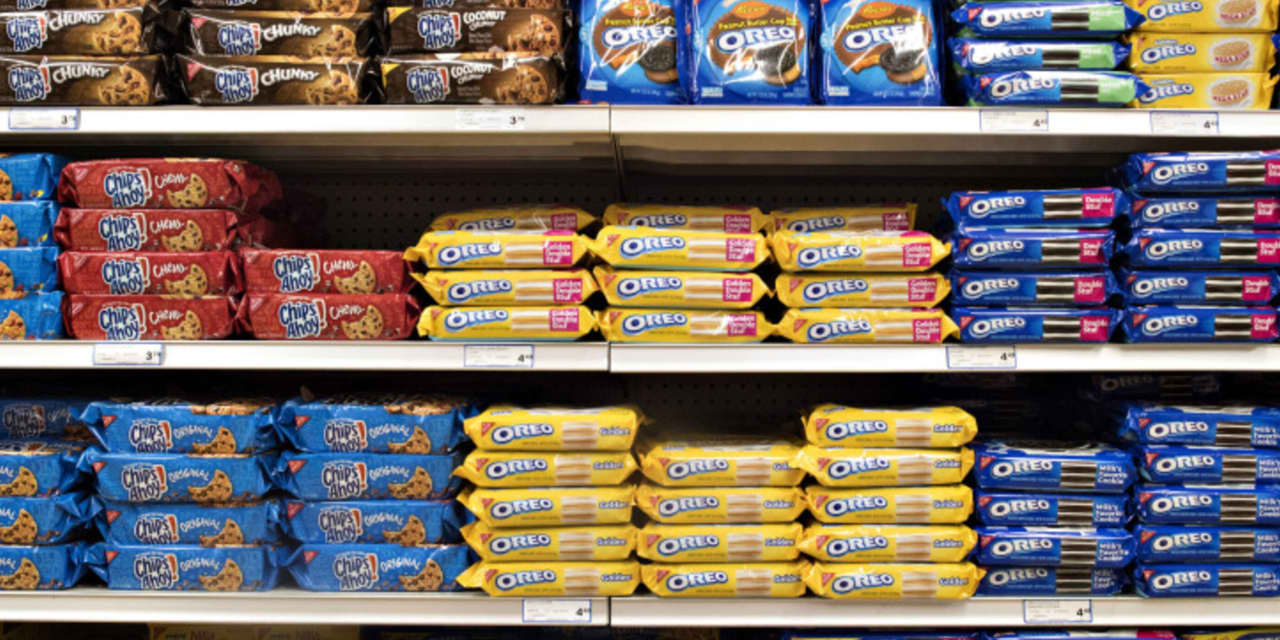
the packaged-food titan that makes Oreo cookies, posted its fourth-quarter earnings on Tuesday.
Revenue increased by 7.1% from a year earlier, while adjusted earnings per share came in almost 24% higher. Operating margins expanded to 13% from 9% a year ago, and are expected to widen to 17% in the coming quarter, according to analysts polled by FactSet.
Although prices rose for much of 2023, demand remained strong as people continued to munch on their favorite snacks—an affordable luxury that can brighten up difficult times.
Over the course of last year, Mondelez raised prices of its products by 13.4%, but sales volume didn’t shrink, recording a 1.3% gain across all of the company’s business segments. In Latin America, where inflation was 31%, units of food and drinks sold increased by 3.8%.
Sales volume slipped a little from a year ago in the fourth quarter, but management said that was mainly caused by temporary problems such as war in the Middle East and adjustments for new acquisitions and product portfolios in the U.S. The company expects volume growth to resume in 2024.
Brinker International,
which owns the Chili’s and Maggiano’s Little Italy restaurant chains, also just reported its earnings. Revenue grew 5.2% from a year earlier, buoyed by higher prices. Higher prices on its menus positioned revenue to rise by 7.1%, but reduced foot traffic and smaller check sizes relative to a year earlier reduced the gain by 1.9 percentage points.
Still, guest traffic improved from the previous quarter, while operating margin expanded to 6.1% from 4.8%, according to FactSet. CEO Kevin Hochman said that increase resulted mainly from effective marketing and efforts to simplify operations. For the first quarter of 2024, analysts expect the restaurant operator to post an even higher margin of 6.4%.
Other stocks on the list include Monster Beverage,
Keurig Dr Pepper,
Sysco,
Brown-Forman,
Darden Restaurants, Performance Food, Papa John’s International, and
Bloomin’ Brands.
Shares of three in the group—pizza chain Papa John’s, Jack Daniel’s owner Brown-Forman, and soft-drink seller Keurig Dr Pepper—have seen their stocks tumble between 10% to 20% over the past 12 months, so extra caution is needed.
But that also means the stocks are well positioned to bounce back if things turn out better than expected in their next earnings reports. Keurig Dr Pepper, especially, is trading at 16 times forward earnings, compared with its five-year average of 20 times.
Write to Evie Liu at [email protected]
Read the full article here