

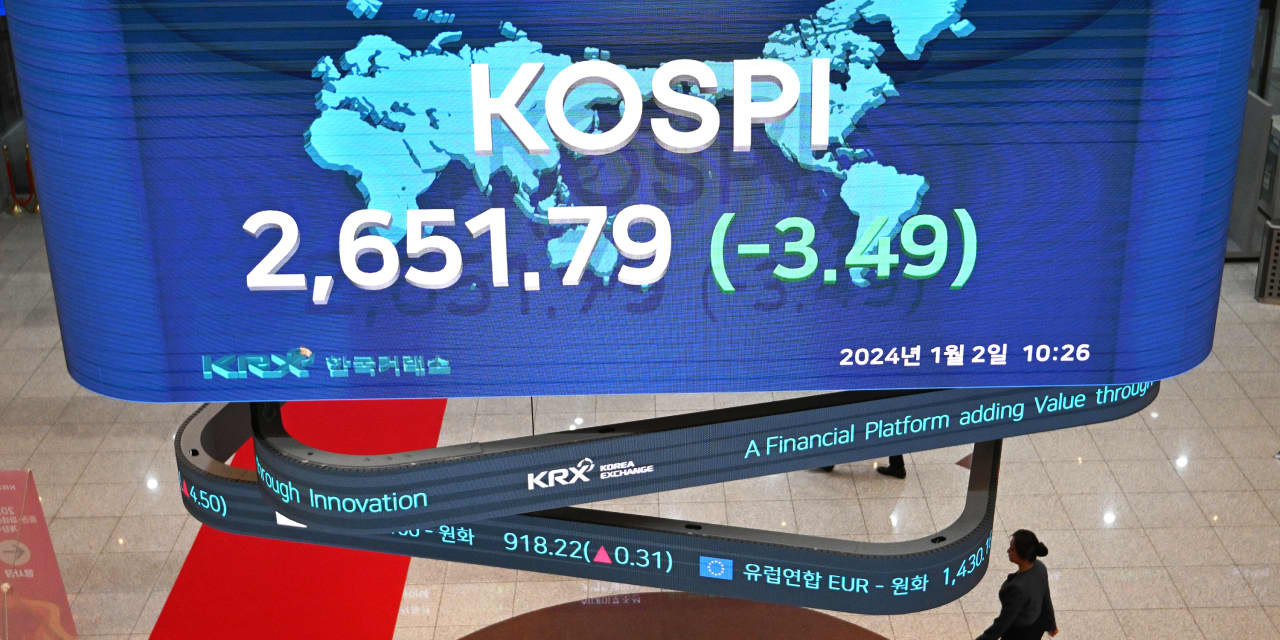
The South Korean stock market has been nothing short of awful in recent years, but regulatory changes could give it a boost and make it a go-to destination for investors.
Korea’s
Kospi Composite Index,
the country’s main benchmark, has dropped an annualized 4.5%, including reinvested dividends, over the past three years, lagging not only the
S&P 500’s
10% return but the
MSCI World Index’s
7.6%.
South Korea’s major issue hasn’t been the economy. Gross domestic product growth has been moderate for the past few years, and cumulative earnings for the Kospi this year should be higher than they were in 2021. Nor is it lacking in exciting companies, with
Samsung Electronics
and others in its ranks.
Few, though, want to own stocks in a country that has been as unfriendly to shareholders as South Korea has been. That’s reflected in the Kospi index’s price/book ratio of just 0.2 times, which means the companies are worth less than their total net assets. The MSCI World index trades at just over three times book.
South Korea’s government is trying to change that. It’s using Japan’s playbook by introducing the “Corporate Value-Up Program,” which would require companies to disclose financial metrics, such as return on equity or earnings as a percentage of book value. They would also have to disclose their strategies for increasing shareholder value. These changes would give investors greater visibility into companies’ performance—and hopefully encourage them to pay a higher price to own them. Other changes include lower taxes on capital gains and dividends, which would increase the after-tax return on investments.
Already, the news has started to work its way into Korea’s market. The Kospi is up about 7.1% since Jan. 17, when the government unveiled some of its intended plan, a gain that is more than double the world index’s rise. The key is that, as the market becomes increasingly certain of when and how quickly the reforms will become official, stocks should have more runway for gains.
For South Korea’s market, “there are many low-hanging fruits, though reform execution will take time,” writes Desh Peramunetilleke, Jefferies’ global head of quantitative strategy. “Lessons from Japan suggest a long runway ahead.”
Peramunetilleke offered lists of companies that could benefit from these changes, including one that focused on companies with price/book ratios below one and return on equity in the double digits for the past three years. Companies meeting those requirements include
Hyundai Motor
and
Korea Air Lines.
Another screen included the most liquid stocks, including
Industrial Bank of Korea
and
Hankook & Co.
These may be sound ideas, but the reality is that the majority of South Korean stocks trade at below book value, so seeking broad exposure to the market also makes sense. The
iShares MSCI South Korea
exchange-traded fund has traded similarly to the Kospi, but it’s more weighted toward the largest companies, with a fifth of the fund in Samsung. The ETF trades at about 0.9 times expected book value by the end of this year. That’s higher than the Kospi, but still leaves room for appreciation.
If change takes hold, Korea could be the world’s next hot stock market.
Write to Jacob Sonenshine at [email protected]
Read the full article here