

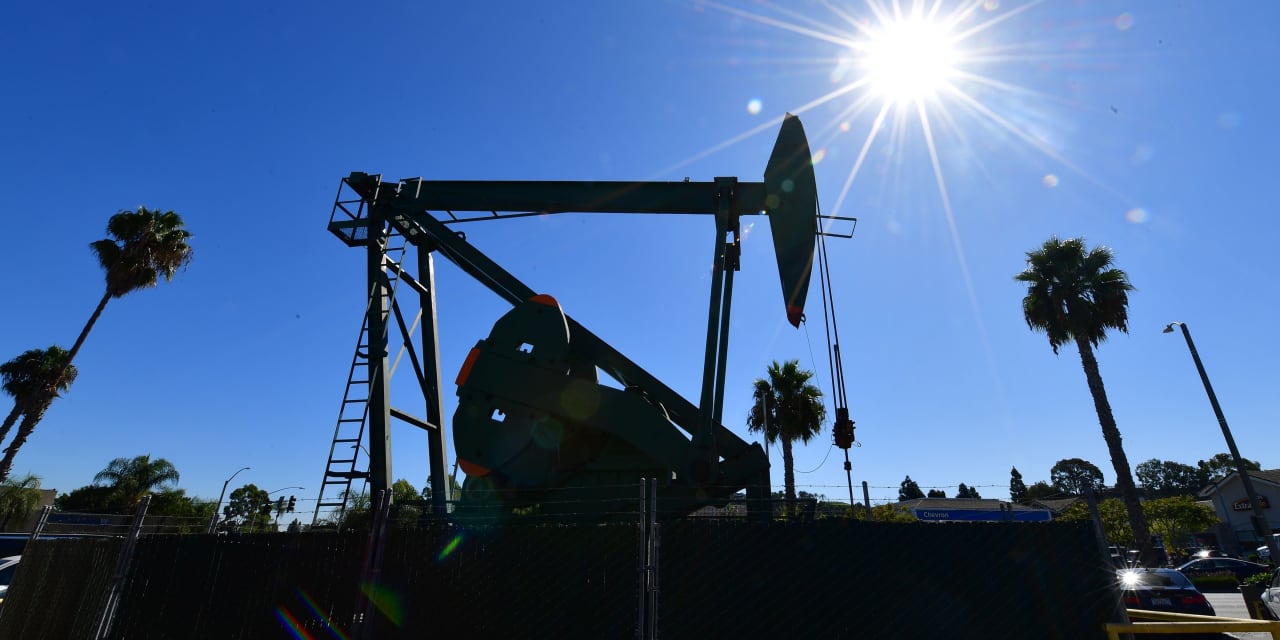
Oil futures headed higher for a fourth straight session on Thursday, with Brent crude climbing back above the $80-a-barrel threshold after Israel rejected a Hamas offer for a cease-fire and return of hostages held in Gaza.
Price moves
-
West Texas Intermediate crude for March delivery
CL00,
+2.22% CL.1,
+2.22% CLH24,
+2.22%
rose $1.60, or 2.2%, to $75.46 a barrel on the New York Mercantile Exchange. -
April Brent crude
BRN00,
+2.15% BRNJ24,
+2.15% ,
the global benchmark, was up $1.50, or 1.9%, at $80.71 a barrel on ICE Futures Europe. Brent last traded above $80 on Feb. 1. -
March gasoline
RBH24,
+2.76%
tacked on 2.9% to $2.3281 a gallon, while March heating oil
HOH24,
+1.10%
added 1.4% to $2.8561 a gallon. -
Natural gas for March delivery
NGH24,
-2.34%
traded at $1.927 per million British thermal units, down 2%, eyeing another settlement at the lowest since September 2020.
Market drivers
Oil futures have seen temporary pops higher on developments in the Middle East since the start of the Israel-Hamas war in October but have failed to build a lasting risk premium. Both Brent and WTI are trading well below 2023 highs set in late September.
Crude has found support this week after the U.S. led airstrikes on Iran-backed militias in Iraq and Syria following a drone attack last month that killed three U.S. service members in Jordan. A U.S.- and U.K.-led coalition also renewed strikes on Iran-backed Houthi rebels in Yemen who have targeted Red Sea shipping and have forced the rerouting of cargo ships and some oil tankers.
Israeli Prime Minister Benjamin Netanyahu on Wednesday rejected Hamas’s terms for a cease-fire, which called for the release of thousands of prisoners.
The development added to concerns around the Middle East, helping crude maintain its recent upward trend, Ricardo Evangelista, senior traders at ActivTrades, said in emailed comments.
“While Gaza remains the focal point of the crisis, its repercussions extend throughout the region, raising the specter of a broader conflict with potential intervention from other parties. Such a scenario could disrupt the Suez shipping route and impact oil production in Gulf nations like Iran,” he said.
In the U.S., natural gas traded lower for a third consecutive session, poised to mark another front-month contract settlement at the lowest in more than three years. Analysts said some forecasts for milder weather eased demand expectations for the heating fuel.
Read: U.S. natural-gas consumption hit a record in January. So why are prices falling?
The U.S. Energy Information Administration reported on Thursday that U.S. natural-gas supplies in storage declined by 75 billion cubic feet for the week that ended Feb. 2. That was generally in line with the average drop of 76 billion cubic feet forecast by analysts polled by S&P Global Commodity Insights.
Read the full article here