

- Canadian Dollar trends broadly lower after brief rally.
- Canada added more jobs than expected in January.
- Canadian wage growth in January continues to ease.
The Canadian Dollar (CAD) slipped back after testing higher on Friday. Markets readjusted exposure to the US Dollar (USD) after the US Bureau of Labor Statistics (BLS) introduced broad seasonal adjustment changes to how the Consumer Price Index (CPI) is calculated, causing slight changes to near-term inflation prints.
Canadian wage figures eased further in January, and net job additions showed a higher number of job gains than markets forecast, while December’s jobs number also saw an upside revision. The Canadian Unemployment Rate also ticked lower in January.
Daily digest market movers: Canadian Dollar falling back despite economic calendar beats
- Canada’s Unemployment Rate declined to 5.7% in January versus the forecast 5.9%, December’s 5.8%.
- Net Change in Employment added 37.3K new jobs in January, handily beating the forecast of 15K.
- December’s job additions also saw an upside revision to 12.3% from 0.1K.
- Canadian Average Hourly Wages declined to 5.3% in January from the previous month’s 5.7%.
- The US BLS brought far-reaching adjustments to how the CPI is seasonally-adjusted, causing an uptick in adjusted annualized US inflation, though recent inflation measures remain largely unchanged.
- With the adjustments out of the way, markets will focus on next week’s US CPI inflation print due on Tuesday.
- Next week sees a thin, low-impact economic calendar for Canada, exposing the Loonie to broad-market flows.
Canadian Dollar price today
The table below shows the percentage change of Canadian Dollar (CAD) against listed major currencies today. Canadian Dollar was the weakest against the New Zealand Dollar.
| USD | EUR | GBP | CAD | AUD | JPY | NZD | CHF | |
| USD | -0.04% | -0.05% | 0.15% | -0.27% | 0.08% | -0.52% | 0.18% | |
| EUR | 0.04% | -0.01% | 0.18% | -0.24% | 0.13% | -0.49% | 0.23% | |
| GBP | 0.05% | 0.01% | 0.19% | -0.24% | 0.12% | -0.48% | 0.22% | |
| CAD | -0.14% | -0.18% | -0.19% | -0.42% | -0.07% | -0.67% | 0.03% | |
| AUD | 0.28% | 0.24% | 0.23% | 0.43% | 0.35% | -0.25% | 0.45% | |
| JPY | -0.08% | -0.11% | -0.11% | 0.06% | -0.38% | -0.58% | 0.10% | |
| NZD | 0.52% | 0.48% | 0.47% | 0.66% | 0.24% | 0.60% | 0.70% | |
| CHF | -0.19% | -0.23% | -0.23% | -0.04% | -0.46% | -0.09% | -0.71% |
The heat map shows percentage changes of major currencies against each other. The base currency is picked from the left column, while the quote currency is picked from the top row. For example, if you pick the Euro from the left column and move along the horizontal line to the Japanese Yen, the percentage change displayed in the box will represent EUR (base)/JPY (quote).
Technical analysis: Canadian Dollar sheds weight against US Dollar after early rise
The Canadian Dollar is broadly lower on Friday, dipping into the red against the majority of its major currency peers with the New Zealand Dollar (NZD) leading the charge, gaining two-thirds of a percent against the CAD, while the Australian Dollar (AUD) approaches half a percent in gains against the Canadian Dollar.
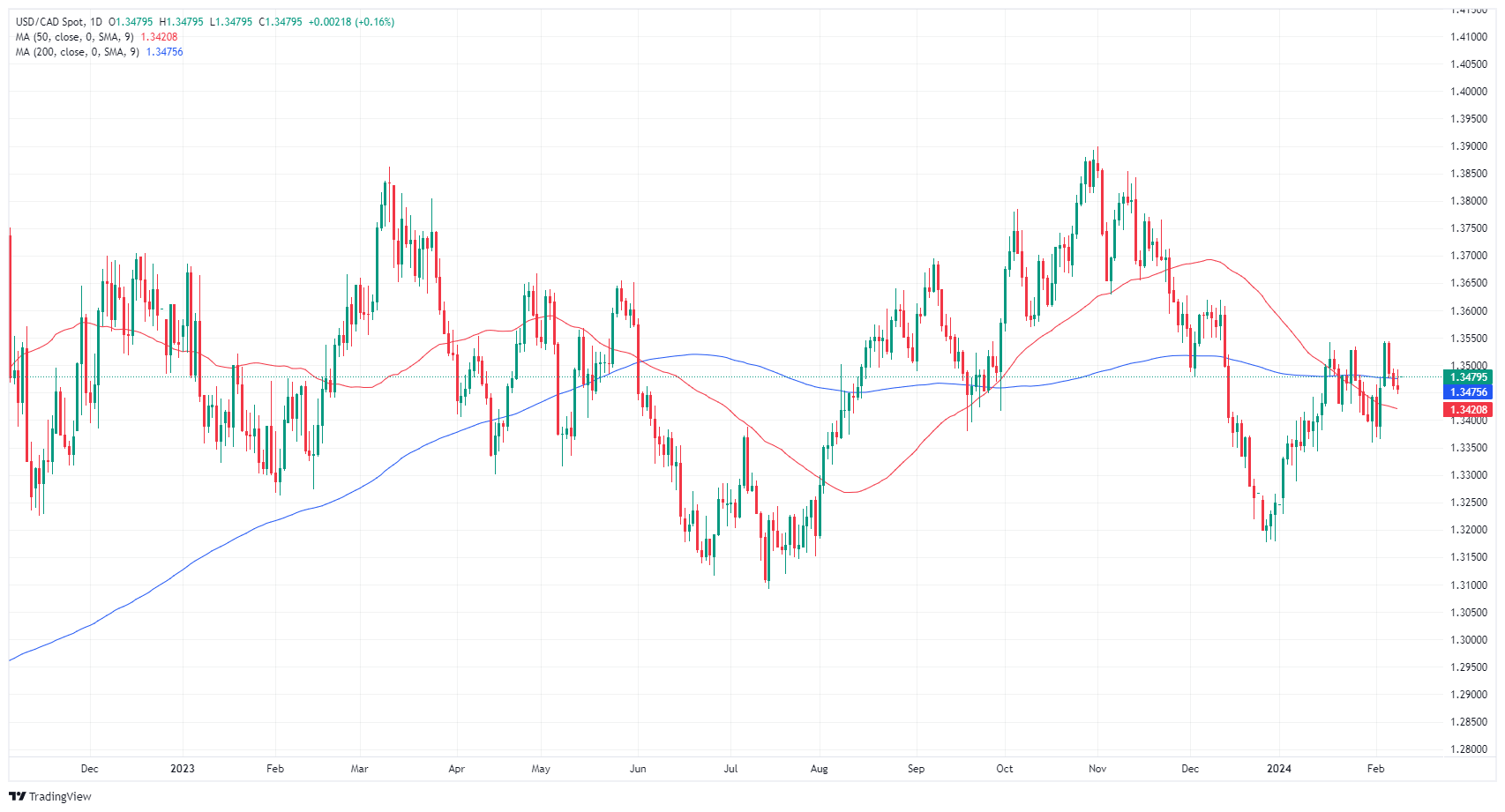
The Canadian Dollar rallied early against the US Dollar, sending the USD/CAD into a near-term low of 1.3413 before a rally in the USD sent the pair back into the high end near 1.3480. The pair has rallied half a percent bottom-to-top on Friday, keeping the USD/CAD pinned into near-term congestion.
The USD/CAD continues to trade into the 200-day Simple Moving Average (SMA) near 1.3475, and bidders will be looking to drive the pair back into the last meaningful swing high at 1.3900 last November. On the low side, sellers will be looking for a return to December’s bottom bids near 1.3200.
USD/CAD hourly chart
USD/CAD daily chart![]()
Central banks FAQs
Central Banks have a key mandate which is making sure that there is price stability in a country or region. Economies are constantly facing inflation or deflation when prices for certain goods and services are fluctuating. Constant rising prices for the same goods means inflation, constant lowered prices for the same goods means deflation. It is the task of the central bank to keep the demand in line by tweaking its policy rate. For the biggest central banks like the US Federal Reserve (Fed), the European Central Bank (ECB) or the Bank of England (BoE), the mandate is to keep inflation close to 2%.
A central bank has one important tool at its disposal to get inflation higher or lower, and that is by tweaking its benchmark policy rate, commonly known as interest rate. On pre-communicated moments, the central bank will issue a statement with its policy rate and provide additional reasoning on why it is either remaining or changing (cutting or hiking) it. Local banks will adjust their savings and lending rates accordingly, which in turn will make it either harder or easier for people to earn on their savings or for companies to take out loans and make investments in their businesses. When the central bank hikes interest rates substantially, this is called monetary tightening. When it is cutting its benchmark rate, it is called monetary easing.
A central bank is often politically independent. Members of the central bank policy board are passing through a series of panels and hearings before being appointed to a policy board seat. Each member in that board often has a certain conviction on how the central bank should control inflation and the subsequent monetary policy. Members that want a very loose monetary policy, with low rates and cheap lending, to boost the economy substantially while being content to see inflation slightly above 2%, are called ‘doves’. Members that rather want to see higher rates to reward savings and want to keep a lit on inflation at all time are called ‘hawks’ and will not rest until inflation is at or just below 2%.
Normally, there is a chairman or president who leads each meeting, needs to create a consensus between the hawks or doves and has his or her final say when it would come down to a vote split to avoid a 50-50 tie on whether the current policy should be adjusted. The chairman will deliver speeches which often can be followed live, where the current monetary stance and outlook is being communicated. A central bank will try to push forward its monetary policy without triggering violent swings in rates, equities, or its currency. All members of the central bank will channel their stance toward the markets in advance of a policy meeting event. A few days before a policy meeting takes place until the new policy has been communicated, members are forbidden to talk publicly. This is called the blackout period.
Read the full article here