

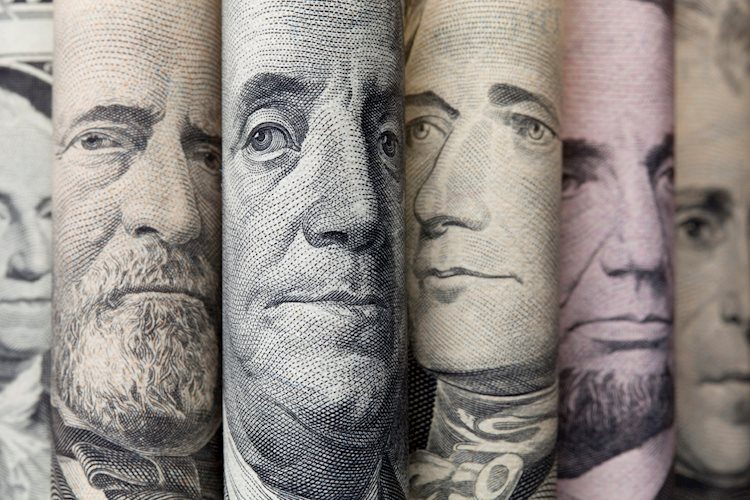
- The DXY stands at 104.10 on Monday with mild gains.
- Fed’s dovish stance remains in place despite minimal chance of a March rate cut.
- January’s CPI figures on Tuesday are set to determine the timing of Fed cuts and USD dynamics.
The US Dollar (USD) remains firmly positioned at 104.10, demonstrating stability ahead of key US data releases expected this week. Financial markets keenly await economic reports on the Consumer Price Index (CPI), Producer Price Index (PPI), and Retail Sales data from January, which could potentially bolster the Dollar’s position further. Simultaneously, anticipation builds around upcoming inflation reports, expected to shed light on the economy’s performance and the Federal Reserve’s (Fed) future stance
In early February, the US Dollar saw notable gains following comments from Jerome Powell, the Federal Reserve Chair, indicating that a March cut in interest rates was unlikely. He stressed the need for more evidence of falling inflation before the Fed could consider reducing rates, making upcoming data crucial. Tuesday’s release of the US Consumer Price Index (CPI) for January is expected to significantly influence the short-term direction of the US Dollar.
Daily digest market movers: US Dollar holds steady as markets await key economic data, yields hold steady
- The Core CPI in January is expected to have risen by 3.7% YoY, while the headline measure is seen decelerating to 2.9% YoY.
- US Treasury yields are mildly down. The 2-year yield stands at 4.47%, the 5-year yield at 4.12%, and the 10-year yield at 4.17%.
- CME’s FedWatch Tool indicates a 20% possibility of a rate cut for the March meeting but may see some changes in case the US CPI from January comes in lower than expected. Those odds stand at around 50% for May.
Technical analysis: DXY bulls hold their ground, unable to conquer the 100-day SMA
The Relative Strength Index (RSI) remains stable within positive territory, indicating that upward force retains some punch in the dynamic of the index despite recent shifts. The Moving Average Convergence Divergence (MACD) also offers green flat bars, suggesting a positive trend in line with the bullish stance.
On the scope of the Simple Moving Averages (SMAs), the DXY appears to hover above the 20-day SMA and similarly above the 200-day SMA, indicating a strong bullish perspective in the longer horizon. However, it’s trading just beneath the 100-day SMA, suggesting some sell-off pressure in the near to intermediate term.
Given these indicators, it’s evident that buying momentum is more present than selling pressure. While the bearish movements have caused some disruption, the resilient undercurrent of bullish energy reflected in the RSI, MACD, and SMAs denotes an optimistic outlook in the overall trend.
US Interest rates FAQs
Interest rates are charged by financial institutions on loans to borrowers and are paid as interest to savers and depositors. They are influenced by base lending rates, which are set by central banks in response to changes in the economy. Central banks normally have a mandate to ensure price stability, which in most cases means targeting a core inflation rate of around 2%.
If inflation falls below target the central bank may cut base lending rates, with a view to stimulating lending and boosting the economy. If inflation rises substantially above 2% it normally results in the central bank raising base lending rates in an attempt to lower inflation.
Higher interest rates generally help strengthen a country’s currency as they make it a more attractive place for global investors to park their money.
Higher interest rates overall weigh on the price of Gold because they increase the opportunity cost of holding Gold instead of investing in an interest-bearing asset or placing cash in the bank.
If interest rates are high that usually pushes up the price of the US Dollar (USD), and since Gold is priced in Dollars, this has the effect of lowering the price of Gold.
The Fed funds rate is the overnight rate at which US banks lend to each other. It is the oft-quoted headline rate set by the Federal Reserve at its FOMC meetings. It is set as a range, for example 4.75%-5.00%, though the upper limit (in that case 5.00%) is the quoted figure.
Market expectations for future Fed funds rate are tracked by the CME FedWatch tool, which shapes how many financial markets behave in anticipation of future Federal Reserve monetary policy decisions.
Read the full article here