

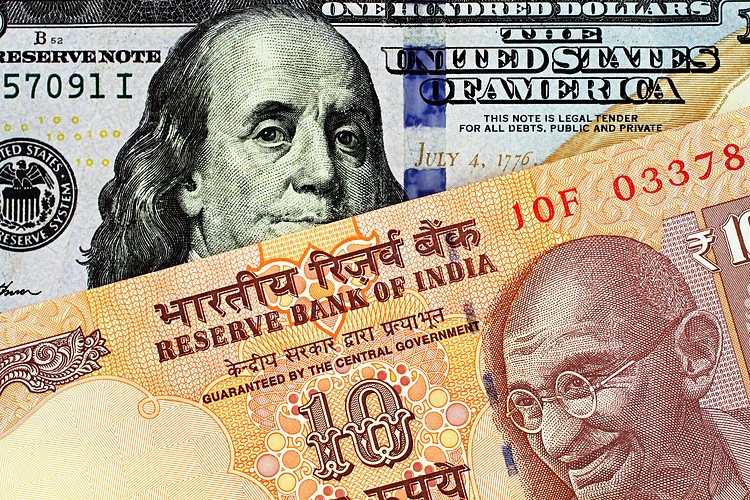
- Indian Rupee trades soft as the higher-than-expected US inflation data boosts the US Dollar.
- The hawkish stance of the Reserve Bank of India (RBI) might cap the INR’s downside for the time being.
- India’s Wholesale Price Index (WPI) Food, Fuel, and Inflation for January will be in the spotlight on Wednesday.
Indian Rupee (INR) loses traction on Wednesday amid the firmer US Dollar (USD). The uptick of the pair is supported by stronger-than-expected US inflation data, which prompts investors to further push back expectations on when the Federal Reserve (Fed) will cut its interest rate.
Meanwhile, the Reserve Bank of India (RBI) stated that it desires to see inflation return to 4%, the midpoint of the 2-6% target. The markets anticipate the Indian central bank to maintain a hawkish stance in the near term and not cut rates ahead of the Fed. This, in turn, could provide some support to the INR and act as a headwind for the USD/INR pair.
Investors await India’s Wholesale Price Index (WPI) Food, Fuel, and Inflation for January, due on Wednesday. The markets expect to see a cooling down of WPI inflation from 0.73% in December to 0.53% YoY in January. On the US docket, Fed’s Goolsbee and Barr are set to speak about the inflation and interest rate outlook. The Retail Sales and Producer Price Index (PPI) for January will be released later this week on Thursday and Friday, respectively.
Daily Digest Market Movers: Indian Rupee remains fragile on the back of renewed US Dollar demand
- The Indian Retail Inflation declined to a three-month low of 5.1% in January from 5.69% in December, above the consensus of 5.09%, according to the Ministry of Statistics & Programme Implementation.
- India needs to grow at 7%–8% annually in order to become a developed nation with USD 13,000 per capita income by 2047, former RBI Governor C. Rangarajan said on Tuesday.
- Union Minister, Hardeep Singh Puri, praised India’s economic growth, citing a robust expansion of 2.6% in the last three quarters.
- The US Consumer Price Index (CPI) inflation softened to 3.1% YoY in January from 3.4% in December, beating the market expectation of 2.9%. On a monthly basis, the headline CPI rose 0.3% MoM from 0.2% in the previous reading.
- The Core CPI, which excludes volatile food and energy prices, climbed 3.9% YoY in the same period, above the market consensus of 3.7%. The monthly Core CPI rose 0.4% MoM in January from a 0.3% rise in December.
- Atlanta Fed President Raphael Bostic said that the US inflation rate will fall to “the lower twos” by the end of this year, down from 3.4% in December.
Technical Analysis: Indian Rupee weakens further against the US Dollar
Indian Rupee trades in negative territory on the day. USD/INR remains range-bound within a descending trend channel of 82.70–83.20 since December 8, 2023.
In the short term, USD/INR resumes its uptrend as the pair returns above the key 100-period Exponential Moving Average (EMA) on the daily timeframe. The bullish momentum is also supported by the 14-day Relative Strength Index, which lies above the 50.0 midline, hinting that further upside looks favorable.
Sustained bullish momentum above the upper boundary of the descending trend channel at 83.20 might make its way back to the next upside barrier at 83.35 (high of January 2), en route to the 84.00 psychological level.
The resistance-turned-support level at 83.00 will be the first downside target to watch for USD/INR. The next contention level is seen at a low of February 2 at 82.83. Any follow-through selling below this level could set off a drop to the next potential support near the lower limit of the descending trend channel at 82.70, followed by 82.45 (low of August 23).
US Dollar price this week
The table below shows the percentage change of US Dollar (USD) against listed major currencies this week. US Dollar was the strongest against the Swiss Franc.
| USD | EUR | GBP | CAD | AUD | JPY | NZD | CHF | |
| USD | 0.77% | 0.25% | 0.74% | 0.94% | 0.84% | 1.19% | 1.36% | |
| EUR | -0.78% | -0.52% | -0.03% | 0.18% | 0.08% | 0.43% | 0.59% | |
| GBP | -0.26% | 0.52% | 0.49% | 0.70% | 0.59% | 0.94% | 1.11% | |
| CAD | -0.74% | 0.03% | -0.49% | 0.21% | 0.11% | 0.47% | 0.62% | |
| AUD | -0.95% | -0.17% | -0.70% | -0.21% | -0.11% | 0.26% | 0.41% | |
| JPY | -0.85% | -0.07% | -0.56% | -0.11% | 0.11% | 0.36% | 0.51% | |
| NZD | -1.21% | -0.43% | -0.95% | -0.47% | -0.26% | -0.35% | 0.16% | |
| CHF | -1.38% | -0.59% | -1.12% | -0.63% | -0.42% | -0.52% | -0.17% |
The heat map shows percentage changes of major currencies against each other. The base currency is picked from the left column, while the quote currency is picked from the top row. For example, if you pick the Euro from the left column and move along the horizontal line to the Japanese Yen, the percentage change displayed in the box will represent EUR (base)/JPY (quote).
Indian economy FAQs
The Indian economy has averaged a growth rate of 6.13% between 2006 and 2023, which makes it one of the fastest growing in the world. India’s high growth has attracted a lot of foreign investment. This includes Foreign Direct Investment (FDI) into physical projects and Foreign Indirect Investment (FII) by foreign funds into Indian financial markets. The greater the level of investment, the higher the demand for the Rupee (INR). Fluctuations in Dollar-demand from Indian importers also impact INR.
India has to import a great deal of its Oil and gasoline so the price of Oil can have a direct impact on the Rupee. Oil is mostly traded in US Dollars (USD) on international markets so if the price of Oil rises, aggregate demand for USD increases and Indian importers have to sell more Rupees to meet that demand, which is depreciative for the Rupee.
Inflation has a complex effect on the Rupee. Ultimately it indicates an increase in money supply which reduces the Rupee’s overall value. Yet if it rises above the Reserve Bank of India’s (RBI) 4% target, the RBI will raise interest rates to bring it down by reducing credit. Higher interest rates, especially real rates (the difference between interest rates and inflation) strengthen the Rupee. They make India a more profitable place for international investors to park their money. A fall in inflation can be supportive of the Rupee. At the same time lower interest rates can have a depreciatory effect on the Rupee.
India has run a trade deficit for most of its recent history, indicating its imports outweigh its exports. Since the majority of international trade takes place in US Dollars, there are times – due to seasonal demand or order glut – where the high volume of imports leads to significant US Dollar- demand. During these periods the Rupee can weaken as it is heavily sold to meet the demand for Dollars. When markets experience increased volatility, the demand for US Dollars can also shoot up with a similarly negative effect on the Rupee.
Read the full article here