

- EUR/USD tested fresh highs at 1.0888 before falling back.
- EU and US PMIs came in soft or mixed, giving bulls cause for pause.
- Friday to wrap up the week with German final GDP, Fed MPR.
EUR/USD broke higher on Thursday, testing into its highest bids since the start of February before falling back into the 1.0800 region after European and US Purchasing Managers Index (PMI) figures softened or came in mixed on forecasts. The Pan-European Composite PMI ticked higher, but the Manufacturing component fell back once again, and US PMIs also gave a mixed showing.
Friday brings final German Gross Domestic Product (GDP) figures, and the US Federal Reserve (Fed) will be releasing its Monetary Policy Report to wrap up the trading week. Investors will be gearing up for next week’s US GDP print due next Wednesday, followed by Thursday’s EU Consumer Price Index (CPI) inflation figures alongside US Personal Consumption Expenditure (PCE) numbers.
Daily digest market movers: EUR/USD recedes just as quickly as it rises on PMI hesitation
- Germany’s HCOB Services PMI rose to 48.2 in February, beating the 48.0 forecast and the previous print of 47.7, while the Manufacturing component declined to a four-month low of 42.3 versus the forecast uptick to 46.1 from January’s 45.5.
- The Pan-European HCOB Composite PMI rose to 48.9 against the forecast of 48.5 from 47.9, getting bolstered by the European Services component printing at 50.0, above contractionary territory for the first time in seven months. The Services component was expected to print at 48.8 versus the previous 48.4.
- Europe’s Manufacturing PMI component fell to 46.1 versus the forecast of 47.0, falling away from the previous 46.6.
- On the US side, the S&P Global Services PMI fell to 51.3 against the expected 52.0, pulling back even further away from the previous print of 52.5.
- The Manufacturing component swung upward to 51.5 compared to the forecast for 50.5, climbing over the previous 50.7 and posting its highest figure since October of 2022.
- Read more: US S&P Global Manufacturing PMI improves to 51.5.
- Fed’s Jefferson: Cautiously optimistic about inflation progress.
Euro price today
The table below shows the percentage change of Euro (EUR) against listed major currencies today. Euro was the strongest against the Swiss Franc.
| USD | EUR | GBP | CAD | AUD | JPY | NZD | CHF | |
| USD | -0.01% | -0.18% | -0.09% | 0.01% | 0.14% | -0.27% | 0.21% | |
| EUR | 0.02% | -0.17% | -0.10% | 0.03% | 0.14% | -0.25% | 0.23% | |
| GBP | 0.17% | 0.17% | 0.07% | 0.18% | 0.31% | -0.09% | 0.41% | |
| CAD | 0.08% | 0.10% | -0.08% | 0.12% | 0.24% | -0.16% | 0.32% | |
| AUD | -0.01% | -0.01% | -0.18% | -0.10% | 0.13% | -0.27% | 0.23% | |
| JPY | -0.14% | -0.15% | -0.34% | -0.26% | -0.15% | -0.41% | 0.10% | |
| NZD | 0.28% | 0.26% | 0.09% | 0.16% | 0.27% | 0.40% | 0.48% | |
| CHF | -0.23% | -0.24% | -0.42% | -0.34% | -0.23% | -0.09% | -0.51% |
The heat map shows percentage changes of major currencies against each other. The base currency is picked from the left column, while the quote currency is picked from the top row. For example, if you pick the Euro from the left column and move along the horizontal line to the Japanese Yen, the percentage change displayed in the box will represent EUR (base)/JPY (quote).
Technical analysis: EUR/USD hits four-week high before falling back into 1.0800 region
EUR/USD’s bullish push on Thursday has the pair on pace to secure its seventh consecutive bullish close as long as Euro (EUR) bidders keep the pressure up, and the pair is finding intraday technical support from the 200-hour Simple Moving Average (SMA) near 1.0770. The immediate ceiling is parked at the 1.0900 handle with the pair supported from 1.0800.
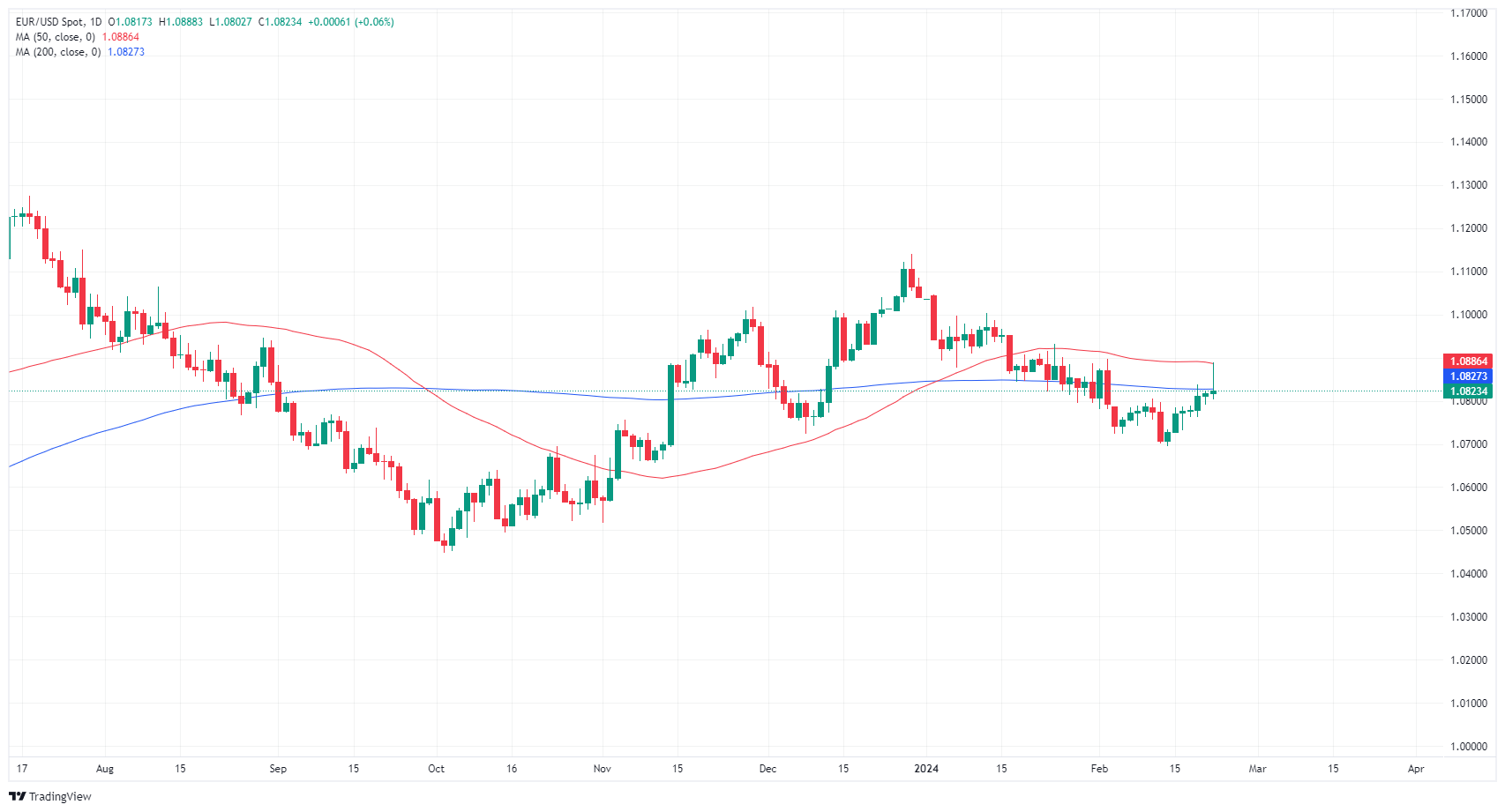
Thursday’s bull run and subsequent slide has the EUR/USD facing a technical rejection from the 200-day SMA at 1.0827, and it’s a bidders ballgame to lose as the pair stumbles on the low side of recent consolidation between 1.0900 and 1.0850.
EUR/USD hourly chart
EUR/USD daily chart![]()
Risk sentiment FAQs
In the world of financial jargon the two widely used terms “risk-on” and “risk off” refer to the level of risk that investors are willing to stomach during the period referenced. In a “risk-on” market, investors are optimistic about the future and more willing to buy risky assets. In a “risk-off” market investors start to ‘play it safe’ because they are worried about the future, and therefore buy less risky assets that are more certain of bringing a return, even if it is relatively modest.
Typically, during periods of “risk-on”, stock markets will rise, most commodities – except Gold – will also gain in value, since they benefit from a positive growth outlook. The currencies of nations that are heavy commodity exporters strengthen because of increased demand, and Cryptocurrencies rise. In a “risk-off” market, Bonds go up – especially major government Bonds – Gold shines, and safe-haven currencies such as the Japanese Yen, Swiss Franc and US Dollar all benefit.
The Australian Dollar (AUD), the Canadian Dollar (CAD), the New Zealand Dollar (NZD) and minor FX like the Ruble (RUB) and the South African Rand (ZAR), all tend to rise in markets that are “risk-on”. This is because the economies of these currencies are heavily reliant on commodity exports for growth, and commodities tend to rise in price during risk-on periods. This is because investors foresee greater demand for raw materials in the future due to heightened economic activity.
The major currencies that tend to rise during periods of “risk-off” are the US Dollar (USD), the Japanese Yen (JPY) and the Swiss Franc (CHF). The US Dollar, because it is the world’s reserve currency, and because in times of crisis investors buy US government debt, which is seen as safe because the largest economy in the world is unlikely to default. The Yen, from increased demand for Japanese government bonds, because a high proportion are held by domestic investors who are unlikely to dump them – even in a crisis. The Swiss Franc, because strict Swiss banking laws offer investors enhanced capital protection.
Read the full article here