

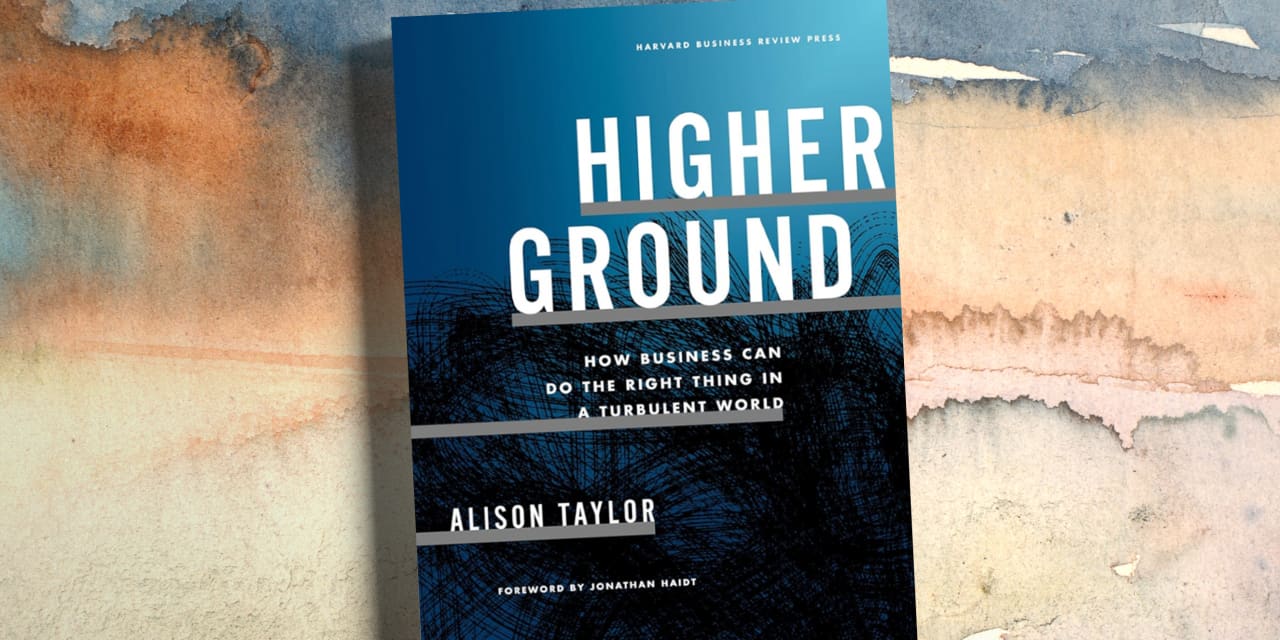
You can’t please everyone. But that doesn’t seem to stop businesses from trying—and from constantly getting flak for it. That problem is the focus of Alison Taylor’s new book, Higher Ground: How Business Can Do the Right Thing in a Turbulent World. Taylor, a clinical professor at the NYU Stern School of Business, has spent over a decade helping companies navigate business ethics and risk. In this week’s book Q&A, Barron’s spoke to Taylor about why companies can’t stay out of sometimes controversial issues. This transcript has been edited.
Barron’s: We’re in a moment when businesses constantly seem to be getting in trouble with the public. What’s happening?
Alison Taylor: We can put this into three big buckets. The first one is transparency and social media. Companies used to be able to control the narrative a lot more. There were just a few newspapers and a few TV stations, but now anyone with a smartphone can capture and post anything they like. That’s forced businesses into a much more interactive relationship with their stakeholders. It’s harder to manage your reputation.
The second thing is that business has been drawn much more into controversial political questions, to the degree that my students don’t even remember a time when business tried to be neutral and keep out of these things.
The third thing is the very profound shift in values that’s going on in the younger generation. What I hear in the classroom about leadership, culture, remote work, and social impact would have seemed completely bizarre to me when I was young. Young people just want different things from leaders and want different things from their jobs.
How should companies deal with controversial topics?
There are a lot of strong arguments for them staying out of a lot of these topics, but that’s not where we are today. We’ve got a dysfunctional government. People are looking to corporations to solve these problems because we really have nowhere else to go.
The other thing is that a neutral middle ground doesn’t really exist anymore. If you [as a business leader] don’t do anything, if you don’t say something, that’s taking a position in itself, partly because we’re so polarized.
There are a couple of things to say about how to do this a little better. One is you should really just focus on speaking up on topics that are directly relevant to your business and that you have some ability to influence. Anything to do with social identity, diversity, equity, inclusion, race, gender, sexuality—no company can say that has nothing to do with them because if you employ human beings then you have to deal with these issues.
In general, I would say focus on all the things that are relevant to your business. So if you’re McDonald’s, focus on the climate impact of beef and not on what’s going on in Israel.
Part of the book is dedicated to building stakeholder trust. How do you build trust when everybody has different values?
There are things [companies] can do to build stakeholder trust. You should listen to your stakeholders, gather their opinions, and consult employees on a lot of these big questions. That is not the same thing as saying a corporation is a democracy, stakeholders are the electorate, and you’ve got to represent or advocate for your stakeholders as if you’re a political entity.
[Companies] need to treat workers and stakeholders with dignity and respect. They need to clean up their own messes before they start going out there and trying to save the world.
But I also think there’s a case for making employees, individual human beings, responsible for their own engagement. What we really need to do is get the general population back engaged in politics and emphasizing their individual rights and freedoms rather than thinking, I can go and yell at my boss and get my boss to do something about these political issues I’m frustrated about.
People often argue that businesses should focus on profits above all. Is there a way to balance environmental, social, and governance concerns with profitability?
A lot of people say we need to go back to Milton Friedman, we need to go back to basics, we need to go back to shareholder value. But the reality is that young people and the majority of stakeholders aren’t going to respond well to a company that’s like, “We don’t care about any of this stuff, we just care about profit.” Good luck hiring or retaining anyone under 30 if you’re going to take that stance.
Does ESG drive profit? It’s hard to make that argument at a general level. Some things will make more money, build trust, or enhance your brand. Some things cost more and are difficult. The answer is, it depends. It depends on what the specific ESG issue is. It depends if it’s relevant to your business. It depends on all sorts of things.
The key is understanding which of these environmental and social issues relate to your negative impacts or externalities, which of them present risks, which of them are opportunities—and then focusing on a couple of them. What most companies do, which is a horribly bad idea, is try to tick the box on 40 things and come up with a giant laundry list of issues and pretend they’re saving the world.
What should companies keep in mind about politics as a particularly contentious election year unfolds?
I think the Republicans are going to keep going on the antiwoke, anti-ESG, anti-DEI stuff. I’m talking to a lot of companies who are feeling nervous about that backlash and potential retaliation and are dialing back those programs. I think that’s a bad idea. Again, if you want to attract and retain young workers, you need to have a good game on these topics.
The other thing that’s going to get really messy before the year is out is the question of corporate political responsibility. Another consequence of all this speaking up on controversial issues is it has focused people on the gap between speech and political spending. It’s actually relatively common in corporate America to have your HR team or your CEO saying, “We really care about climate change, or we really care about this or that,” while the government relations team is funding politicians or or funding business associations that are taking the completely opposite stance. There’s going to be a focus on lobbying and political spending and what companies are and are not doing about various candidates.
I think the most sensible thing to do is just to stop all this political spending and just get out of the political process and have a defense around that, because that scrutiny is just going to keep going up.
Thanks, Alison.
Read the full article here