
EUR/USD fell back into 1.0800 on Thursday after US PCE inflation fails to bolster rate cut hopes

- EUR/USD knocked back into 1.0800 again on Thursday.
- German Retail Sales, CPI showed economic weakness.
- US PCE inflation came in as expected, lower than the prior month
EUR/USD drifted back into the 1.0800 handle once again on Thursday after weak-kneed German Retail Sales and Consumer Price Index (CPI) inflation came in mixed but missed the mark overall. The US Personal Consumption Expenditure Price Index (PCE) printed at median market forecasts, but investor confidence still wavered as US inflation remains too high for the Federal Reserve (Fed) to rush into rate cuts.
Friday will bring pan-European Harmonized Index of Consumer Prices (HICP) inflation for February, and February’s US ISM Manufacturing will round out the trading week. European HICP inflation is forecast to tick lower for the year ended February, and the US ISM Manufacturing PMI is expected to recover slightly but remain in contraction territory.
Daily digest market movers: EUR/USD backslides on US PCE inflation non-starter
- German YoY Retail Sales in January came in at -1.4%, falling less than the forecast of -1.5% but still a slight recovery from the previous -1.7%.
- MoM German Retail Sales missed the mark, printing at -0.4% versus the forecast of 0.5%. The previous month saw a -1.6% print.
- Germany’s YoY CPI for February saw 2.5% versus the forecast of 2.6%, down from the previous 2.9%.
- US Core PCE for the year through January printed at market expectations, coming in at the forecast of 2.4% versus the previous 2.6%.
- The Fed’s favored inflation indicator eased back in-line with model forecasts, but the figure still remains above the US central bank’s inflation target, eating away at investor hopes for a near-term Fed rate cut.
- According to the CME FedWatch Tool, money markets see nearly 80% chance of no rate cut in May, and a 35% chance of another rate hold in June.
Euro price today
The table below shows the percentage change of Euro (EUR) against listed major currencies today. Euro was the weakest against the Japanese Yen.
| USD | EUR | GBP | CAD | AUD | JPY | NZD | CHF | |
| USD | 0.33% | 0.36% | 0.02% | 0.00% | -0.44% | 0.21% | 0.63% | |
| EUR | -0.35% | 0.02% | -0.32% | -0.33% | -0.78% | -0.11% | 0.30% | |
| GBP | -0.37% | -0.03% | -0.35% | -0.37% | -0.82% | -0.16% | 0.27% | |
| CAD | -0.02% | 0.33% | 0.34% | -0.02% | -0.47% | 0.20% | 0.62% | |
| AUD | -0.01% | 0.33% | 0.36% | 0.02% | -0.46% | 0.21% | 0.63% | |
| JPY | 0.44% | 0.79% | 0.81% | 0.45% | 0.44% | 0.68% | 1.09% | |
| NZD | -0.21% | 0.13% | 0.16% | -0.19% | -0.20% | -0.67% | 0.45% | |
| CHF | -0.63% | -0.29% | -0.27% | -0.61% | -0.64% | -1.10% | -0.41% |
The heat map shows percentage changes of major currencies against each other. The base currency is picked from the left column, while the quote currency is picked from the top row. For example, if you pick the Euro from the left column and move along the horizontal line to the Japanese Yen, the percentage change displayed in the box will represent EUR (base)/JPY (quote).
Technical analysis: EUR/USD drops back to familiar technical support at 1.0800 on Thursday
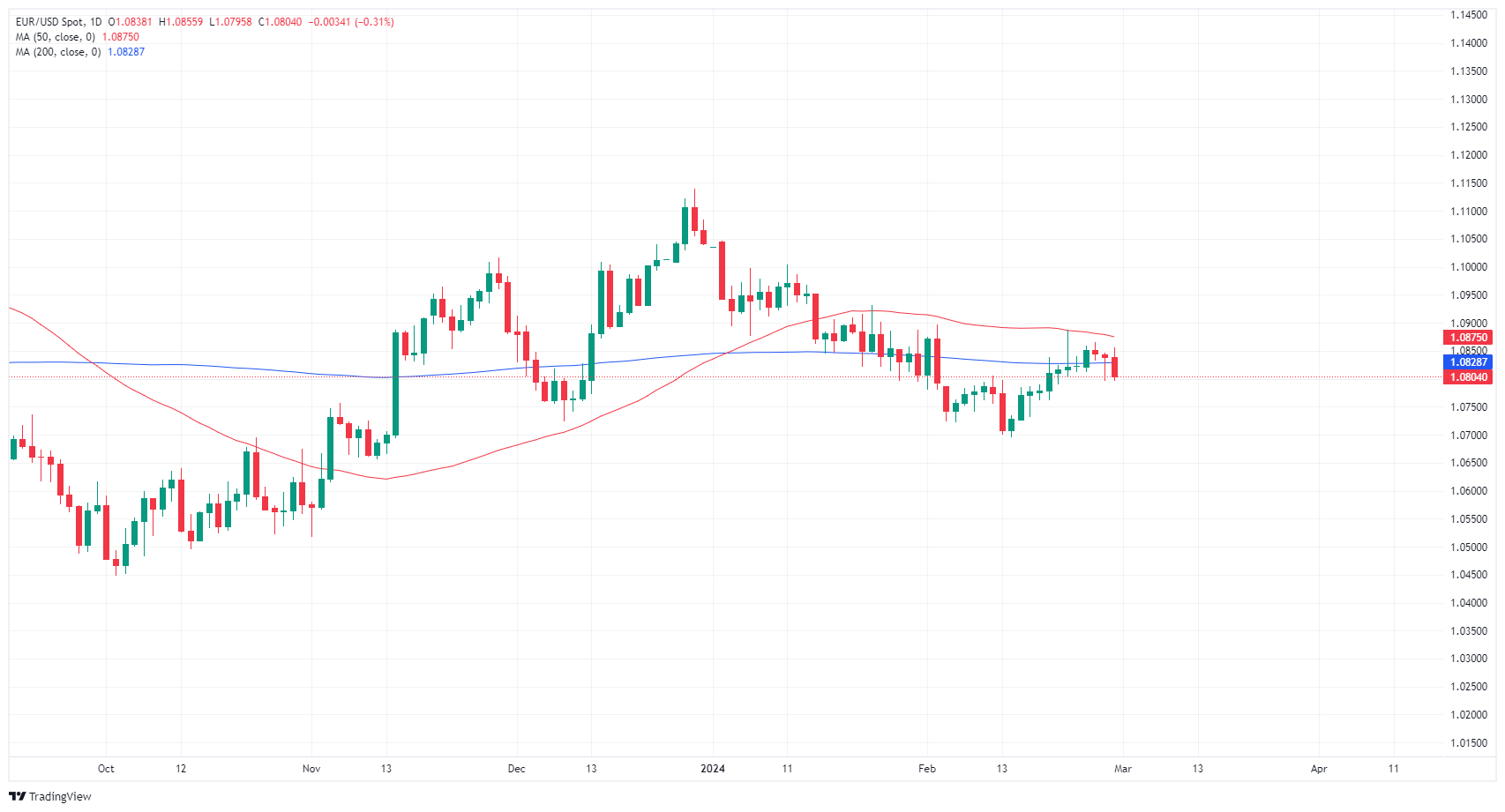
EUR/USD slid back into the 1.0800 handle on Thursday, declining a little over half a percent top-to-bottom from the day’s high at 1.0856. The pair has struggled to find topside momentum since climbing over 1.0800 on February 20.
EUR/USD remains trapped between a supply zone near 1.0860 and a heavy demand zone above 1.0800. Near-term technicals are leaning into a bullish recovery if selling pressure fails to crack 1.0800.
EUR/USD remains mired on the 200-day Simple Moving Average (SMA) at 1.0828, and Thursday’s decline sets the pair up for a steeper downside rejection. The pair has struggled at the key long-term moving average since rising from the last swing low into the 1.0700 handle.
EUR/USD hourly chart
EUR/USD daily chart![]()
Inflation FAQs
Inflation measures the rise in the price of a representative basket of goods and services. Headline inflation is usually expressed as a percentage change on a month-on-month (MoM) and year-on-year (YoY) basis. Core inflation excludes more volatile elements such as food and fuel which can fluctuate because of geopolitical and seasonal factors. Core inflation is the figure economists focus on and is the level targeted by central banks, which are mandated to keep inflation at a manageable level, usually around 2%.
The Consumer Price Index (CPI) measures the change in prices of a basket of goods and services over a period of time. It is usually expressed as a percentage change on a month-on-month (MoM) and year-on-year (YoY) basis. Core CPI is the figure targeted by central banks as it excludes volatile food and fuel inputs. When Core CPI rises above 2% it usually results in higher interest rates and vice versa when it falls below 2%. Since higher interest rates are positive for a currency, higher inflation usually results in a stronger currency. The opposite is true when inflation falls.
Although it may seem counter-intuitive, high inflation in a country pushes up the value of its currency and vice versa for lower inflation. This is because the central bank will normally raise interest rates to combat the higher inflation, which attract more global capital inflows from investors looking for a lucrative place to park their money.
Formerly, Gold was the asset investors turned to in times of high inflation because it preserved its value, and whilst investors will often still buy Gold for its safe-haven properties in times of extreme market turmoil, this is not the case most of the time. This is because when inflation is high, central banks will put up interest rates to combat it.
Higher interest rates are negative for Gold because they increase the opportunity-cost of holding Gold vis-a-vis an interest-bearing asset or placing the money in a cash deposit account. On the flipside, lower inflation tends to be positive for Gold as it brings interest rates down, making the bright metal a more viable investment alternative.
Read the full article here