

Shares of
Spirit AeroSystems
have taken off in response to news that
Boeing
is in talks to buy the supplier it once owned.
Boeing confirmed the discussions late Friday, following a report by the Wall Street Journal. A deal for Spirt would be a strategic pivot for Boeing and would highlight that spinning out company-owned supply businesses isn’t really a great idea.
Spirit Aero stock closed up 15.3% at $32.98 on Friday. Boeing stock closed down 1.8%, while the
S&P 500
was up about 0.8%. Spirit shares added 2.2% in after-hours trading after Boeing confirmed talks.
“We have been working closely with Spirit AeroSystems and its leadership to strengthen the quality of the commercial airplanes that we build together. We confirm that our collaboration has resulted in preliminary discussions about making Spirit AeroSystems a part of Boeing again,” said the company in an emailed statement.
Spirit AeroSystems didn’t respond to a request for comment.
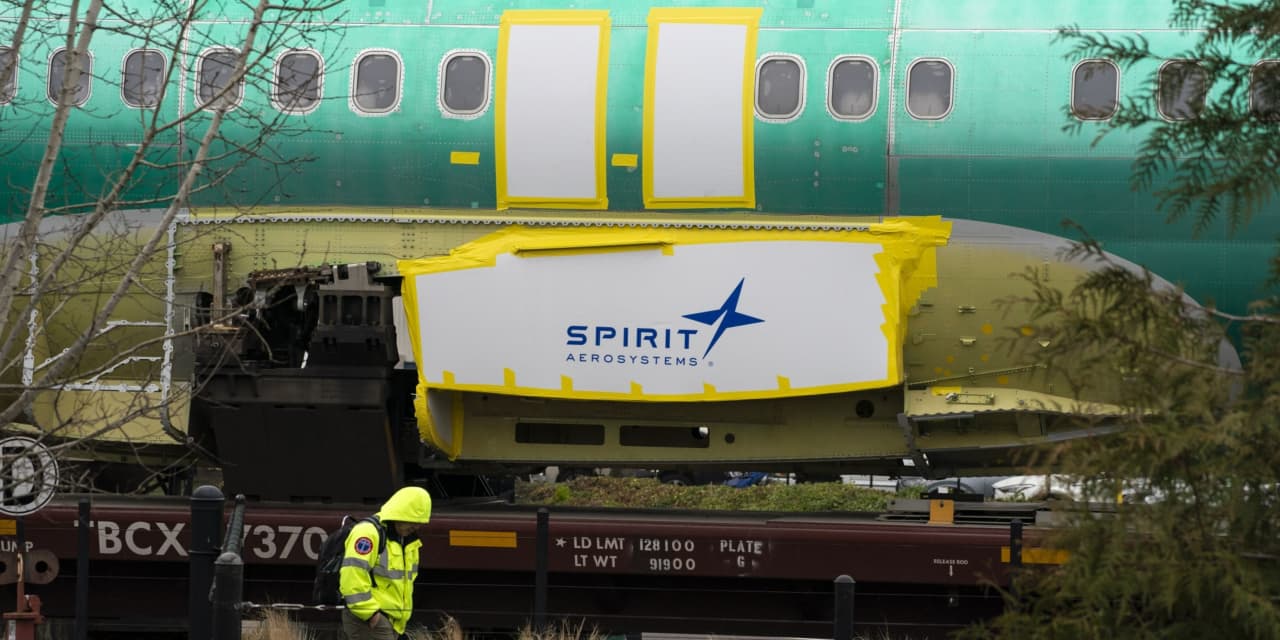
Spirit Aero makes fuselages for both Boeing and
Airbus
—including a large portion of the fuselage for a 737 MAX jet. Some 60% of Spirt Aero’s sales come from Boeing. Airbus is responsible for about 20%.
Spirit Aero was once a part of Boeing. The company became a publicly traded company in a November 2006 initial public offering of stock priced at $26. Through Thursday trading, shares had returned about 0.3% a year on average since then, while the S&P 500 has returned about 9% a year on average over the same span.
Investors just didn’t warm up to an aerospace supplier with its fortunes tied predominantly to one customer, despite some success in diversifying its business. Spirit Aero’s sales in 2024 are expected to be about $7.4 billion, up from $3.2 billion in 2006. That’s an annual growth rate of almost 5%.
It isn’t the first time that a supply business spun out of a larger manufacturing organization hasn’t worked out for investors.
General Motors
spun out its parts business Delphi in 1999.
Ford Motor
followed with
Visteon
in 2000. Both companies, in various forms, still operate today, but both had to reorganize in Chapter 11 bankruptcy roughly 10 years after being spun off.
The reason Boeing is looking at a deal is easy to see. The plane maker is looking to gain more control over quality and production in the aftermath of a Jan. 5. incident in which an emergency-door plug blew out of a 737 MAX 9 jet, leaving a hole in the fuselage. The incident resulted in an emergency landing for an
Alaska Air Group
flight as well as more oversight from the Federal Aviation Administration.
It’s “a massive [change] by Boeing management who have long said that they don’t need to do this,” said Vertical Research Partners analyst Rob Stallard. “On the plus side, it would bring Spirit AeroSystems back in house so Boeing can sort it out.”
“On the negative side…Boeing has no money,” added Stallard. No money is hyperbole, but Boeing has added some $35 billion in long-term debt over the past few years, a consequence of the pandemic and the worldwide grounding of the 737 MAX between March 2019 and November 2020.
“The most obvious issue is what happens to the [portion of] revenues that came from aerostructures built for Airbus aircraft,” wrote Capital Alpha analyst Byron Callan in a Friday report. “We assume they would be divested, as Airbus is not going to want to risk enabling Boeing to conceivably have detailed insight into its production plans and aircraft designs.”
Bringing Spirit Aero back into Boeing won’t be easy, but Boeing may have no choice.
Write to Al Root at [email protected]
Read the full article here