

- The Mexican Peso found fresh gains against the US Dollar on Monday.
- Mexican inflation is expected to ease sharply, propping up Banxico cut expectations.
- Seasonal flows typically bolster the Mexican Peso at the tail end of the first quarter.
The Mexican Peso (MXN) gained ground against the US Dollar (USD) on Monday as counter-balanced rate cut expectations push the USD/MXN pair further down the charts. Common seasonal flows see bullish momentum leak into the Mexican Peso during the first quarter, and markets are forecasting a tumble in Mexican inflation.
Mexico is broadly expected to see further rate cuts from the Banco de México, aka Banxico. Mexico’s main reference rate has been held at record highs of 11.25% since April of 2023. US labor figures are also in the mix, with Friday’s Nonfarm Payrolls (NFP) in the barrel. Hopes of market rate cuts from the Federal Reserve (Fed) are also weighing on Monday market action.
Daily digest market movers: Uptick in Banxico rate cut bets push Peso to six-week highs
- Mexico’s inflation print due on Thursday is expected to print a continued decline in Mexican price growth, forecast to print at 0.12% for February versus the previous 0.89%.
- January’s 0.89% Mexico inflation print was a 22-month high.
- This week’s US labor figures kick off with Wednesday’s ADP Employment Change for February, forecast to jump to 150K from the previous 107K.
- Fed Chairman Jerome Powell due to testify before the Financial Services Committee about the Semi-Annual Monetary Policy Report on Wednesday and Thursday.
- Friday’s February US NFP is expected to fall back to 200K from the previous 353K, and investors will be keeping a close eye on revisions to previous prints.
- Tuesday will kick off the US weekly data docket with ISM Services Purchasing Managers Index (PMI) figures for February forecast to tick down to 53.0 from 53.4.
- The Mexican Peso typically finds bullish interest heading into the second quarter, according to the Moore Research Center (MRCI).
- MRCI: Mexican Peso has closed higher from February 28 to April 4 about 93% of the time over the past 15 years.
Technical analysis: USD/MXN drops into new lows as Peso finds bullish bids
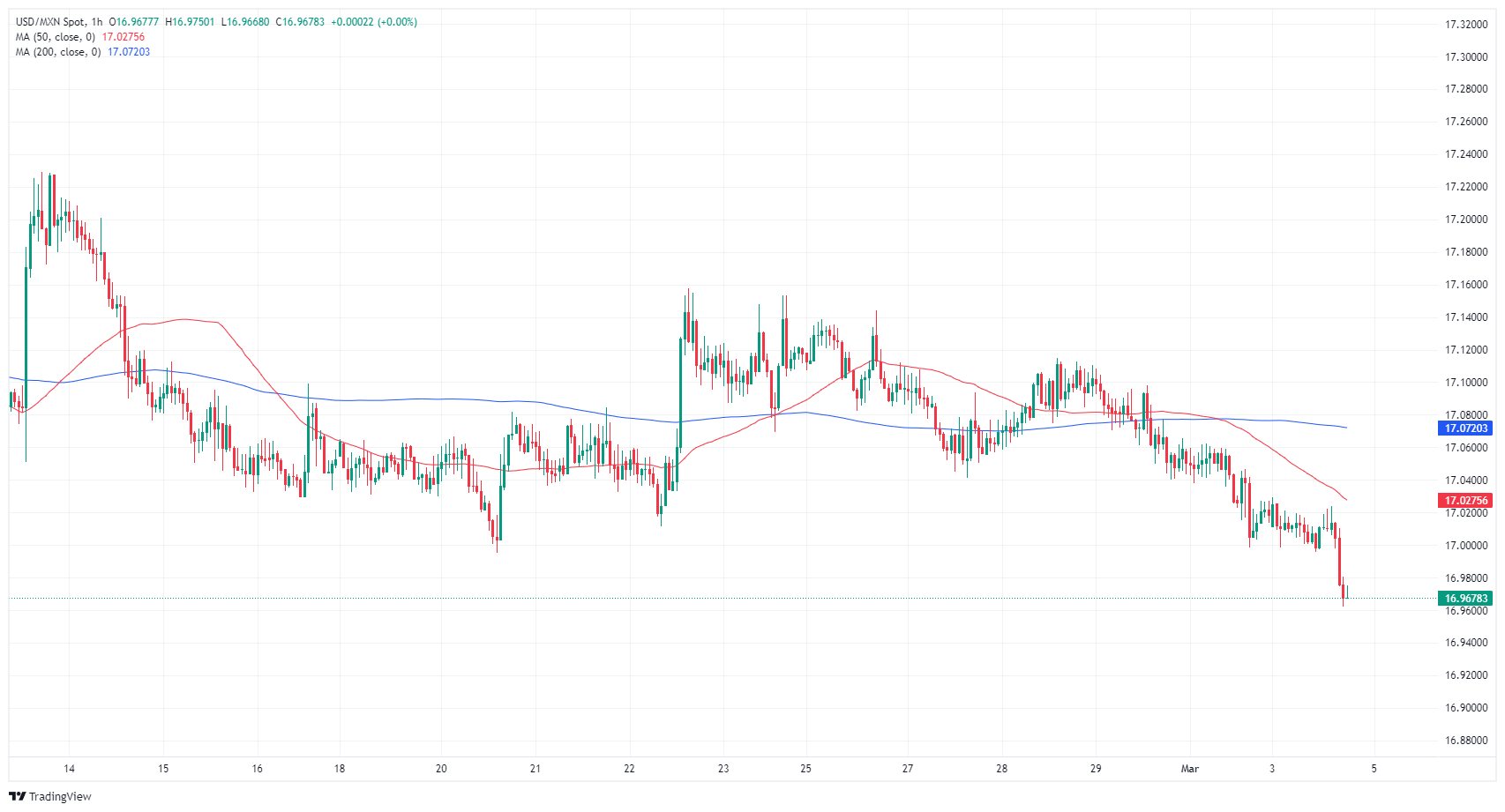
The Mexican Peso (MXN) is climbing on Monday, driving the USD/MXN pair down below the 17.00 handle for the first time since mid-January. The pair is down nine-tenths of a percent from last week’s peak bids near 17.12.
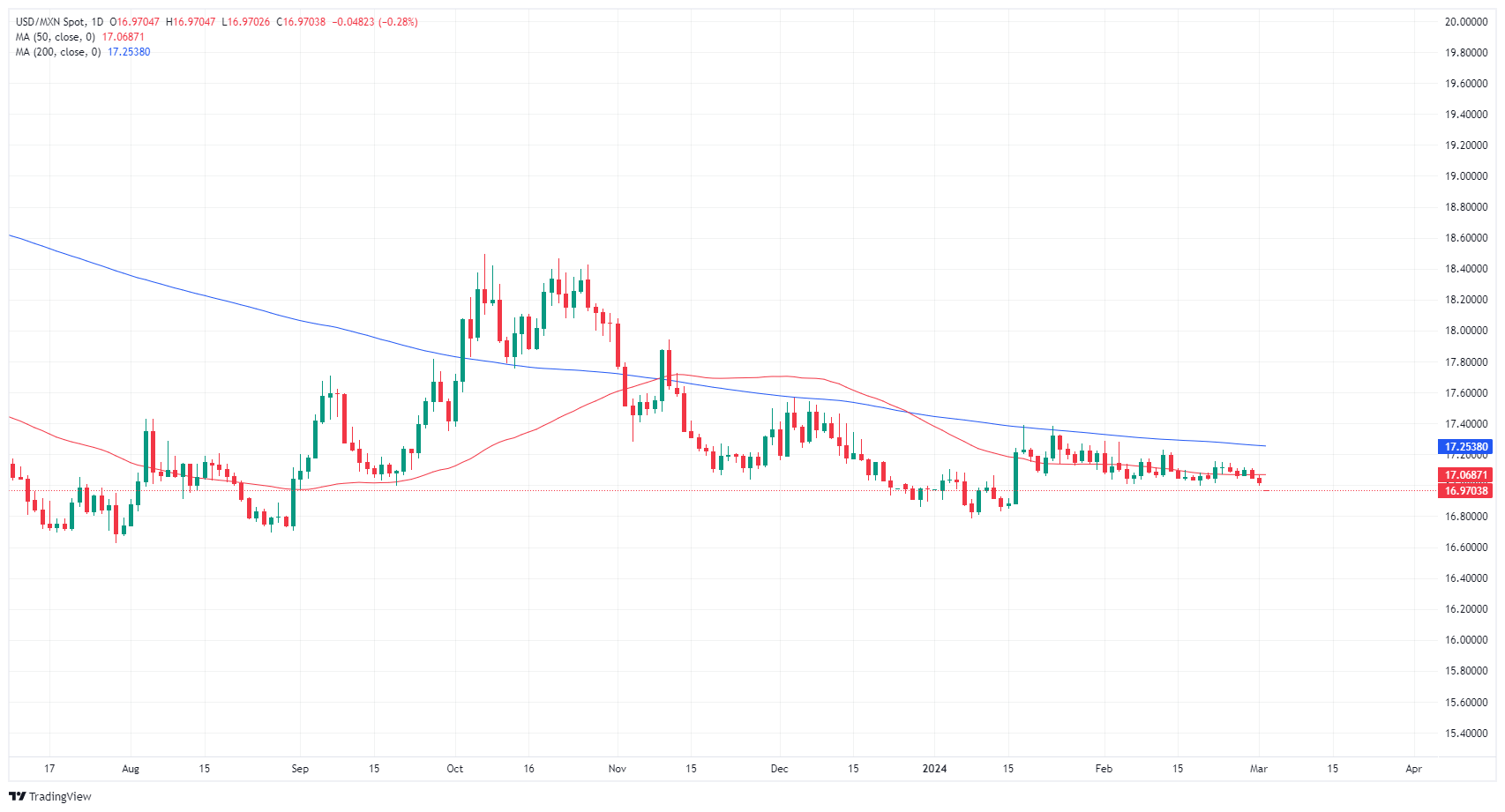
USD/MXN is on pace to close in the red for a third consecutive trading day, and bids are tumbling into chart territory last seen in January. 2024’s technical floor sits at January’s swing low into the 16.80 handle, and the pair continues to drop away from the 200-day Simple Moving Average (SMA) at 17.25.
USD/MXN hourly chart![]()
USD/MXN daily chart![]()
Banxico FAQs
The Bank of Mexico, also known as Banxico, is the country’s central bank. Its mission is to preserve the value of Mexico’s currency, the Mexican Peso (MXN), and to set the monetary policy. To this end, its main objective is to maintain low and stable inflation within target levels – at or close to its target of 3%, the midpoint in a tolerance band of between 2% and 4%.
The main tool of the Banxico to guide monetary policy is by setting interest rates. When inflation is above target, the bank will attempt to tame it by raising rates, making it more expensive for households and businesses to borrow money and thus cooling the economy. Higher interest rates are generally positive for the Mexican Peso (MXN) as they lead to higher yields, making the country a more attractive place for investors. On the contrary, lower interest rates tend to weaken MXN. The rate differential with the USD, or how the Banxico is expected to set interest rates compared with the US Federal Reserve (Fed), is a key factor.
Banxico meets eight times a year, and its monetary policy is greatly influenced by decisions of the US Federal Reserve (Fed). Therefore, the central bank’s decision-making committee usually gathers a week after the Fed. In doing so, Banxico reacts and sometimes anticipates monetary policy measures set by the Federal Reserve. For example, after the Covid-19 pandemic, before the Fed raised rates, Banxico did it first in an attempt to diminish the chances of a substantial depreciation of the Mexican Peso (MXN) and to prevent capital outflows that could destabilize the country.
Read the full article here