

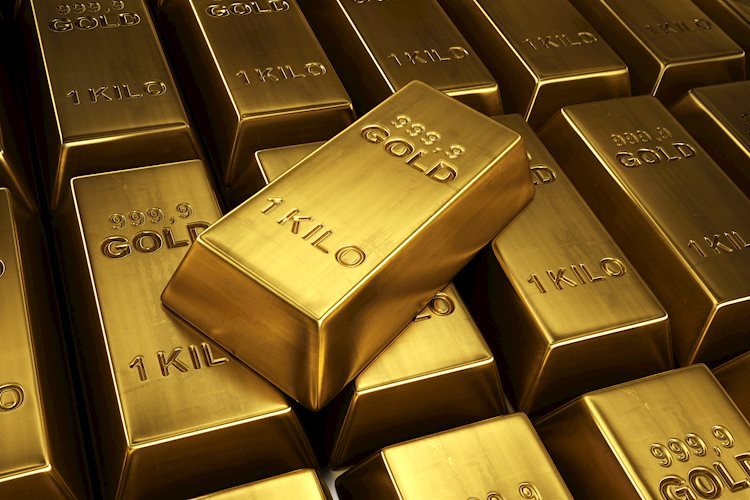
Gold prices fell in Pakistan on Wednesday, according to data compiled by FXStreet.
The price for 24-carat Gold stood at 19,098.32 Pakistani Rupees (PKR) per gram, down PKR 32.30 compared with the PKR 19,130.62 it cost on Tuesday.
The price for 24-carat Gold decreased to PKR 222,759.08 per tola from PKR 223,135.83 per tola.
| Unit measure | Gold Price in PKR |
|---|---|
| 1 Gram | 19,098.32 |
| 10 Grams | 190,983.22 |
| Tola | 222,759.08 |
| Troy Ounce | 594,024.66 |
FXStreet calculates Gold prices in Pakistan by adapting international prices (XAU/USD) to the local currency and measurement units. Prices are updated daily based on the market rates taken at the time of publication. Prices are just for reference and local rates could diverge slightly.
Global Market Movers: Gold price might continue to draw support from Fed rate cut bets, softer risk tone
- Weaker US economic data released on Tuesday reaffirmed market expectations that the Federal Reserve will cut interest rates sooner rather than later and lifted the Gold price back closer to the all-time peak.
- The Institute for Supply Management (ISM) reported that economic activity in the services sector expanded in February for the 14th consecutive month, albeit at a slower pace amid a decline in employment.
- Separately, data published by the US Commerce Department’s Census Bureau showed that total Factory Orders fell by 3.6% MoM (-2.0% YoY) in January following a 0.3% decline in the previous month.
- Apart from this, persistent geopolitical tensions and China’s economic woes tempered investors’ appetite for riskier assets and further contributed to driving flows towards the perceived safe-haven precious metal.
- Bulls, meanwhile, opt to lighten their positions ahead of Fed Chair Jerome Powell’s congressional testimony, which will offer clarity on the interest rate path and provide a fresh impetus to the XAU/USD.
- According to the CME Group’s FedWatch tool, the markets are pricing in a 70% chance that the Fed will start cutting rates by June, keeping the US Dollar bulls on the defensive and limiting the downside for the commodity.
- Traders on Wednesday will further take cues from the release of the US ADP report on private-sector employment and JOLTS Job Openings data ahead of the closely-watched Nonfarm Payrolls report on Friday.
: (An automation tool was used in creating this post.)
Gold FAQs
Gold has played a key role in human’s history as it has been widely used as a store of value and medium of exchange. Currently, apart from its shine and usage for jewelry, the precious metal is widely seen as a safe-haven asset, meaning that it is considered a good investment during turbulent times. Gold is also widely seen as a hedge against inflation and against depreciating currencies as it doesn’t rely on any specific issuer or government.
Central banks are the biggest Gold holders. In their aim to support their currencies in turbulent times, central banks tend to diversify their reserves and buy Gold to improve the perceived strength of the economy and the currency. High Gold reserves can be a source of trust for a country’s solvency. Central banks added 1,136 tonnes of Gold worth around $70 billion to their reserves in 2022, according to data from the World Gold Council. This is the highest yearly purchase since records began. Central banks from emerging economies such as China, India and Turkey are quickly increasing their Gold reserves.
Gold has an inverse correlation with the US Dollar and US Treasuries, which are both major reserve and safe-haven assets. When the Dollar depreciates, Gold tends to rise, enabling investors and central banks to diversify their assets in turbulent times. Gold is also inversely correlated with risk assets. A rally in the stock market tends to weaken Gold price, while sell-offs in riskier markets tend to favor the precious metal.
The price can move due to a wide range of factors. Geopolitical instability or fears of a deep recession can quickly make Gold price escalate due to its safe-haven status. As a yield-less asset, Gold tends to rise with lower interest rates, while higher cost of money usually weighs down on the yellow metal. Still, most moves depend on how the US Dollar (USD) behaves as the asset is priced in dollars (XAU/USD). A strong Dollar tends to keep the price of Gold controlled, whereas a weaker Dollar is likely to push Gold prices up.
Read the full article here