

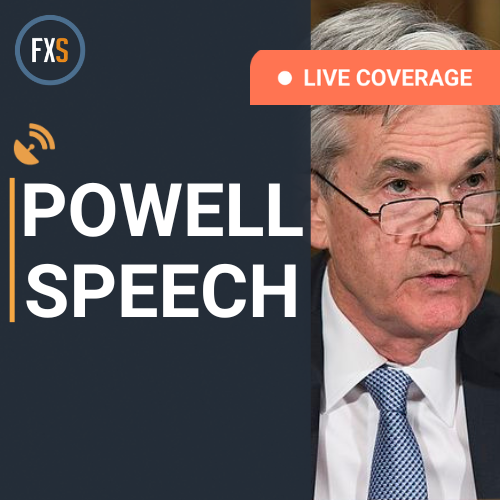
Federal Reserve Chairman Jerome Powell testifies before the House Financial Services Committee after delivering the semi-annual Monetary Policy Report.
Main takeaways from Powell’s Q&A session in the US House
“Rate cuts will depend on path of the economy.”
“Incoming data will determine when rate cuts begin.”
“We would like to have more confidence on inflation; we have some confidence but want more.”
“Let’s see a little bit more data so we can become confident.”
“Strength of economy and labor market means we can approach that carefully, thoughtfully.”
“Pandemic may have changed in a sustained way how we target inflation.”
“We are seeing continued solid growth, which should continue.”
“No reason to think the economy is in or faces significant near-term risk of recession.”
“I don’t think possibility of recession is elevated right now.”
“So far we have economy growing at solid pace, labor market still tight and strong.”
“Inflation has come down sharply.”
“These are very attractive conditions we want to continue.”
“I think we can achieve a soft landing.”
“We are using our tools to keep a strong labor market and strong growth while making progress on inflation.”
“We are on a good path so far in being able to get there.”
“We are making sure banks with commercial real estate sector exposure can manage any losses.”
“This fallout will last over next several years.”
“Our Fed supervisors are engaged with small and medium-sized banks on their exposure risks.”
“Immigration and labor force participation both contributed to strong economic growth we had last year.”
“Silicon Valley Bank’s failure was due to a too-concentrated funding structure.”
“We are not climate change policymakers.”
“We are starting very carefully with large institutions on their climate exposure; not for imposing it on small banks.”
“Compensation incentives were not a main driver of Silicon Valley Bank’s failure.”
“Climate change is real and poses risks over the longer term.”
Highlights from Powell’s prepared statement
“It will likely be appropriate to begin dialing back policy restraint at some point this year.”
“Policy rate likely at its peak for this cycle.”
“The Economic outlook is uncertain; ongoing progress to 2% inflation is not assured.”
“We will carefully assess incoming data, evolving outlook, balance of risks.”
“Risks to both cutting rates too early and too fast as well as too late or too little.”
“The labor market remains relatively tight.”
“Fed’s restrictive stance is putting downward pressure on economic activity and inflation.”
“Labor demand still exceeds supply; nominal wage growth has been easing.”
“Risks to achieving dual goals moving into better balance.”
“While inflation is still above 2%, it has eased substantially.”
“The economy has made considerable progress over past year on dual mandate.”
This section below was published as a preview of Federal Reserve Chairman Jerome Powell’s testimony at 12:00 GMT.
- Jerome Powell testimony in the US Congress will be a top-tier market moving event.
- New clues on the Federal Reserve interest rate path are awaited.
- US Dollar, stock markets and other asset classes could see big swings on Fed Chair words.
Jerome Powell, Chairman of the Federal Reserve System, will testify on March 6 in the US Congress, before the Senate Committe on Banking, Housing and Urban Affairs. The hearing, entitled as “The Semi-Annual Monetary Policy Report to the Congress”, will start at 15:00 GMT (10:00 US Eastern Standard Time), and it will have the full attention of all financial market players.
Jerome Powell is expected to address the main takeaways of the semi-annual Federal Reserve Monetary Policy Report, published last Friday. In that report, the Fed mentioned that it remains inappropriate to reduce the target range until policymakers have greater confidence inflation will move sustainably toward 2%, adding that they remain attentive to inflation risks. The publication also reiterated that risks to achieving the goals have moved into a better balance.
US representatives are expected to ask Powell about the interest rate outlook, inflation developments and a long Q&A session about the future path of interest rates and how will the Fed assess how much more monetary policy tightening is needed. Markets could see strong moves to the US Dollar, US Treasury bond yields, stock markets and all asset classes, including Gold price and all major currency pairs, during Powell’s testimony.
Fed FAQs
Monetary policy in the US is shaped by the Federal Reserve (Fed). The Fed has two mandates: to achieve price stability and foster full employment. Its primary tool to achieve these goals is by adjusting interest rates. When prices are rising too quickly and inflation is above the Fed’s 2% target, it raises interest rates, increasing borrowing costs throughout the economy. This results in a stronger US Dollar (USD) as it makes the US a more attractive place for international investors to park their money. When inflation falls below 2% or the Unemployment Rate is too high, the Fed may lower interest rates to encourage borrowing, which weighs on the Greenback.
The Federal Reserve (Fed) holds eight policy meetings a year, where the Federal Open Market Committee (FOMC) assesses economic conditions and makes monetary policy decisions. The FOMC is attended by twelve Fed officials – the seven members of the Board of Governors, the president of the Federal Reserve Bank of New York, and four of the remaining eleven regional Reserve Bank presidents, who serve one-year terms on a rotating basis.
In extreme situations, the Federal Reserve may resort to a policy named Quantitative Easing (QE). QE is the process by which the Fed substantially increases the flow of credit in a stuck financial system. It is a non-standard policy measure used during crises or when inflation is extremely low. It was the Fed’s weapon of choice during the Great Financial Crisis in 2008. It involves the Fed printing more Dollars and using them to buy high grade bonds from financial institutions. QE usually weakens the US Dollar.
Quantitative tightening (QT) is the reverse process of QE, whereby the Federal Reserve stops buying bonds from financial institutions and does not reinvest the principal from the bonds it holds maturing, to purchase new bonds. It is usually positive for the value of the US Dollar.
About Jerome Powell (via Federalreserve.gov)
“Jerome H. Powell first took office as Chair of the Board of Governors of the Federal Reserve System on February 5, 2018, for a four-year term. He was reappointed to the office and sworn in for a second four-year term on May 23, 2022. Mr. Powell also serves as Chairman of the Federal Open Market Committee, the System’s principal monetary policymaking body. Mr. Powell has served as a member of the Board of Governors since taking office on May 25, 2012, to fill an unexpired term. He was reappointed to the Board and sworn in on June 16, 2014, for a term ending January 31, 2028.”
US Dollar FAQs
The US Dollar (USD) is the official currency of the United States of America, and the ‘de facto’ currency of a significant number of other countries where it is found in circulation alongside local notes. It is the most heavily traded currency in the world, accounting for over 88% of all global foreign exchange turnover, or an average of $6.6 trillion in transactions per day, according to data from 2022. Following the second world war, the USD took over from the British Pound as the world’s reserve currency. For most of its history, the US Dollar was backed by Gold, until the Bretton Woods Agreement in 1971 when the Gold Standard went away.
The most important single factor impacting on the value of the US Dollar is monetary policy, which is shaped by the Federal Reserve (Fed). The Fed has two mandates: to achieve price stability (control inflation) and foster full employment. Its primary tool to achieve these two goals is by adjusting interest rates. When prices are rising too quickly and inflation is above the Fed’s 2% target, the Fed will raise rates, which helps the USD value. When inflation falls below 2% or the Unemployment Rate is too high, the Fed may lower interest rates, which weighs on the Greenback.
In extreme situations, the Federal Reserve can also print more Dollars and enact quantitative easing (QE). QE is the process by which the Fed substantially increases the flow of credit in a stuck financial system. It is a non-standard policy measure used when credit has dried up because banks will not lend to each other (out of the fear of counterparty default). It is a last resort when simply lowering interest rates is unlikely to achieve the necessary result. It was the Fed’s weapon of choice to combat the credit crunch that occurred during the Great Financial Crisis in 2008. It involves the Fed printing more Dollars and using them to buy US government bonds predominantly from financial institutions. QE usually leads to a weaker US Dollar.
Quantitative tightening (QT) is the reverse process whereby the Federal Reserve stops buying bonds from financial institutions and does not reinvest the principal from the bonds it holds maturing in new purchases. It is usually positive for the US Dollar.
Read the full article here