

- Dow Jones shied away from gains after PPI printed higher than expected.
- Fed Chair Powell made an appearance to soothe investor nerves after inflation print.
- US CPI inflation and Retail Sales in the barrel for Wednesday.
The Dow Jones Industrial Average (DJIA) stumbled on Tuesday, slipping back to 39,320.00 after US Producer Price Index (PPI) inflation came in higher than expected. Market sentiment recovered and dragged the DJIA back above even on the day. However, a double-header of US Consumer Price Index (CPI) inflation and Retail Sales are still loaded in the barrel for Wednesday.
US PPI inflation rose to 0.5% MoM in April, over and above the forecast 0.3% and rebounding from the previous month’s -0.1% decline (revised down from 0.2%). Core annualized PPI came in at the expected 2.4% YoY, rising from the previous period’s 2.1% which was revised down from 2.4%.
Next up will be the US’ data headliner for the week with Wednesday’s Consumer Price Index (CPI) inflation print. US CPI inflation is expected to hold steady in April at 0.4% MoM, while YoY headline CPI inflation is expected to drop slightly to 3.4% from 3.5%.
US Retail Sales are also due on Wednesday, and investors are forecasting that MoM Retail Sales growth in April will ease to 0.4% from the previous month’s 0.7%.
Dow Jones news
About half of the securities that make up the Dow Jones Industrial Average are in the red on Tuesday. Visa Inc. (V) fell -1.5%, shedding -4.2 points and trading below $276.00 per share, closely followed by Walmart Inc. (WMT) which shed -1.25% and fell below $60.00 per share.
On the high side, Goldman Sachs Group Inc. (GS) gained around 1.6%, climbing seven points to trade above $460.00 per share. Boeing Co. (BA) and Intel Corp. (INTC) are battling for second place, up around 1.3% apiece on Tuesday and trading near $181.00 and $31.00 per share, respectively.
Dow Jones technical outlook
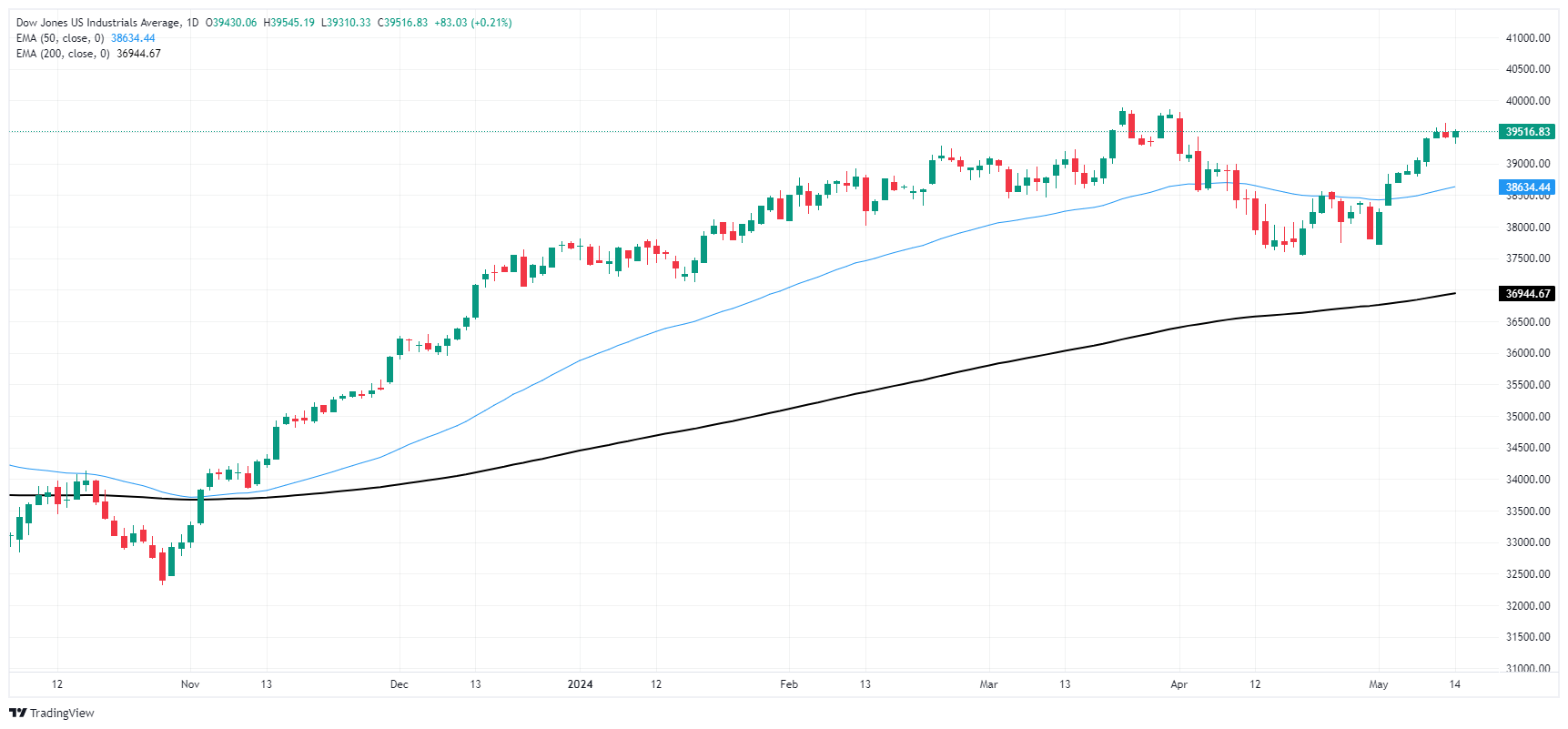
The Dow Jones Industrial Average (DJIA) is mired in intraday technical congestion near 39,400.00 on Tuesday as the major equity index grapples with twisting investor sentiment. The index dumped below 39,320.00 on reaction to inflation data, but the Dow Jones recovered back above the day’s opening bids before treading water.
Downside potential is weighing on the Dow Jones after snapping a winning streak that saw the index gain nearly 5% over seven consecutive trading days. The last bull run on daily candlesticks fell short of crossing all-time highs as the equity index nears the 40,000.00 major handle.
Dow Jones five minute chart
Dow Jones daily chart![]()
Inflation FAQs
Inflation measures the rise in the price of a representative basket of goods and services. Headline inflation is usually expressed as a percentage change on a month-on-month (MoM) and year-on-year (YoY) basis. Core inflation excludes more volatile elements such as food and fuel which can fluctuate because of geopolitical and seasonal factors. Core inflation is the figure economists focus on and is the level targeted by central banks, which are mandated to keep inflation at a manageable level, usually around 2%.
The Consumer Price Index (CPI) measures the change in prices of a basket of goods and services over a period of time. It is usually expressed as a percentage change on a month-on-month (MoM) and year-on-year (YoY) basis. Core CPI is the figure targeted by central banks as it excludes volatile food and fuel inputs. When Core CPI rises above 2% it usually results in higher interest rates and vice versa when it falls below 2%. Since higher interest rates are positive for a currency, higher inflation usually results in a stronger currency. The opposite is true when inflation falls.
Although it may seem counter-intuitive, high inflation in a country pushes up the value of its currency and vice versa for lower inflation. This is because the central bank will normally raise interest rates to combat the higher inflation, which attract more global capital inflows from investors looking for a lucrative place to park their money.
Formerly, Gold was the asset investors turned to in times of high inflation because it preserved its value, and whilst investors will often still buy Gold for its safe-haven properties in times of extreme market turmoil, this is not the case most of the time. This is because when inflation is high, central banks will put up interest rates to combat it. Higher interest rates are negative for Gold because they increase the opportunity-cost of holding Gold vis-a-vis an interest-bearing asset or placing the money in a cash deposit account. On the flipside, lower inflation tends to be positive for Gold as it brings interest rates down, making the bright metal a more viable investment alternative.
Read the full article here