

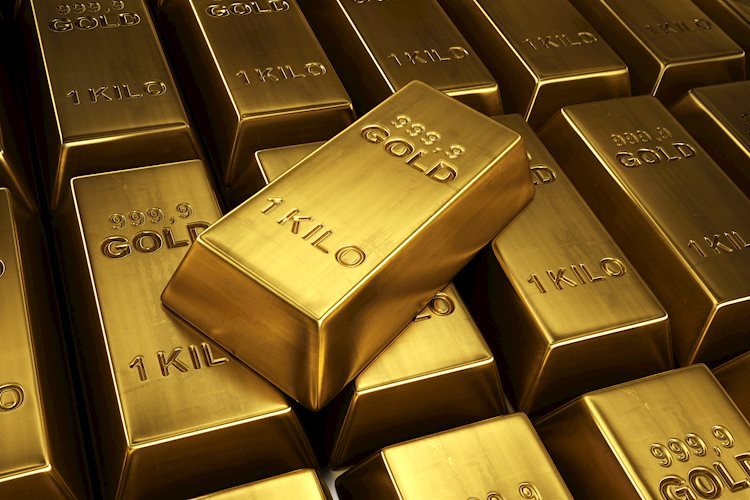
- Gold price attracts some buyers for the third straight day, albeit lacking bullish conviction.
- Fed rate cut bets keep the USD bulls on the defensive and continue to lend some support.
- The risk-on mood caps the upside as traders keenly await the release of the US CPI report.
Gold price (XAU/USD) gains some positive traction for the third successive day on Thursday and climbs back above the $2,380 level during the Asian session, though remains below the weekly top. Expectations that the US central bank will begin its rate-cutting cycle in September, bolstered by Federal Reserve (Fed) Chair Jerome Powell’s comments, continue to exert downward pressure on the USD. This, along with sustained central bank buying, macroeconomic uncertainties, and geopolitical risks, lend some support to the XAU/USD.
That said, the prevalent risk-on environment might keep a lid on any further move up for the safe-haven Gold price as traders keenly await the release of the latest consumer inflation figures from the United States (US). The key US CPI report will be looked upon for more cues about the Fed’s rate-cut path, which should drive the US Dollar (USD) demand and provide some meaningful impetus to the commodity. Nevertheless, the fundamental backdrop suggests that the path of least resistance for the XAU/USD remains to the upside.
Daily Digest Market Movers: Gold price is underpinned by Fed rate cut hopes-inspired modest USD weakness
- Firming acceptance that the Federal Reserve (Fed) will begin its rate-cutting cycle in September and lower borrowing costs again in December continues to undermine the US Dollar, lending some support to the Gold price.
- The bets were lifted by Fed Chair Jerome Powell’s comments, saying that the US remained on a path back to stable prices and that the central bank will consider neutral rates later in 2024 once inflation makes more progress.
- Powell acknowledged some cooling in the US economy, though he said that he continues to see a soft landing, boosting investors’ appetite for riskier assets, which, in turn, is seen capping the upside for the safe-haven XAU/USD.
- Powell also reiterated that the Fed remained committed to its 2% inflation target, making the release of the latest US consumer inflation more relevant and holding back traders from placing fresh bullish bets around the metal.
- The headline CPI is estimated to have risen by 0.1% in June and the yearly rate decelerated from 3.3% to 3.1%, while the Core CPI (excluding Food and Energy prices) is expected to remain sticky and come in at a 3.4% YoY rate.
- The crucial inflation data will set the stage for the Fed’s rate-cut path, which, in turn, should influence the USD price dynamics and help in determining the next leg of a directional move for the non-yielding yellow metal.
Technical Analysis: Gold price seems poised to appreciate beyond $2,400 mark and retest the all-time peak
From a technical perspective, last week’s sustained breakout through the 50-day Simple Moving Average (SMA) and a subsequent move beyond the $2,365 supply zone was seen as a fresh trigger for bullish traders. Moreover, oscillators on the daily chart have been gaining positive traction and suggest that the path of least resistance for the Gold price is to the upside. This, in turn, supports prospects for some follow-through strength towards reclaiming the $2,400 mark with some intermediate hurdle near the overnight swing high, around the $2,386-2,387 zone, and the $2,393 area, over a one-month top touched last week.
On the flip side, any corrective slide is likely to find some support near the $2,360-2,358 region ahead of the 50-day SMA, currently pegged near the $2,345 area. A convincing break below the latter has the potential to drag the Gold price to the $2,319-2,318 support en route to the $2,300 mark and the $2,285 horizontal zone. The latter now coincides with the 100-day SMA, which, if broken, decisively might shift the near-term bias in favor of bearish traders. The XAU/USD might then slide to the $2,258 intermediate support before dropping to the $2,225-2,220 area and the $2,200 round-figure mark.
Inflation FAQs
Inflation measures the rise in the price of a representative basket of goods and services. Headline inflation is usually expressed as a percentage change on a month-on-month (MoM) and year-on-year (YoY) basis. Core inflation excludes more volatile elements such as food and fuel which can fluctuate because of geopolitical and seasonal factors. Core inflation is the figure economists focus on and is the level targeted by central banks, which are mandated to keep inflation at a manageable level, usually around 2%.
The Consumer Price Index (CPI) measures the change in prices of a basket of goods and services over a period of time. It is usually expressed as a percentage change on a month-on-month (MoM) and year-on-year (YoY) basis. Core CPI is the figure targeted by central banks as it excludes volatile food and fuel inputs. When Core CPI rises above 2% it usually results in higher interest rates and vice versa when it falls below 2%. Since higher interest rates are positive for a currency, higher inflation usually results in a stronger currency. The opposite is true when inflation falls.
Although it may seem counter-intuitive, high inflation in a country pushes up the value of its currency and vice versa for lower inflation. This is because the central bank will normally raise interest rates to combat the higher inflation, which attract more global capital inflows from investors looking for a lucrative place to park their money.
Formerly, Gold was the asset investors turned to in times of high inflation because it preserved its value, and whilst investors will often still buy Gold for its safe-haven properties in times of extreme market turmoil, this is not the case most of the time. This is because when inflation is high, central banks will put up interest rates to combat it. Higher interest rates are negative for Gold because they increase the opportunity-cost of holding Gold vis-a-vis an interest-bearing asset or placing the money in a cash deposit account. On the flipside, lower inflation tends to be positive for Gold as it brings interest rates down, making the bright metal a more viable investment alternative.
Read the full article here