

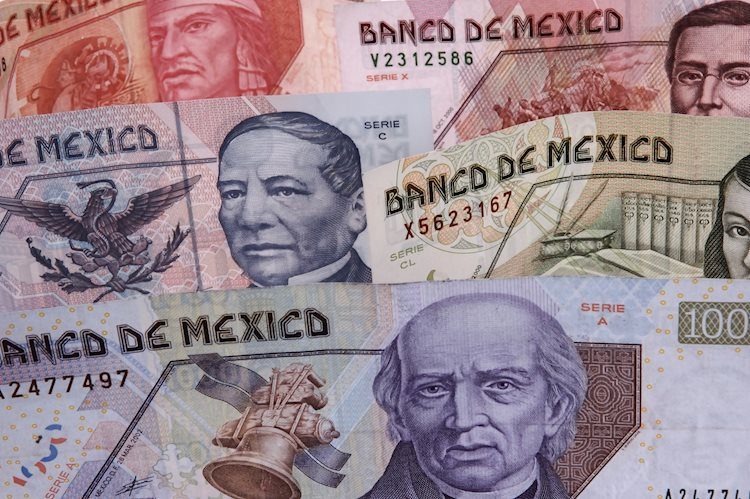
- Mexican Peso edges down 0.20% as USD/MXN rebounds from a daily low of 17.63.
- IMF lowers Mexico’s 2024 GDP forecast from 2.4% to 2.2% amid economic slowdown.
- Trump’s interview boosts market volatility; Fed officials hint at potential rate cuts.
The Mexican Peso stumbled and lost some 0.20% on Wednesday as risk appetite deteriorated. Former US President and Republican Candidate Donald Trump’s interview with Bloomberg spooked investors, and Wall Street equity indices plunged. Therefore, the USD/MXN trades at 17.70 after bouncing off daily lows of 17.63.
The economic docket in Mexico is absent, though the Bank of Mexico Deputy Governor Omar Mejia Castelazo crossed the wires, saying that although Banxico cut rates, it doesn’t mean the beginning of a cycle of interest rate cuts.
Meanwhile, the International Monetary Fund (IMF) adjusted Mexico’s Gross Domestic Product (GDP) expectations for 2024 from 2.4% to 2.2%. The revision shows Mexico’s ongoing economic slowdown driven by manufacturing contraction, observed in the first quarter of 2024, blamed on an experienced deceleration in the US economy.
The Deputy Director of the IMF Research Department, Petya Koeva Brooks, said, “We have revised the forecast for this year slightly downwards, which results from comparing it with the strong growth of last year when there was a lot of non-resident investment in construction as well as a significant expansion of manufacturing activity driven by the United States.”
In addition, Bloomberg published an interview with Donald Trump. He commented that he favors tax reductions, lower interest rates, and tariffs, including a 60% to 100% increase in China’s products and a 10% in the general rate in other countries.
Trump added that he would allow the current Fed Chairman, Jerome Powell, to finish his term, yet warned the Fed wouldn’t cut interest rates before the election.
Lately, Federal Reserve officials have crossed the wires. Richmond’s Fed President Thomas Barkin said inflation has come down over the last quarter, stating that current policy is restrictive. Nevertheless, he’s open to the idea that policy “is not as restrictive as thought.”
His colleague, Fed Governor Christopher Waller, commented that the time to cut the policy rate is approaching, adding that the most likely direction for the Fed funds rate is downwards.
Daily digest market movers: Mexican Peso depreciates on Trump’s comments
- Mexico’s economic docket will be absent during the week, resuming on July 22, when the National Statistics Agency (INEGI) reveals growth figures for the month of May. Nevertheless, Bank of Mexico (Banxico) policymakers and political developments could rock the boat.
- Mexico’s June inflation figures were higher than expected due to a rise in food prices when most economists expect Banxico to resume lowering interest rates.
- The US economic calendar featured Building Permits for June, which increased from 1.3999 million to 1.446 million, an increase of 3.4%. Further housing data showed that Housing Starts for the same period expanded 3% from 1.314 million to 1.353 million.
- US Industrial Production in June decelerated from 0.9% in May to 0.6% MoM yet exceeded estimates for a 0.3% increase.
- The CME FedWatch Tools show the chances for a quarter of a percentage rate cut to the federal funds rate in September are at 100%, capping the Greenback’s advance.
- June consumer inflation figures were lower than expected in the United States, increasing the chances that the Federal Reserve would lower borrowing costs in 2024 by at least 54 basis points, according to the December 2024 fed funds rate futures contract.
Technical analysis: Mexican Peso trips down as USD/MXN climbs above 17.70
The USD/MXN has bottomed at around the 50-day Simple Moving Average (SMA) after the pair tumbled more than 2.50% as the Mexican currency appreciated. However, buyers had stepped in, forming a floor at around 17.58-17.60.
Momentum suggests that sellers are in charge, as depicted by the Relative Strength Index (RSI) below the 50-neutral line. Buyers seem to be gathering some steam, as the RSI has cleared its previous peak.
If USD/MXN extends its gains above the July 15 high of 17.85, that would exacerbate a rally toward the psychological 18.00 figure. A breach of the latter will expose the July 5 high at 18.19, followed by the June 28 high of 18.59, allowing buyers to aim for the YTD high of 18.99.
On further weakness, if USD/MXN clears the 50-day SMA at 17.63, that would pave the way to challenge the December 5 high at 17.56, followed by the 200-day SMA at 17.27. Further losses would test the 100-day SMA at 17.21.
Banxico FAQs
The Bank of Mexico, also known as Banxico, is the country’s central bank. Its mission is to preserve the value of Mexico’s currency, the Mexican Peso (MXN), and to set the monetary policy. To this end, its main objective is to maintain low and stable inflation within target levels – at or close to its target of 3%, the midpoint in a tolerance band of between 2% and 4%.
The main tool of the Banxico to guide monetary policy is by setting interest rates. When inflation is above target, the bank will attempt to tame it by raising rates, making it more expensive for households and businesses to borrow money and thus cooling the economy. Higher interest rates are generally positive for the Mexican Peso (MXN) as they lead to higher yields, making the country a more attractive place for investors. On the contrary, lower interest rates tend to weaken MXN. The rate differential with the USD, or how the Banxico is expected to set interest rates compared with the US Federal Reserve (Fed), is a key factor.
Banxico meets eight times a year, and its monetary policy is greatly influenced by decisions of the US Federal Reserve (Fed). Therefore, the central bank’s decision-making committee usually gathers a week after the Fed. In doing so, Banxico reacts and sometimes anticipates monetary policy measures set by the Federal Reserve. For example, after the Covid-19 pandemic, before the Fed raised rates, Banxico did it first in an attempt to diminish the chances of a substantial depreciation of the Mexican Peso (MXN) and to prevent capital outflows that could destabilize the country.
Read the full article here