

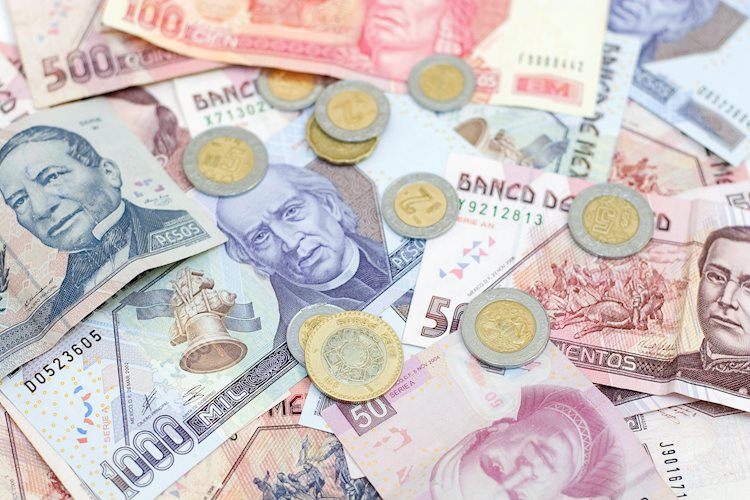
- Mexican Peso accelerates on high inflation data.
- Market participants divided on Banxico’s next move: hold or cut rates.
- US jobless claims arrive below consensus, but Peso resists USD strength.
The Mexican Peso rose in early trading in the North American session on Thursday after the Instituto Nacional de Estadistica Geografia e Informatica (INEGI) revealed that the Consumer Price Index (CPI) in July rose above estimates ahead of the Bank of Mexico’s (Banxico) monetary policy decision. The USD/MXN trades at 19.15, down 0.70%.
Mexico’s inflation rose to its highest level in more than a year, revealed INEGI, sponsoring a leg-down in the USD/MXN exotic pair as traders brace for the Banxico decision today at around 19:00 GMT. However, the core figure mostly used by policymakers as the main reference for inflation ticked lower.
Given the backdrop, market players are split between Banxico keeping rates in check, following inflation data, or opting for a cut. During the last meeting, Deputy Governor Omar Mejia Castelazo was the outlier in a 4-1 vote for maintaining rates at 11.00%. It is worth noting that Governor Victoria Rodriguez Ceja said later that rate cuts would be “on the table” in the subsequent meetings.
According to swaps, market players expect 50 basis points of easing in the next three months and 175 bps over the next 12 months.
Across the border, the number of Americans filing for unemployment benefits dipped below the consensus, bolstering the Greenback. So far, it has been up against most G7 currencies but failed to gain traction against the Mexican Peso.
Wall Street rallied as a relief that the labor market is not in a bad position. This follows last week’s Initial Jobless Claims report, followed by dismal Nonfarm Payrolls (NFP) figures.
Daily digest market movers: Mexican Peso rallies ahead of Banxico’s meeting
- Mexico’s inflation rate rose 1.05% MoM, exceeded estimates of 1.02%, and crushed June’s 0.38%. In the 12 months to July rose from 4.98% to 5.57% as foreseen.
- Core prices ticked up from 0.22% to 0.32% MoM, above economists’ projections of 0.29%. On an annual basis, however, inflation missed the 4.02% consensus but dipped to 4.05%, improving compared to June’s 4.13%.
- Societe Generale expects Banxico to hold rates unchanged due to the Mexican Peso depreciation to 20.00 Pesos per US Dollar following NFP data. They noted that this “could be counter-productive to restoring stability and should be delayed.”
- On Friday, Mexico’s Industrial Production is expected to dip, which could put Banxico at a crossroads as headline inflation rises, while the economy stagnates.
- US Initial Jobless Claims for the week ending August 3 dipped from 250K to 233K, below forecasts of 240K. Continuing Claims through July 27 jumped from 1,869K to 1,875K, exceeding the forecast of 1870K.
- Banxico’s decision should influence the USD/MXN and the Fed. The CME FedWatch Tool shows the odds of a 50-basis-point interest rate cut by the Fed at the September meeting at 57.5%, down from 63.5% a day ago.
Technical analysis: Mexican Peso dives as USD/MXN hovers around 19.10
The USD/MXN drops to four-day lows of 19.08 as traders begin to price in Banxico keeping rates unchanged, clearing key support levels as the pair accelerated to the 19.00 psychological mark. Momentum remains in favor of buyers, but in the near term the Relative Strength Index (RSI) shows sellers have the upper hand.
If USD/MXN drops below 19.00, the next support would be the July 31 high at 18.94, before dropping to the August 1 low of 18.42. Once cleared, further losses await, with the 50-day Simple Moving Average (SMA) up next at 18.26.
Conversely, if USD/MXN climbs past 19.50, the next resistance would be 20.00. A decisive break will expose the YTD high at 20.22, followed by the 20.50 mark.
Banxico FAQs
The Bank of Mexico, also known as Banxico, is the country’s central bank. Its mission is to preserve the value of Mexico’s currency, the Mexican Peso (MXN), and to set the monetary policy. To this end, its main objective is to maintain low and stable inflation within target levels – at or close to its target of 3%, the midpoint in a tolerance band of between 2% and 4%.
The main tool of the Banxico to guide monetary policy is by setting interest rates. When inflation is above target, the bank will attempt to tame it by raising rates, making it more expensive for households and businesses to borrow money and thus cooling the economy. Higher interest rates are generally positive for the Mexican Peso (MXN) as they lead to higher yields, making the country a more attractive place for investors. On the contrary, lower interest rates tend to weaken MXN. The rate differential with the USD, or how the Banxico is expected to set interest rates compared with the US Federal Reserve (Fed), is a key factor.
Banxico meets eight times a year, and its monetary policy is greatly influenced by decisions of the US Federal Reserve (Fed). Therefore, the central bank’s decision-making committee usually gathers a week after the Fed. In doing so, Banxico reacts and sometimes anticipates monetary policy measures set by the Federal Reserve. For example, after the Covid-19 pandemic, before the Fed raised rates, Banxico did it first in an attempt to diminish the chances of a substantial depreciation of the Mexican Peso (MXN) and to prevent capital outflows that could destabilize the country.
Read the full article here