

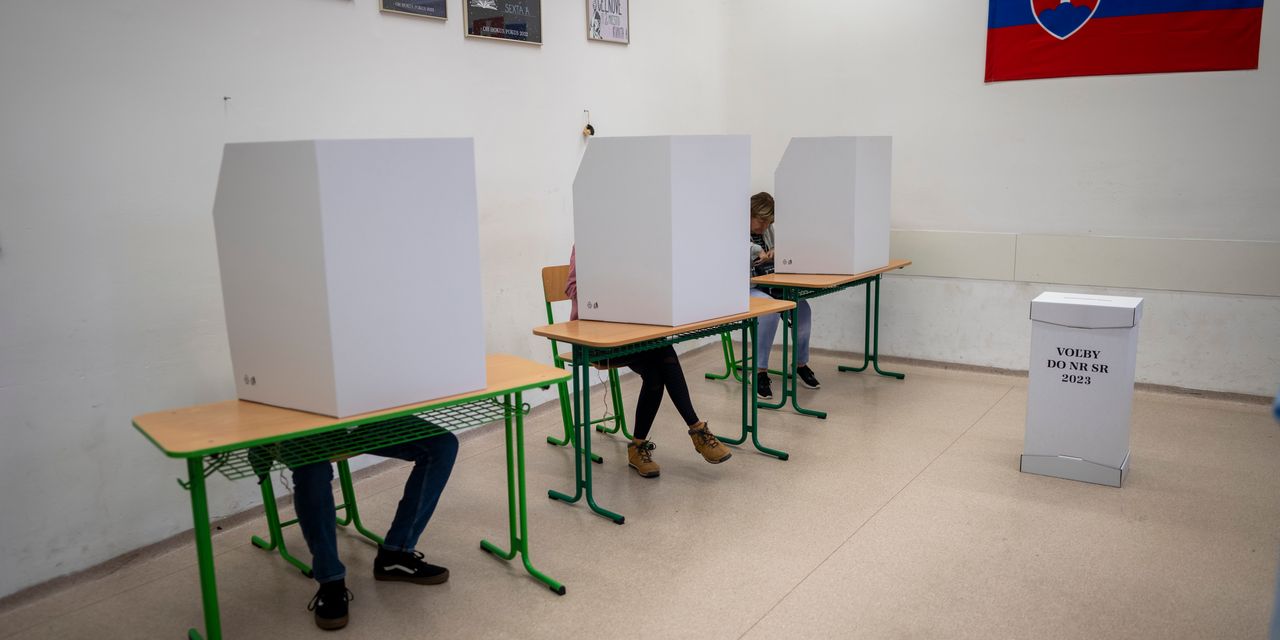
BRATISLAVA, Slovakia (AP) — A populist former prime minister who campaigned on a pro-Russian and anti-American message looked to be heading for victory in early parliamentary elections in Slovakia, according to preliminary results early Sunday.
With results from almost 88% of about 6,000 polling stations counted by the Slovak Statistics Office, former Prime Minister Robert Fico and his Smer, or Direction, party led with 23.7 % of the vote.
A liberal, pro-West newcomer, the Progressive Slovakia party, was a distant second with 15.6% of the votes cast Saturday.
“ Michal Šimečka, a 39-year-old member of the European Parliament who leads the liberal Progressive Slovakia, campaigned on a promise to continue Slovakia’s support for Ukraine. ”
With no party likely to win a majority of seats, a coalition government would need to be formed.
Exit polls, according to the BBC and others, had pointed to Progressive Slovakia emerging as the leading vote getter.
The left-wing Hlas, or Voice, party, led by Fico’s former deputy in Smer, Peter Pellegrini, was in third with 15.4%. Pellegrini parted ways with Fico after Smer, nominally a center-left formation, lost the previous election in 2020, but their possible reunion would boost Fico’s chances to form a government.
“It’s important for me that the new coalition would be formed by such parties that can agree on the priorities for Slovakia and ensure stability and calm,” Pellegrini said after voting in Bratislava.
Context: Slovak elections seen as key test that could usher pro-Russia former prime minister back to power
The populist Ordinary People group was in fourth, and the conservative Christian Democrats were in fifth.
Two parties close to the 5% threshold needed for representation in the 150-seat National Council could be potential coalition partners for Fico: the ultranationalist Slovak National Party, an openly pro-Russian group, and the Republic movement, a far-right group led by former members of the openly neo-Nazi People’s Party Our Slovakia.
The pro-business Freedom and Solidarity party also could get seats.
Final results were expected to be announced later Sunday.
The election was a test for the small eastern European country’s support for neighboring Ukraine in its war with Russia, and a win by Fico could strain a fragile unity in the European Union and NATO.
Fico, 59, vowed to withdraw Slovakia’s military support for Ukraine in Russia’s war if his attempt to return to power succeeded.
“ Fico, who served as prime minister from 2006 to 2010 and again from 2012 to 2018, opposes EU sanctions on Russia, wants to bar Ukraine from NATO membership and has echoed Russian President Vladimir Putin’s incongruous claim that under its current government Ukraine is a Nazi state. ”
Michal Šimečka, a 39-year-old member of the European Parliament who leads the liberal Progressive Slovakia, campaigned on a promise to continue Slovakia’s support for Ukraine.
Fico, who served as prime minister from 2006 to 2010 and again from 2012 to 2018, opposes EU sanctions on Russia, questions whether Ukraine can force out the invading Russian troops and wants to block Ukraine from joining NATO.
He proposes that instead of sending arms to Kyiv, the EU and the U.S. should use their influence to force Russia and Ukraine to strike a compromise peace deal. He has repeated Russian President Vladimir Putin’s unsupported claim that the Ukrainian government runs a Nazi state.
Fico also campaigned against immigration and LGBTQ+ rights and threatened to dismiss investigators from the National Criminal Agency and the special prosecutor who deal with corruption and other serious crimes.
Progressive Slovakia, which was formed in 2017, sees the country’s future as firmly tied to its existing membership in the EU and NATO.
The party also favors LGBTQ+ rights, a rarity among the major parties in a country that is a stronghold of conservative Roman Catholicism.
“Every single vote matters,” Šimečka had said Saturday.
Popular among young people, the party won the 2019 European Parliament election in Slovakia in coalition with the Together party, gaining more than 20% of the vote. But it narrowly failed to win seats in the national parliament in 2020.
MarketWatch contributed.
Read on: EU official says X — the Musk-era Twitter — is now the No. 1 disinformation source
Read the full article here