

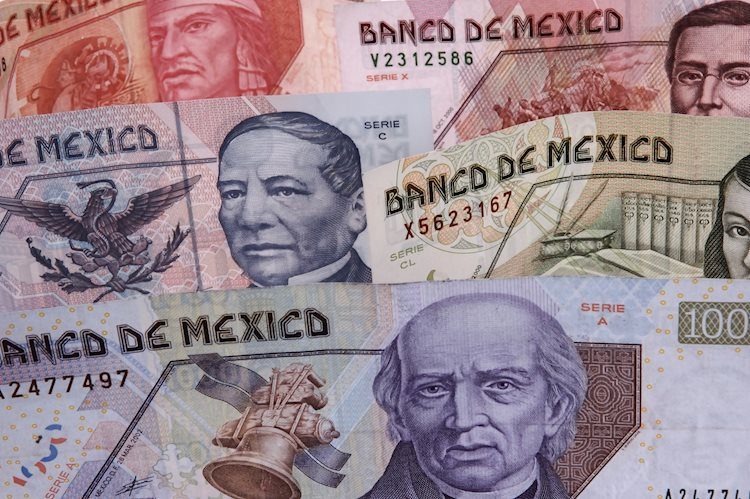
- The Mexican Peso gave back 0.6% against the US Dollar on Monday.
- Mexico has limited representation on the economic calendar this week.
- Jackson Hole looms large in the week ahead alongside US PMI figures.
The Mexican Peso (MXN) returned six-tenths of one percent to Greenback bidders on Monday, paring back recent gains as Peso bulls took a breather. The US Dollar is broadly softer across the board to kick off the new trading week, but recent Peso-positive flows have briefly reversed direction.
Mexico has a scant release schedule on this week’s data docket, and all figures slated to print this week on the Peso side are strictly low-tier numbers. Mexican Retail Sales for the year ended in June are due on Tuesday, and are expected to contract by 1.8% YoY compared to the previous 0.3% growth.
Fortnightly headline and core Mexico inflation figures are due on Thursday. Core Inflation is forecast to tick up slightly to 0.19% from 0.18% in the first half of August, while headline Inflation is forecast to slump to 0.13% over the same period, down sharply from the previous 0.71%.
Daily digest market movers: Greenback goes belly up, but Peso flows need a breather
- Peso bidding has reversed course on Monday, paring back the MXN against the US Dollar.
- Despite a brief easing in buying pressure, the MXN is still up 6.6% against the USD as the Peso recovers from a 22-month low.
- Markets are broadly looking ahead to this week’s kick-off of the Jackson Hole Economic Symposium, where rate-cut-hungry investors will be hanging on every word from Federal Reserve (Fed) policymakers.
- Recent bets of a double cut in September have eased significantly after reaching a peak of 70% two weeks ago. According to the CME’s FedWatch Tool, rate markets are pricing in a scant one-in-five chance of a 50 bps cut on September 18.
- Overall, markets still have a 25 bps cut in September fully priced in, with three or four quarter-point cuts expected by the end of the year.
Mexican Peso price forecast: Pullback leaves Peso bidders primed for another leg, but technical limits remain
The Mexican Peso’s recent recovery against the US Dollar has sent USD/MXN bids skidding toward 18.50. Still, a long-run bullish trend in the chart leaves Peso bidders grappling with an accelerating pattern of higher lows as the Greenback trends higher against the MXN.
Price action is poised for a continued decline into the 50-day Exponential Moving Average (EMA) at 18.35, with a hard floor priced in at the rising trendline drawn from April’s lows near 16.25.
USD/MXN daily chart
Fed FAQs
Monetary policy in the US is shaped by the Federal Reserve (Fed). The Fed has two mandates: to achieve price stability and foster full employment. Its primary tool to achieve these goals is by adjusting interest rates. When prices are rising too quickly and inflation is above the Fed’s 2% target, it raises interest rates, increasing borrowing costs throughout the economy. This results in a stronger US Dollar (USD) as it makes the US a more attractive place for international investors to park their money. When inflation falls below 2% or the Unemployment Rate is too high, the Fed may lower interest rates to encourage borrowing, which weighs on the Greenback.
The Federal Reserve (Fed) holds eight policy meetings a year, where the Federal Open Market Committee (FOMC) assesses economic conditions and makes monetary policy decisions. The FOMC is attended by twelve Fed officials – the seven members of the Board of Governors, the president of the Federal Reserve Bank of New York, and four of the remaining eleven regional Reserve Bank presidents, who serve one-year terms on a rotating basis.
In extreme situations, the Federal Reserve may resort to a policy named Quantitative Easing (QE). QE is the process by which the Fed substantially increases the flow of credit in a stuck financial system. It is a non-standard policy measure used during crises or when inflation is extremely low. It was the Fed’s weapon of choice during the Great Financial Crisis in 2008. It involves the Fed printing more Dollars and using them to buy high grade bonds from financial institutions. QE usually weakens the US Dollar.
Quantitative tightening (QT) is the reverse process of QE, whereby the Federal Reserve stops buying bonds from financial institutions and does not reinvest the principal from the bonds it holds maturing, to purchase new bonds. It is usually positive for the value of the US Dollar.
Read the full article here