

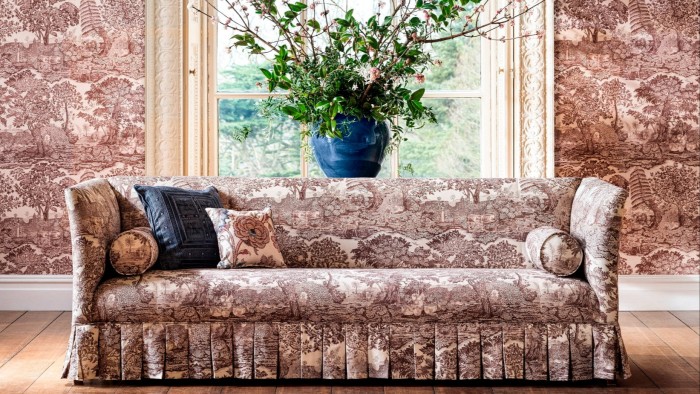
“It almost feels like archiving the gardens at Highgrove with fabric,” says Claire Vallis, design director of heritage brand Sanderson. For the past 15 months, her team has been creating a new collection of fabrics and wallpapers based on the private Gloucestershire garden of King Charles III. “At times it’s been crazy; we’ve been putting design mood boards together and then sending them to get his approval.” The King’s final response? “He said he couldn’t believe what we’d done to represent the garden.”
When the King bought the handsome Georgian property in the summer of 1980, its garden was an unprepossessing blank canvas. An avenue of stubby golden yews ran west of the house, trees dotted the parkland and the original kitchen garden was overgrown and neglected. The one defining feature was a majestic Cedar of Lebanon tree.
Forty-five years later, the garden is a tour de force: fully mature, although never standing still. The original yews are meticulously clipped into 24 whimsical topiary shapes, swaths of fragrant thyme at their base, while wildflower meadows wrap around the house. There are intimate areas such as the formal Sundial Garden, with its low box hedges, and the exuberant Cottage Garden; deeper into the estate, more experimental gardens include the atmospheric Stumpery, a mass of mosses and magnolias, spring-flowering snowdrops and hellebores. This is a garden that is fully grounded in nature, craft and collaboration — and a magnet for tens of thousands of visitors each year.
The new collection, Highgrove by Sanderson, took the King’s favourite features and plants (ferns, hostas and delphiniums among them) as a starting point, but from there the design team were given free rein to take inspiration directly from the gardens. The fabrics tell their story. The Wildflower Meadow, for instance, is reimagined with meandering pathways abstracted into cloudlike waves, interspersed with fritillaries and wild blooms. Available as a cotton-linen mix and a brocade woven in Italy, the Wildflower Meadow design incorporates the King’s favourite acer trees as well as roaming pheasants, sheep and deer — and the estate’s distinctive carved oak beehives, which were designed by Anthony Paine and commissioned by Fortnum & Mason as a 70th birthday gift in 2018.
For head gardener Gráinne Ring, who first joined Highgrove in 2016 before leaving in 2021 to study and returning last year, the gardens are a marker of the King’s commitment to ecological concerns. “His Majesty is an environmentalist and at Highgrove he can contribute to that debate himself,” she says. “He’s been at the forefront of it for a long time; everyone is doing organic now but it was very different in the 1980s when he started.”
All the compost is created on-site except for the bracken used as a mulch on the acid-beds, which is brought in from Cumbria and Hampshire. No chemicals are used; the King has a sanguine approach to pests. “In an organic setting you have to accept a certain level of damage as we are working with nature,” says Ring. “We keep the plants as healthy as possible so that they can recover.” But the garden is as prone as any other to common problems including box blight or box caterpillars; organic sprays, pheromone traps and using disease-resistant varieties have so far helped avoid any catastrophic damage.
The biodiverse grassland of the meadow now has 70 plant species and seven native orchids, including the green-winged orchid. “It’s a threatened species but we have it here,” says Ring. “It’s amazing to think about how it’s been built up and how the King has followed through on what he’s talked about. He’s done it himself.”
At the same time, when the then Prince of Wales first arrived at Highgrove, a 31-year-old gardening novice, he was helped by a string of mentors and collaborators — including garden designers Mollie Salisbury and Rosemary Varey, naturalist Dame Miriam Rothschild and art historian Sir Roy Strong. And collaboration continues; the garden team creates briefs for new planting but the King will make the final selection, adding long-held favourites such as “The Generous Gardener” or “Lady Waterlow” roses. They’ve recently boosted the Stumpery with new tree ferns, added a new rose garden and renovated the Thyme Walk which was originally planted in the 1990s by the King.
Highgrove is a highly personal garden, decorated with objects that have been collected on travels or gifted by family, friends or organisations. Its eclecticism is keenly felt in the Sanderson collection too. The intricately carved gate that greets visitors was originally found in Jodhpur and is named after Queen Camilla’s late brother, Mark Shand; it has provided the starting point for a richly embroidered fabric called Shand Gate, made with a newly developed technique at an Indian mill. Embroidery is coated with ink and then blown off the surface, leaving puddles of dye that evoke the door’s tactile carvings.
There are further references to handwoven west African Ewe Kente cloth, to ikat fabrics and to embroidered suzanis from Uzbekistan. “You see a lot of suzanis in British country homes and the King collects them,” says Vallis. The Sanderson take features stylised floral motifs with dense embroideries, and is named after the Queen’s sister Annabel Eliot, an interior designer and frequent collaborator on the King’s properties. “British decorating has always been very layered, and that eclecticism was something we were keen to explore because the garden has lots of influences from around the world,” adds Vallis.
The ultimate endorsement comes from the royal household. “They are using the collection so that’s fantastic,” says Vallis, who has already been working on special versions with unique scales or colour palettes.
Each new design also pulls inspiration from drawings and textile fragments in Sanderson’s vast archive at Voysey House in Chiswick, London, which contains more than 70,000 documents. An early 20th-century chintz, for instance, has been reworked to incorporate the King’s much-loved delphiniums (he is patron of The Delphinium Society and the towering blue flowers are a significant feature of Highgrove Gardens). A toile de Jouy — something the Sanderson team were keen to include for its classicism but also its storytelling potential — began with an 18th-century print. The original design has been redrawn to incorporate Highgrove’s swagged yew hedging, topiary and terracotta pots; the hedge that encloses the Sundial Garden close to the house is also included, a bust of the King nestled within.
The toile was produced at the historic fabric printer Standfast & Barracks, established in 1924 in Lancaster. Moreover, this is a collection that showcases heritage craft in every piece of cloth or paper. “Each artist working on a design is handpicked for a particular skill,” says Vallis. “We either draw in-house or we go to a specific artist that we know has maybe a more botanical hand or someone that’s more painterly.”
An archive Walter Crane design from 1902 has been repainted to incorporate the fruits and blossom of the tunnel of espalier apple trees in the kitchen garden at Highgrove. The wallpaper is surface-printed in Sanderson’s factory on machines that are 100 years old. “There’s not many of them left in the country now and it requires real skill to keep those machines going,” says Vallis. “There have been stories in the press about how expensive wallpapers are but it’s a craft. We’ve got several generations working in our factories. As a country, we need to value it more. If we don’t, we will lose it.”
The King is on board. Ten per cent of net sales from the collection will go to The King’s Foundation. The charity supports myriad crafts with courses and workshops across the country (and beyond), on subjects ranging from farming and rural skills to fine furniture making. At the entrance to Highgrove, a cluster of buildings has been transformed into studios and workshops for some of the Foundation’s students. The gardens also have a role to play in this work; since opening to tours in 1996, they have raised millions for the King’s charities.
At Highgrove, “there are always new projects”, says Ring, who has been overseeing the planting of imposing topiary beds made with specimens gifted to the King for his 70th birthday. A new topiary tour promises to be a highlight for visitors this season and, of course, there’s a fabric to go with that too. Topiary View, a hemp-based cloth, is a whimsical take on the vista from the west side of the house, so that we can all gaze on the King’s own views over his topiary lawns this summer.
Find out about our latest stories first — follow @ft_houseandhome on Instagram
Read the full article here