

Unlock the Editor’s Digest for free
Roula Khalaf, Editor of the FT, selects her favourite stories in this weekly newsletter.
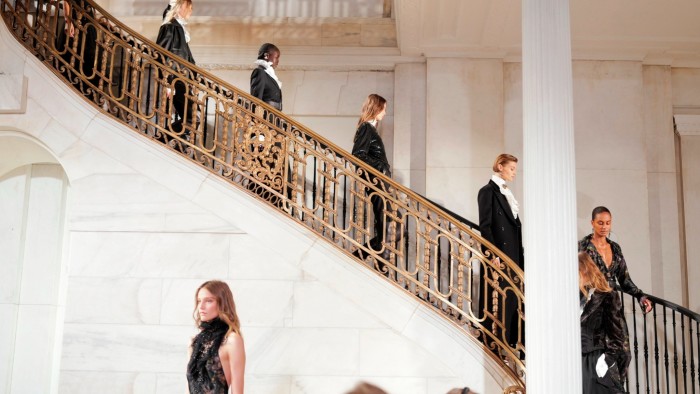
On Thursday, Ralph Lauren unveiled its autumn 2025 collection at the Jack Shainman Gallery in downtown New York. The Clock Tower, a Beaux Arts space with Corinthian columns and marble walls, provided a fitting backdrop for a show titled “Modern Romantics,” watched by Hollywood heavyweights Michelle Williams, Naomi Watts and Anne Hathaway. The collection balanced classic Ralph Lauren Americana — think leather jodhpur trousers and velvet prairie dresses in autumnal tones — with light, romantic flourishes like lace-crocheted gowns and jabot blouses.
Aesthetically, it was firmly on brand: a display of optimism grounded in Lauren’s own quintessentially American rags-to-riches rise from a boy in the working-class section of the Bronx to a self-made billionaire. But at a time in the US when federal programmes designed to level the playing field in education and employment are under siege, it’s hard to imagine a story like his unfolding today. Maybe that’s the point: to dream, to believe in what’s possible in a world that could exist.
But as President Donald Trump’s tariff policy pivots continue to throw global markets into flux, the real world could become a nightmare for many fashion brands. Both LVMH and Hermès missed analysts’ estimates in the first-quarter results they posted this week, with the latter pledging to increase prices on its US goods to offset the 10 per cent tariffs the Trump administration is now levying on European imports. Shares in Ralph Lauren have slid 6 per cent in the last month as investors weigh the impact of economic uncertainty on discretionary spending.
We remain “positively paranoid,” says Patrice Louvet, the chief executive and president of Ralph Lauren. The advantage he sees in the business is the clarity of its purpose — a familiar identity that its customers have been buying into for half a decade. That’s the old-money vision of American elegance that sells a breadth of products from Polo bear knit sweaters to a filet mignon at one of its Polo Bars.
At 85, Ralph Lauren still serves as the company’s chief creative officer. “At a time of uncertainty, consumers will tend to gravitate to friends they know, products they trust,” says Louvet. “Ralph [Lauren] and his team have done a wonderful job staying very clear on who we are, and consistent, yet keeping it fresh at the same time. And that’s the balance that we need to strike.”
In a moody, saturated colour palette, a feminine Edwardian blouse was toughened with a distressed leather jacket, a masculine double-breasted suit cinched at the waist, and a tailored coat layered over a cotton top with flouncy cuffs worn by South Sudanese-Australian model Adut Akech. But perhaps the blend of classic and modern was best exemplified by what Hathaway wore off the runway: a tan trenchcoat paired with crystal-embellished ripped jeans.
But to stay “fresh” even in turbulent times means the business needs to evolve too. “We’ve got a very strong men’s business,” says Louvet. “The women’s business is less than a third of the company. So it points to a massive opportunity.”
The lifeblood of any fashion company is attracting new audiences — and Lauren is doing that well by showing up at major sports moments such as the US Open and partnering with influencers who resonate with younger audiences, like @izzipoopi, who sat front row. Last month, it launched a virtual world on Roblox, a gaming platform popular with Gen Z and Gen Alpha. And in April, it introduced a dedicated Polo Women’s shop on Douyin, China’s leading short-form video app known for driving real-time purchases among digitally savvy Gen Z consumers.
“This company has been around for 58 years because it’s been able to renew its customer base,” says Louvet. “It’s not just one thing — it’s about targeting their interests, where they shop, where they engage with brands, and using a portfolio of activities to connect in ways that resonate.”
Well, in life and in business, if there’s hope, it lies with the kids.
Follow us on Instagram and sign up for Fashion Matters, your weekly newsletter about the fashion industry
Read the full article here