

In early February I was coming back from a lovely sunny break in Marrakech and had to attend a dinner, immediately before the increasingly successful Wine Paris trade fair, to accept an award on behalf of my Australian wine writer colleague James Halliday.
Not surprisingly, there are multiple flights from Marrakech to Paris, so it seemed sensible to take one of them and then the train back to London. To ensure I was on time for the Sunday night dinner, I was asked to fly in on Saturday afternoon and so had that evening and all day Sunday to kill.
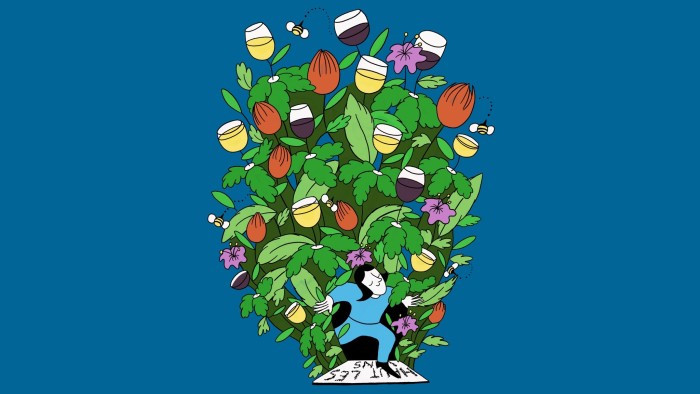
Of course I considered spending Sunday at the Louvre or the Musée d’Orsay, but then my friend Mark Williamson of Willi’s Wine Bar told me he was planning to attend a really good wine tasting with the splendid name of Haut Les Vins (“Long live wine!”), so I joined him instead.
I’d spent Saturday evening with friends in Juveniles, a wine bar around the corner from Willi’s, founded by Mark’s ex-business partner Tim Johnston, so I’m afraid there was a certain Anglo-wine theme to my stay in the French capital. I really did mean to try to get into the restored Notre-Dame, having failed to penetrate the crowds on a short day trip to Paris in early January, but when I woke up on Sunday morning it was cold and rainy. And my bed was extremely comfortable.
I’d never consciously heard of Haut Les Vins, but when I examined my inbox I realised that, since 2018, I had been invited to their tastings, held on the eve of the major European wine trade fairs in Düsseldorf and now Paris. The initiative was born in 2007 “from the strong connections [formed] between fellow producers when travelling with the importers we share in various countries”, according to its founder Laurence Texier. She’s the wife and mother respectively of wine producers Eric and Martin Texier. The location of the Texiers’ vineyards provides a clue to the genesis of these wine tastings.
The Texiers make distinctive, artisanal wines in a sort of no man’s land of the Rhône Valley between Valence and Montélimar, so are allowed no appellation more precise than Côtes du Rhône, one of the most extensive appellations in France. Creating a reputation for their wines therefore has not been easy. Like the other vignerons showing their wines that Sunday, they believe passionately (forgive me for this apt but overused word) in wines driven by terroir.
According to the Haut Les Vins manifesto, which complains about the standardisation of wines, the products they showcase share the goal of “a return to more nuance and sensitivity”, and “remain closer to the natural character of wine by rejecting the systematic use of techniques championed by agronomy and modern oenology”. All these vignerons are relatively small-scale family affairs — typically practising organic, biodynamic or regenerative viticulture and minimal intervention in the cellar — so they can undoubtedly make more noise by joining together rather than by acting alone.
They are not helped by the fact that France has no effective national distribution system for wine, so an event on the eve of a trade fair is ideal for meeting a maximum number of potential customers rather than depending on them to visit their domains. But I was intrigued to see from the list of exhibitors sent to me in advance that this was not an all-French showing. There were wine producers from Germany, Austria, Spain, Hungary, Italy, Portugal, Slovenia and Switzerland. The great majority of them, however, had come from all over France (but not the fancy appellations, unless you count the lone champagne Tarlant). They were supplemented by a Norman cider and calvados producer and one cognac distiller, Fanny Fougerat.
Curious, I trooped along to the Maison des Métallos art space in — where else? — the 11th arrondissement, the Shoreditch of Paris, and was struck by the bonhomie evident. The exhibitors are deliberately mixed up to promote as much useful discussion between them as possible, which is not so helpful for visitors trying to work their way through the tasting booklet that profiles every enterprise. It doesn’t, however, list the wines on show, presumably to allow producers to choose at the last minute which bottles to bring. A Mexican food truck had thoughtfully been provided just outside to keep exhibitors by their tables for as long as a groaning stomach would allow.
Looking down the list of roughly 60 vignerons, I realised I knew only about 17 of them, so set about educating myself. There was not an industrial-tasting wine among them. And I did learn a great deal, although many of the exhibitors brought so many wines that it was impossible to taste them all. What I did notice was how many inventive, difficult-to-remember names the wines had, and how many wines were labelled not with an appellation, nor as an IGP, the less demanding geographical denomination, but the simple Vin de France, which allows producers even more freedom.
One problem was that it was the most recent vintages of these wines that were shown in Paris, and far too few of them are available yet in the UK.
One of the most impressive ranges of wines was from a producer well outside France, Vino Gross of Slovenia represented by Maria and Michael Gross, who, according to the profile they submitted for the catalogue, are trying to teach their young children “a conscious and open approach to their environment”.
But I mainly learnt a great deal about some of the lesser-known wine regions of France. Yann de Agostini of Domaine du Petit Août came to Paris from the high plateau of the Hautes-Alpes around the town of Gap and told me there are now 11 vignerons growing vines there, at up to 700m elevation. He began in 2009 and was certified organic by 2013. His wine names are particularly creative (Le Poids de Superflu, for instance), but I especially appreciated his reds based on the very local grape Mollard.
Camille and Thomas Fort of Domaine de Mouscaillo in Limoux had come from the far south-west, and showed me yet again how good the Pinot Noir grown in these Pyrenean foothills can be.
Producers from south-west France were especially interesting, and included a couple trying to make new-wave wines in Bordeaux. I was also struck by Marc and Thibaut Penavayre from Domaine Plaisance Penavayre in the little Fronton appellation north of Toulouse. According to them, it was “dying five years ago”, but now there’s a new dynamism. They are campaigning to get a special new appellation for Fronton Blanc made from their local grape Bouysselet.
Fortunately, I did very much like the wines of Eric Texier, husband of the Haut Les Vins organiser. He reported that the influential Perrin family from the southern Rhône (Ch de Beaucastel in Châteauneuf-du-Pape, Miraval Provençal rosé with Brad Pitt etc) have been buying extensively in his area. “So Brézème will presumably have its own appellation soon. It took me 10 years to do what the Perrins have done in one,” he observed, ruefully. Hollywood connections clearly help, even in the wilds of the Rhône valley.
Find out about our latest stories first — follow FT Weekend Magazine on X and FT Weekend on Instagram
Read the full article here