

Stay informed with free updates
Simply sign up to the Film myFT Digest — delivered directly to your inbox.
What is the best way to experience Pink Floyd: Live at Pompeii? “It’s the kind of film,” David Gilmour once said of his band’s 1972 concert movie, “that they should show just once on late night television.”
The sight of the Floyd playing in Pompeii’s empty amphitheatre, superimposed by images of Roman statues and friezes, and — shudder — the petrified bodies of the fallen after Vesuvius’s eruption in 79AD, is a head trip, with a side-helping of Spinal Tap. After a muddled release, it became a staple of post-midnight cinema screenings, attended by wide-eyed, or dozing, viewers who were powered (or poleaxed) by more intoxicating fare than buckets of popcorn and vats of cola.
It has now been scrubbed up for the age of widescreen televisions and streaming platforms under the title Pink Floyd at Pompeii — MCMLXXII, the print given a crisp digital revamp by Lana Topham. Meanwhile, Steven Wilson of the band Porcupine Tree, a modern keeper of the progressive rock flame, has done a new audio mix for the soundtrack, which will be released as a standalone album. Debuted at the BFI’s Imax cinema in London prior to a brief theatrical run, the restored film looks and sounds magnificent.
More by luck than design, it shows Pink Floyd at a hinge moment. The idea to have them perform in Pompeii’s deserted amphitheatre in October 1971 came from the film’s director, Adrian Maben. He wanted to make an anti-concert film, without cutaways to ecstatic fans and the usual sense of second-hand spectacle. The style is old-school art house.
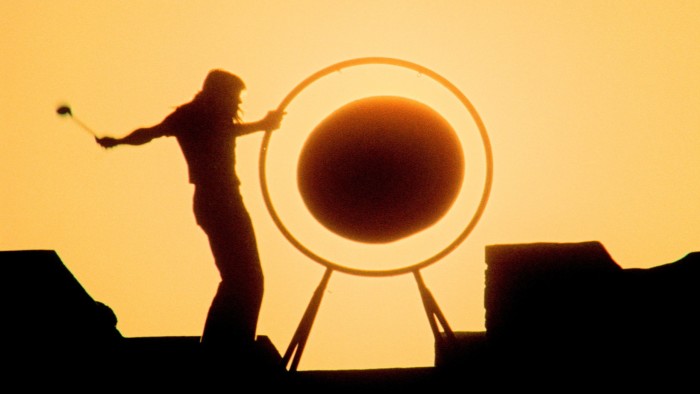
A gong is ceremoniously placed in the amphitheatre’s dusty bowl like Chekhov’s gun. The camera pans black loudspeaker stacks as though in the presence of the towering monolith from 2001: A Space Odyssey. The first number is the sublime space-rocker “Echoes”, from the then soon-to-be released Meddle. According to unsubstantiated Floyd lore, the song was designed to match the final sequence of Kubrick’s masterpiece.
A bone-bleaching sun beats down. Gilmour and Richard Wright are initially shirtless. The gong duly goes off when it gets a ferocious pasting from a snarling Roger Waters during the band’s crazed rendition of “A Saucerful of Secrets”. Gilmour plays scorching slide guitar during “One of These Days”, while Nick Mason is a drumming powerhouse, head swivelling to monitor his bandmates. Wright is diffident, but his keyboard parts are central. The music, at the band’s insistence, was mostly performed live.
Daft shots show them walking round Vesuvius’s blasted terrain, puzzled-looking adventurers in search of the molten core of rock. Supposed night scenes in the amphitheatre were actually shot later in Paris. Abrupt switches to Abbey Road Studios, where they were working on The Dark Side of the Moon were added to pad the film out. Cue polite English banter about the food in the canteen. But we also get early run-throughs of songs such as “Brain Damage”: the only allusion to their LSD-damaged former leader Syd Barrett.
There are “a lot of things left unsaid” in the band, Wright remarks at one point. Their complex, often fraught, dynamics are largely hidden. But this fascinating mish-mash of a film captures them at a crucial juncture, moving from psych-rock trailblazers in the European underground to prog superstars in US arenas. The head-trip still works. Live rock music in an antique necropolis: wow, dig it, man — that’s some heavy archaeology.
★★★★☆
In UK cinemas from April 24
Read the full article here