

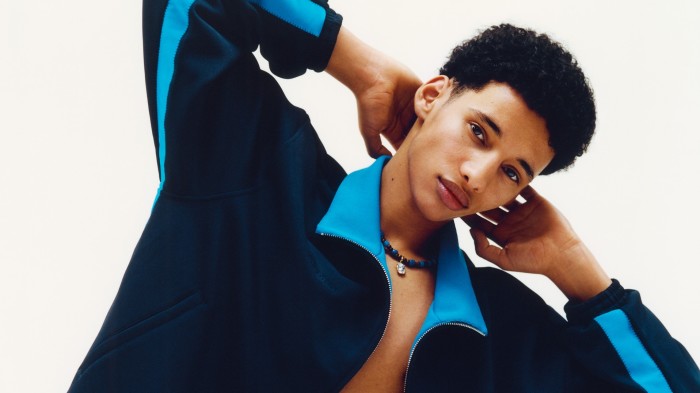
What does the most coveted shoe of the season look like? Boat shoes are making a hipster comeback. Bejewelled Mary-Janes proliferate. But those in the know will be quietly setting alerts for Wales Bonner’s latest Adidas drop on 28 May to snag a pair of toffee suede or sequin-embellished WB Karintha sneakers.
Grace Wales Bonner, the 34-year-old London-based fashion designer and curator, has been collaborating with Adidas Originals since 2020, but this is the first sneaker silhouette (slim-line, rubber-soled) that she has designed from scratch. She has a knack for starting trainer trends: in previous Adidas collections she revitalised the SL72, a crinkle-soled 1972 running shoe, and the chunky-tongued Superstar, reworking them in just-so colourways. And she is widely credited as one of the progenitors of the Samba sneaker revival, rebooting the 1950 silhouette first designed for a German football team with crochet detailing in her AW20 collection and later in glossy mock-croc leather. When Wales Bonner’s ponyskin Samba was released in November 2023, searches skyrocketed 13,227 per cent, according to data from 200 million users of the shopping platform Lyst.
The Samba is now one of Adidas’s bestselling shoes, not least because of the decision of its newish CEO Bjørn Gulden to ramp up production to millions of units when he saw things taking off in 2023. Rihanna wore them, then prime minister Rishi Sunak. The shoe helped fuel a turnaround that saw Adidas recover from a €377mn loss in the final quarter of 2023 to post an operating profit of €57mn for the final quarter of 2024. “I didn’t create the Samba, but I had a way of working with it that gave it a resonance,” says Wales Bonner.
“Resonance” is an understatement: her brand is a lightning rod for modern British style whose aesthetic manages to be both refined and radical. Wales Bonner’s shy demeanour belies her brand’s emotional openness and joyful sense of freedom. When we meet in her north-east London studio – a spa-like minimalist unit in a 19th-century former millinery – she is wary, wrapping her arms around her petite frame. She wears a navy sweater, black tuxedo trousers, leopard-print Wales Bonner loafers and a smattering of jewellery. On her ring finger is an emerald ring flanked by baguette-cut diamonds; on the opposite digit is a tiny tattoo of a cross. She speaks quietly and carefully, cautious always to draw the boundaries between her professional and personal lives. “It’s kind of private,” she smiles politely, when asked where she likes to go on holiday.
She approaches fashion with an academic’s appetite for research and an anthropologist’s understanding of symbolism; Black culture is central to her work. Wales Bonner graduated from Central Saint Martins in 2014 with the dean’s commendation for a 10,000-word dissertation, “Black on Black”, that identified a turning point in the late ’60s and early ’70s where Black creatives and thinkers took ownership of their representation. Her graduate collection, titled Afrique, set the culture-saturated, formalwear-meets-sportswear template that has since characterised her namesake brand. “I want there to be an aspect of recollection in my work – a double take,” she says of the label she founded in 2014. “I don’t intend for what I do to be nostalgic; I feel like I’m more of a conduit, finding connections across time. It’s connected to how real people create style.”
Her conscientious approach was born of a hard-working household. She is one of five siblings; her white British mother is a business consultant, her Black Jamaican father a lawyer. (They separated when Grace was about 10.) Her idea of style was largely informed by growing up in London. Specifically, it originated on the 201 bus. The route took her from Dulwich, where she lived, through Brixton and Tooting to Graveney secondary school where she was a student. “I saw so many people coming from different cultural backgrounds, wearing this mix of everything together. You can be wearing something traditional but with sneakers,” she says. “That duality, hybridity – it’s about being between two things. That’s the space I think is interesting. I’ve always resisted being locked in.”
Wales Bonner’s references are accordingly wide-ranging: she sees her research as “a spiritual and artistic practice”. Her first solo show for SS17, Ezekiel, was inspired by the court of Ethiopian emperor Haile Selassie, mixing impeccably cut tailoring with cowrie-shell and bone beading. In 2016 she won the LVMH Prize, beating more than 1,000 applicants to the €300,000 award. She’s made clothes for royals (the Duchess of Sussex wore a custom dress to present her first child to the world’s media) and been namechecked by rappers (Kendrick Lamar boasted about being “best-dressed” in his song The Hillbillies: “I ain’t even gotta fact check, all I’m wearing is Wales Bonner”).
Her scholarly ambitions extend well beyond the catwalk. She has curated exhibitions at London’s Serpentine Galleries in 2019 and at New York’s MoMA in 2023. She is currently leading a four-year research project at the University of Applied Arts in Vienna, which unites her long-held fascinations with music and archives. “It’s looking at how music and rhythm can be captured within other forms, whether that’s photography or poetry. And building a visual archive that explores the connection between sound and image.” It’s almost a surprise that she went into fashion at all, given her artistic and curatorial tendencies. “I wasn’t really doing it for an audience, or to set up a business,” she recalls. “It was just an evolution of my education.” In her placement year at Central Saint Martins she wangled an internship in New York with the influential Vogue fashion editor Camilla Nickerson through Tom Guinness, a London-based stylist who has styled collections for Wales Bonner ever since.
“She was always thoughtful and stylish, but I don’t think she was like, ‘I’m going to be a fashion designer.’ She was like, ‘I want to communicate a vision,’” Guinness recalls of fashion-student Grace. “She was into Malick Sidibé, James Baldwin, Robert Mapplethorpe. Fashion was just the place she was at. If she had been studying painting, it would have come across in the paintings.” Nickerson, a hard person to impress, was charmed from the off. “The minute Grace walked into my apartment, I understood that she was compelling and on a mission. Whip smart in her skirt, bar jacket and slippers; so chic. She was a little intimidating. But also super-inspiring.”
Today, Wales Bonner has expanded her remit from menswear to womenswear. (Women have been wearing her clothing since her debut, and she sees the collections as integrated.) “There’s a sense of formality that comes from the men’s wardrobe but I think the brand is much more expansive than that,” she says. “I like some sense of formality, but I like to disrupt that in my own way.” Its bestselling categories are knitwear and jersey, but tailoring – some of which has been made in collaboration with Savile row tailor Anderson & Sheppard since 2020 – is a growing segment. Looking ahead, she adds, “my focus is more” – she hesitates – “product-centric”.
Her team numbers between 14 and 17 people at any one time; she also operates a six-month internship programme for Black students funded by the Austrian footballer David Alaba. Wholesale accounts for 60 per cent of the business, with more than 100 stockists including Dover Street Market and Net-A-Porter, though the biggest area of growth is in DTC. The brand reports that it expects to end the financial year with 81 per cent growth compared to 2023-2024, with business revenue having more than doubled over the past three years, driven by new categories such as shoes (the Jewel Mary-Jane sneaker-slipper hybrid, £560, is a hit) and jewellery (Lewis Hamilton is a fan of her brooches, £600), the growth of womenswear and “our strategic collaborations”.
It is with Adidas, however, that she has made the biggest impression. The German corporation has been collaborating with fashion designers such as Yohji Yamamoto for more than 20 years, but Wales Bonner’s contribution has bestowed on it a new veneer of cool. “It was a natural conversation because Adidas would come up in my research. The people I was inspired by would be wearing it,” she says. Her biannual Adidas collections have included a football strip for the Jamaican national team. “What I really like is that the products, they mean something. They represent something that people connect with.”
Torben Schumacher, global general manager of Adidas Originals, acknowledges that the Wales Bonner link-up has enabled the sportswear giant to tap into “new consumer groups”. “We’ve been so impressed with her identity, the cultural insights that she has been bringing, her memory of our brand growing up. It has given us a new perspective on our archive that has resonated really well,” he says. As for the Samba: “Grace has been very influential and very important in the resurgence of the Samba. She has started a conversation with her audience and into fashion and luxury that we didn’t have before. It has led to a lot of hype and very fast sell-outs.”
Simeon Siegel, managing director and senior analyst at BMO Capital Markets, says fashion collaborations remain key for sportswear brands who are seeking to offset their performancewear prowess with cultural relevance. “The best athletic brands in the business are both fashionable and technical,” he says. The skill lies in picking the right collaborator. “Scale is often the enemy of cool. And size can too often erode authenticity. Syncing up with a small but influential community can be the greatest validation of cultural relevance. The question becomes figuring out how to grow that halo so that it can move the revenue needle without losing what made it special in the first place.”
In June, Wales Bonner will stage a fashion show in Paris to celebrate 10 years of her business. How does she feel the narrative around Black identity has shifted in that time? “Elevating the location of Blackness within culture, that was why I wanted to start the brand,” she says. “In some ways, through many different people’s contributions, I think that that initial mission to some extent has been achieved. As the business evolves, it’s about creating beautiful and soulful clothing that is precious and timeless, and building an important institution within fashion. Showing up in different spaces from film to music to art.” In 2025, she will expand on a “musical experience” event she first held in June last year at Paris’s Fête de la Musique, with a series of listening parties. She would like to open a store.
“She sees her brand not just as a fashion house but as a vessel for amplifying voices and perspectives,” says Tyler Mitchell, the American photographer and one-time Wales Bonner runway model. “Her work carries a deep, almost ancestral connection that shines through in her designs and collaborations. It’s not just about aesthetics; it’s about building a world view that’s uniquely her own.”
Perhaps the most remarkable thing about Grace Wales Bonner’s expansive world view, though, is that behind it, she remains utterly discreet. Consider these hard-won facts: she lives in north London and is an Arsenal supporter. She’s currently reading Kibogo, a novel by Scholastique Mukasonga, at the suggestion of her father, and is listening to Laraaji, the enigmatic American multi-instrumentalist. She played the trumpet at school but didn’t keep it up.
One thing you might not know about her? “She’s got an enormous, quite English sense of humour and she loves comedy,” says Guinness. “Often she’ll come back from holiday and I’ll ask what she got up to, and she’ll say she watched an old funny TV programme.” Like Blackadder? “Something like that.” Then he adds: “She’s very mindful. She doesn’t just float through life. She always has this wry smile.”
Models, Abdi Moalim at Squad, Abdallah El Farjani at Supa and Lebo Malope at Models1. Casting, Piergiorgio Del Moro and Helena Balladino at DM Casting. Hair, Naoki Komiya at Julian Watson using Redken. Make-up, Maho Moriyama. Set design, Miguel Bento at CLM. Photographer’s assistants, Willy Cuylits and Milan Rodriguez. Stylist’s assistant, Charlotte Ghesquière. Production, Sam Rhodes at Total World
Read the full article here