

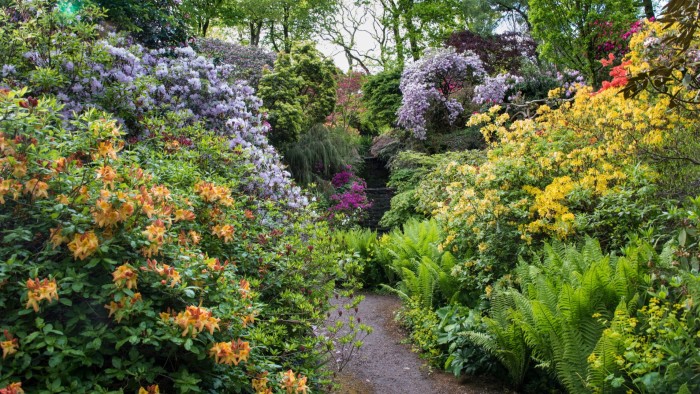
“Adversity is my ally”: I first learnt this slogan from film directors. Since then I repeat it to myself whenever weather, fire and uninvited animals do their worst to gardens in my care. There are two sides to turbulence, ones that skilled investors have recently exploited. I have just been to a big garden that exemplifies the maxim. About 35,000 visitors came to enjoy it in 2024. Its trustees are hoping to add another three and a half acres this year to the 12 that they already open to the public. So there is plenty to assess.
The Dorothy Clive Garden, privately funded, unfolds down a hillside near Market Drayton in Shropshire. It is a garden for all seasons with roses, fine autumn colour, a winter garden and a big greenhouse, but it is especially strong in magnolias, camellias, rhododendrons and azaleas. It is at one of its peaks in early May but until now I have misunderstood it. It is not an “Englishwoman’s garden”. Dorothy Clive did not design or plant it, much though she loved its setting, its violets and its many other flowers. The garden was made for her, not by her. Adversity inspired it in a way that remains inspiring.
Dorothy Clive, from Warwickshire, married Harry Clive in 1907. She happened to share his surname without being related by blood. They lived for decades in a big Staffordshire house near Willowbridge, but in the 1930s Dorothy began to suffer from Parkinson’s disease. At that time, management of the condition was rudimentary and the main treatment was to encourage sufferers to walk daily as far as they could. Dorothy’s dog used to follow her as she walked, slow and shaking, round and round the lawn that surrounded the house. The monotony disenchanted her. It also disenchanted the dog, which soon refused to join in.
Her husband, Harry, was a distinguished soldier as well as a man of many business interests. He had begun his military career as a volunteer, aged 19, and had then enlisted in the North Staffordshire infantry during the first world war. He survived and reached the rank of colonel, and continued to serve in peacetime. Distressed by his wife’s daily battle, he began a new campaign.
In April 1940, as his diary records, he entered a former gravel quarry beyond the garden and found it full of trees, brambles and undergrowth. It had steep rocky sides and many remaining piles of gravelly debris. It was also smothered in brambles, elderberries, hollies, rotting tree stumps and mountain ash trees. They had made it “impregnable”, he noted, but the Colonel, aged 60, pushed into it nonetheless and marked out 20 yards of path. “My man, John Moore,” he then wrote, “always ready and willing for a new job, skimmed it off the next day.”
During the retreat from Dunkirk, the Battle of Britain and its sequel, the ageing Colonel and the invaluable Moore “hacked and sawed and brushed and burned” their way through the undergrowth for 12 months. They made about half a mile of easy walks, along which Dorothy could extend her daily circuit and carry out the doctors’ orders.
As the finely cut leaves burst open on the Japanese maples, I stood with the garden’s curator director, Kathryn Robey, and looked down into the quarry from a grassy walkway above it. As we entered, we had admired a violet-mauve Rhododendron augustinii, one of the Colonel’s plantings to cheer his wife, and a Rhododendron yakushimanum Koichiro Wada, another of his fine choices. Its big rose-pink buds open to white bell-shaped flowers: it is still on sale in UK nurseries. On the quarry’s far wall a big Rhododendron May Day was leaning sideways, covered in heads of narrow scarlet flowers. Beside us, a stone plaque in the grass records in her husband’s words where Dorothy’s ashes lie. In April 1943, they were “scattered among the stately Fortune daffodils up the rising slopes of Azaleas and Rhododendrons”. She had died aged 59, only three years after paths through the quarry had begun to be cleared for her.
In fine poems, Olivia Harrison, widow of The Beatles’ George, has reflected on the loss of her musical husband. One is called “Death is Good for the Garden”. Like George, who was also a keen gardener, the Colonel would applaud. He too found solace in planting after Dorothy’s death. His notes show that in autumn 1942 he was planting many azaleas from the great gardens at Exbury, Lionel Rothschild’s masterwork, which had just been requisitioned by the Royal Navy. Like old master paintings, the azaleas needed to be spread around for safety during wartime.
In 1948, a local magazine already noted more than 100 types of rhododendron, azalea, magnolia and flowering cherry in the Dorothy Clive Garden. The exercise ground had become a flowery memorial and the Colonel was opening it to visitors, “close on 1,000” in 1950, in groups guided by himself. In the early 1960s, 2,000 seedling azaleas were bought from Exbury. They still flower round the Colonel’s bungalow, now the garden’s tea room, where I enjoyed the view and the pots of a vivid yellow tulip called World Friendship.
Important arrivals since the Colonel’s death in 1963 have been many unnamed camellias, sent by the Rhododendron, Camellia and Magnolia Society with numbers to identify them. The garden’s reputation as a haven had spread, and its staff were required to count the number of flowers on each camellia and help the society to evaluate them. Some of the originals are now small trees, covered in pink or white flowers without accurate knowledge of their identity. In the quarry they are followed by bulbous self-seeding camassias, first the dark blues, then the pale blues, lastly the whites. Big white-flowered eucryphias are spectacular in August, followed by blazing autumn colour on parrotias, the ironwood trees.
The quarry garden is the centre, but no longer the totality, of the garden. In 1990, the valiant head gardener George Lovatt designed and built an excellent waterfall, which runs down one corner of the quarry. In a grass walk beyond it, a long laburnum archway has been planted and is pruned, I learnt, as late as January without affecting its cascades of flower. Magnolias edge a further walk, added after the Colonel’s time, but Dorothy would have enjoyed passing through its huge specimens of hybrid magnolias from New Zealand and the big Magnolia sprengeri, whose flowers start the season in March. I admired the huge flowers on Magnolia Iolanthe, fading from pink to white, my flower of the day when I visited.
Down the slope, borders and roses have been added, giving colour and interest all summer. Nonetheless, the garden is kept up by Robey and a full-time staff of only three. They would struggle without a pool of volunteers, some 50 in number, who come in to work in groups of up to 10 each week. As in social care, so in public gardens, volunteers are crucial to keeping things going.
On March 22 1943, so the Colonel noted, there were “severe frosts, the heaviest [minus] 14 degrees” after a fortnight of more frost and “NO RAIN” so far that month. Adversity never overcame him, whether health or climate or uncontrolled undergrowth. I am no military man, but after studying the Colonel’s work and notes, I realise yet again that adversity is indeed an ally and an impulse.
Find out about our latest stories first — follow @ft_houseandhome on Instagram
Read the full article here