

Hello and welcome to Working It.
This week I’ve been enjoying conversations with our readers, both in the FT.com comments section and on email 📧.
Here’s one fun example: I’d written that leaders need to be alert to staff copying the boss’s hobbies. Bob, Freelancer reminded us that this is nothing new: some staff used to smoke 🚬 to spend time with their manager. Someone mentioned a Friends episode where Rachel does just this.
Meanwhile, Smiley sent a link to a 2010 article on “the secret society of workplace smokers” who helped each other climb the corporate ladder. I don’t think there are enough smokers to do that any more (are there?) but I love going down these rabbit holes.
Back in smoke-free 2025, read about the rapid rise of AI coaches as a frontline defence to help managers cope. And in Office Therapy, we hear about a boss who needs a style makeover if he’s to make CEO.
Ask me anything? How AI coaches help managers cope 😣
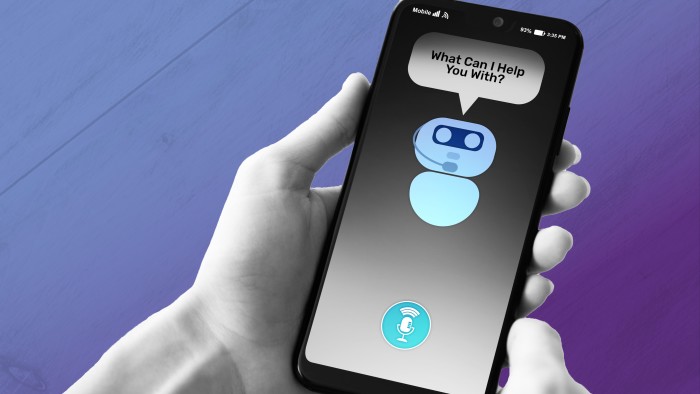
When I wrote last week about the need to train, and maintain, managers’ people skills at scale, I didn’t suspect that one of the solutions to the massive problem of poor and overwhelmed managers (44 per cent of them have had no training at all, according to Gallup), might be generative AI.
Lots of people think that “coach bots”, which have human names such as Valence’s Nadia and CoachHub’s Aimy, represent a quick and cheap solution to the enormous problem of badly trained or untrained managers. My hunch is they are right to be cheerleaders for this kind of virtual hand-holding, although I realise this is a nuanced topic. (Don’t @me, in other words 🙏.) One report valued the global online coaching market at $3.2bn in 2022, projected to reach $11.7bn by 2032.
My colleague Emma Jacobs wrote a great feature in the FT recently about the wider pros and cons of using AI at scale to coach staff, and she quotes alarmed academics and human coaches, all worried about our potential dependence on these friendly virtual agents. (One suspects they are concerned about their own future, although current trends suggest that high-end human coaches don’t have anything to worry about. CEOs and senior leaders will always get more support than a bot can provide.)
Meanwhile, to get an idea of who is using coach bots and what they do with them, I met the founder and chief executive of Valence, Parker Mitchell, who started his company in 2018. At first it made tech tools to improve teamwork. “The idea was that the team is the new unit of creative work.” The idea took off and, Parker says, they learned a lot from early clients about the challenge of trying to create change in workplace culture. When large language models arrived, Valence was ready. “We believe what people want is basically a personal assistant that understands them, and that can act as a proxy to them. We built it to understand you by asking you questions 🙋🏽, not just by giving you answers.”
WPP, the advertising group, uses Valence’s coach bot, and Lindsay Pattison, WPP’s chief people officer, says: “We now have several thousand employees using Nadia for various needs, including career planning, challenging conversation role-play, team management and managing interpersonal relationships. Nadia, despite being AI, is seen as very personal, a safe space to ask questions, and people particularly liked the confidentiality, always-on access and personalisation.”
WPP staff use Nadia in 36 different languages. Overall, Valence offers the service in about 70 languages. For global employers, an AI coach is potentially a huge benefit, Parker says: “Coaching is not always offered in whatever is your native language, and there is anecdotal evidence that those who might not have had the traditional educational credentials feel more comfortable talking to an AI coach.”
While Valence started out thinking that an AI coach would be a cost-effective alternative to executive coaching, its real-world users are often focused on in-the-moment help. Things like reaching for some guidance and support before a tricky meeting, or using the AI coach in the car on the way to work as quick prep for the day ahead 🚘.
*Are AI coach bots going to transform management? I think so but keen to hear your views, especially if you don’t agree with me 🫣: [email protected]
US workplace insights: the end of the org chart?
Is AI going to put an end to the traditional organisational chart, also known as an “org chart” or organigram? AI agents might be taking our places in the hierarchy 👀. Kevin Delaney, editor-in-chief of Charter, the future of work media and research company, tells me that if jobs are being done by agents that can autonomously complete a series of tasks, it will challenge the traditional chart 👩🏻💼👨🏽💼. “When expertise doesn’t live in humans any more, but lives in agents in addition to humans, you can start to question whether or not the org can be structured differently,” Alexia Cambon, Microsoft senior research director, told Kevin.
Alexia suggests a “work chart” might be more relevant, conveying the work to be done either by AI agents or humans. She points to the Hollywood model, where teams of experts are assembled for a production and then disbanded after the film or TV series is complete.
Office Therapy
The problem: Our boss is applying for a promotion to run the whole organisation. (We are non-profit/third sector.) The outgoing CEO has a relaxed, smart style. Our boss wears old jumpers, dated glasses and bad shoes. The saying “dress for your next job” was made for him. The interviews are soon and we want him to get the job. Can we say anything? What kind of look should we suggest if we do manage it?
Isabel’s advice: As an enthusiastic follower of fashion 👗, this may be my favourite reader question, ever. Can you engineer a conversation about the interview format, who is on the panel, and . . . what is he planning to wear? Stress how important it is to dress for the CEO role. Assuming you manage that, FT deputy fashion editor Carola Long advises that your boss, and anyone else looking for a style upgrade at work, starts with accessories: better glasses, a good bag and smart shoes.
“Glasses can really elevate or downgrade a look. I would head to the optical store Cubitts, which has such good frames you can’t really go wrong, and opt for something in dark acetate or tortoise-shell that suits the face shape.” Bags, meanwhile, “are important: on my journey to work I see a lot of depressing rucksacks that look more suited to mountain climbing. Instead, choose a tote, or neat roll top backpack from somewhere like Porter-Yoshida. And in terms of shoes, we are finally moving away from falling back on trainers, and styles such as loafers and suede desert boots look modern with officewear.”
As for the clothing, if the interview requires a suit, stick with blue, not grey or black. “Try navy or a rich blue,” Carola says.
Five top stories from the world of work
-
Gen Z is leading the charge back to the office: Full offices with lots of in person contact, and time with managers, will help younger workers embed in corporate life — and the popular image of Gen Z as wanting to be at home isn’t right, finds Anjli Raval.
-
Publishing grapples with where to draw the line on AI: As the 2025 FT and Schroders Business Book of the Year launches, Andrew Hill talks to authors and agents about the impact of AI on research and writing. It’s still early days, but the debate is fierce.
-
Moral Ambition: Rutger Bregman on a different kind of success for smart workers: I reviewed a book that will challenge you to think differently about what we want to achieve with our working lives. Bregman shows how one person, or a tight team, can change the world for the better.
-
ECB staff says bank promotes the wrong people, survey finds: Just 19 per cent of European Central Bank staff who answered a union survey thought the bank “did a good job of promoting the right people,” Olaf Storbeck writes. Many thought that knowing “the right people” was favoured instead.
-
Ikea plans to lure city dwellers with a store on London’s Oxford Street: The new central London Ikea (in the old Topshop building) opens tomorrow, writes Laura Onita, and aims to bring the Swedish retailer “to where customers live, work and socialise”.
One more thing . . .
We know that WhatsApp and Signal groups have changed workplaces, politics and much more, but Ben Smith at Semafor has captured “the group chats that changed America”. He’s uncovered, most importantly the “Chatham House” Signal group, with thousands of members. It is, he suggests, the “single most important place in which a stunning realignment towards Donald Trump was shaped and negotiated, and an alliance between Silicon Valley and the new right formed”. At the centre of it all are venture capitalist Marc Andreessen, and senior Silicon Valley figures.
Supported internships: a great idea 💡
Fair Shot, a social enterprise café ☕️ and training scheme in London’s Covent Garden, is a great spot for a work meeting. (I was taken there first by Yasmin Jones-Henry, who’s a patron.) Fair Shot trains young adults with autism and/or a learning disability as baristas and café assistants, and then works with businesses to support them into sustainable employment, often in the hospitality industry. Do you know a young person in London who might benefit? Fair Shot is recruiting its next cohort of 16-25 year olds to start in September. More information here.
*Know other schemes like this? I will return to this subject soon: [email protected]
A word from the Working It community
Lots of emails in response to last week’s newsletter, “Happy managers = happy staff”, highlighting the key role that managers play. I liked this suggestion from Susannah Haan, a corporate governance adviser:
“Overall, my view is that training for first time managers should be compulsory and that companies should be required to report on what training they provide. This could then be a differentiator for those seeking employment, plus of interest to investors. I understand that some companies are disclosing training hours and training costs; this could be included in the future UK White Paper on non-financial reporting and/or the ISSB human capital reporting standard, and it would be good to see some evidence of what other information companies look at internally (eg. from chief learning officers / people analytics). I would be inclined to require large companies to include a report on their people strategy from their chief people officer in their annual report.”
Before you log off . . .
The world’s oldest Sunday newspaper, The Observer, has been sold by The Guardian to Tortoise media, a new-ish media organisation known for its newsletters and podcasts. Tortoise is now rebranding as The Observer. As a fan of both publications, I’m keen to see how this works out, given that about a third of Observer staff are believed to have taken redundancy packages. I especially like the Tortoise/Observer daily Sensemaker current affairs email: sign up here.
Read the full article here