

Unlock the Editor’s Digest for free
Roula Khalaf, Editor of the FT, selects her favourite stories in this weekly newsletter.
January 1941. Political theorist Hannah Arendt and her husband endure a desperate and precarious trek across the Pyrenees from occupied France to Spain — one of a series of fraught journeys that eventually lead to safety and their settling in exile in America. Arendt, who was Jewish, later coined the phrase “the banality of evil” to describe the horrors unleashed by totalitarian regimes. She had been stateless since 1933, after escaping Nazi Germany.
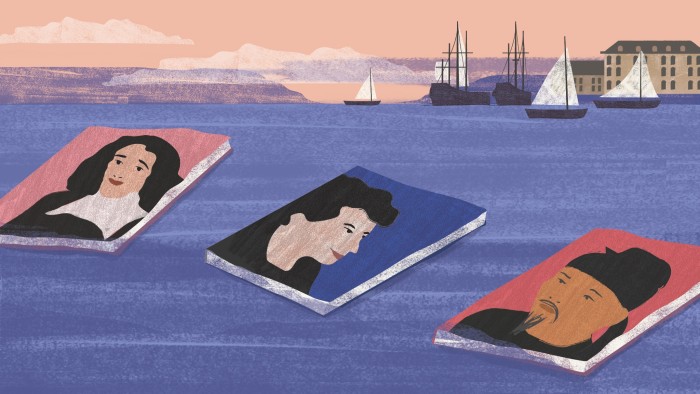
She is one of three “great lives” acting as signposts in Canadian writer Madeleine Thien’s abstract and momentous new book about time, resistance and resilience. The others are the Chinese Tang dynasty poet Du Fu and the 17th-century Portuguese-Dutch radical philosopher Baruch Spinoza.
Thien’s previous novel, Booker and Women’s Prize shortlisted Do Not Say We Have Nothing (2016), referred to a manuscript called The Book of Records, which characters passed on in secret. At the time, Thien explained in an interview that the manuscript represented a narrative “in which the characters are seeing an alternative China where they recognise mirrors of themselves”. (Thien’s own background is Malaysian-Chinese.)
Her new work takes the same name as that embedded document. Lina, a woman in her fifties, recalls that “half a century ago, during the rainy season, when I was seven years old”, she and her dissident, dying father Wui Shin arrived from Foshan, China, to a holding point known only as the Sea, where she is able to connect with other refugees from across the centuries.
Their stories play out with Lina as conduit. The refugees are Jupiter (Thien’s nickname for Du Fu), Bento (Spinoza’s Portuguese name) and Blucher (Arendt’s married surname). Each is not exactly that historical figure, but a representative. Once more, an invented book takes a role in the narrative — these three tales of displacement are based on three volumes of The Great Lives of Voyagers, the only books Lina’s father carried on their own hurried flight: “Dad said these people had each, at different times, been figures of fascination in the People’s Republic of China.” Lina grumbles that he “had packed Volumes 3, 70 and 84. I wished he’d taken number 1, about the Ming dynasty sailor Zheng He. Or 23, on the tireless wanderer Ibn Battuta.”
At first this somewhat whimsical framing is frustrating — what is the deeper link between Lina, her father and these voices from history? As the novel proceeds, their correlation becomes clearer and Thien plunges the reader into thrilling, perilous leaps back and forth across time. Her rendering of the bustling commerce of Spinoza’s Amsterdam is exquisite. A city recovering from the Thirty Years’ War, devastated by repeated plagues yet an international hub of canals and barges, bookshops and new concepts, is fastidiously rendered, like a painting from the Dutch Golden Age: “The harbour bell clanged, and the ships along the Damrak whipped and sawed, tilting like giant dancers. Baruch walked into the wind, crossing to the New Town, entering a street of ropemakers. The day was consumed by mist.”
In 1656, aged 23, Spinoza, then a young merchant, was excommunicated from the Talmud Torah congregation in which he grew up. With his parents and most of their siblings now dead, Spinoza and his brother had carried on the family business. This act, or herem, occurred years before Spinoza had begun to write down the controversial ideas that would constitute his Ethics. He crossed the canal, a devastating breach, never to return to the Jewish quarter, and was taken in by a lively Christian family, later becoming apprentice to a lens maker.
Arendt initially fled Germany for Paris, where she lived among an artistic circle that included her close ally Walter Benjamin, “Benji” — one that war would disperse for ever. Friendship and solace are prominent themes throughout the novel, whether among humans or animals. Spinoza’s cat “Brother Orange” winds its way into Lina’s household; Du Fu (“thirty-eight years old, ancient and without prospects”) refuses, despite poverty, to give up his beloved horse Big Red, who “knew everything”. Big Red is a silent companion to the poet’s futile attempts to secure a position and an income as a civil servant — Du Fu’s talent was never celebrated in his lifetime. In Thien’s retelling, Arendt’s treasured volume of Proust is a gift from Gertrud, a woman she met in the Gurs internment camp in France. Gertie’s passion for chess is another of the novel’s motifs, as is Don Quixote, “the book of wonders which fed all [the] games” of the Spinoza children. Here, books are lifesavers.
Thien’s inhabiting of these different timescales is a marvel of research and imagination. At times it takes on a surreal aspect: in one passage featuring Arendt, a poem by Du Fu appears on the reverse of the paper she threads through the communal typewriter of a boarding house in Lisbon.
Eventually, the true nature of Lina’s father’s government-sanctioned role as “a systems engineer managing the structures of cyberspace” and the reason for separating from the rest of their family becomes horrifyingly clear. While guilt and betrayal nibble at the corner of each narrative, Thien thrusts her characters forward through crisis and urges the reader to follow suit. A line from Chinese poet Yu Qiuyu, not born until 1946, is somehow implanted into the mind of Arendt: “In order to extend life and preserve civilization, we are obliged to rescue one another.” Thien’s dazzling historical somersault doubles as a plea for humanity.
The Book of Records by Madeleine Thien Granta £20, 368 pages
Join our online book group on Facebook at FT Books Café and follow FT Weekend on Instagram and X
Read the full article here