

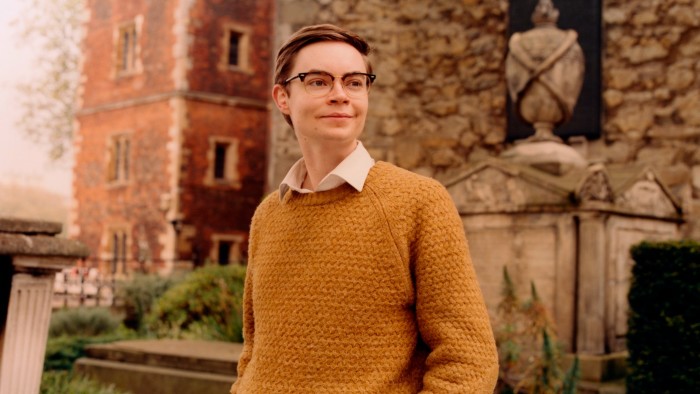
At the front desk of the Garden Museum in London, I came across a man in an unusual pair of trousers. I say “unusual” because, despite the best efforts of Robert Armstrong and our other menswear pundits, the FT has not persuaded men to swap their narrow, clingy, low-waisted trousers for those that sit, with far more elegance, at the natural waist. But this pair, worn by 24-year-old Spencer Drake and cut generously in a heavyweight black wool, with a fishtail back, did.
Drake informed me that the trousers were from Darcy Clothing, which produces men’s garments based on Victorian and Edwardian patterns (and some much older than that). Drake lifted his mustard-coloured jumper to show me the braces holding them aloft. “They’re really comfortable,” he said.
I later learn that Darcy Clothing is no niche Etsy operation but a £2.5mn-a-year purveyor of ready-made period menswear largely serving the British entertainment industry. Customers like Drake constitute only a tiny fraction of sales, says Catherine Darcy, 68, who founded the business 25 years ago.
“There’s [almost] no movie [in Britain] we haven’t been involved in,” she says from her desk at the brand’s headquarters, housed in an unassuming but airy former malthouse behind Lewes Castle in East Sussex. “Even the sci-fi ones, there’s usually a flashback.”
On the shelves lining her office and in the warehouse in the basement below are thousands of cardboard boxes of costumes and accessories that back up her claim. Her clients are largely confidential — “We work for terrifying people like Disney and sign NDAs,” she says. But she drops hints: “Peaky Blinders was great for our business.”
Darcy specialises in the clothes and accessories you don’t notice in films — plain white shirts, black trousers, starched collars and collar studs — but would if they weren’t right. “We supply the basic boring stuff. It’s not that the designers don’t care, but they will spend on principals.”
Darcy is clever and playful, with a dry sense of humour and a badger streak running through her white hair. She read English at Oxford — “the only university I’d heard of” — and spent the first half of her career working for the stage, climbing the ranks of “the lowest of the low” at nearby Glyndebourne to become a costume supervisor, mainly for opera. All-nighters at her sewing machine, stitching up shirts to replace doublets that “weren’t working”, persuaded her there was a market for ready-made period clothes.
“Costume is essentially a couture business model. Everything is individually made,” she says. “It’s getting more and more expensive to do that — now it’s almost prohibitive. What I wanted to do was knit together the worlds of costume and mass production.”
Her business thrives on the last-minute nature of film and stage production — “We are an emergency service” — and also the need to dress many actors, mainly extras, in virtually the same thing. “The reason this works is because we [almost exclusively] do menswear. Men wear a uniform and women don’t. In a big ball scene, there’s 30 men wearing identical clothes, but you’ll never see 30 women wearing identical ball gowns.”
Darcy and her team source antique clothes from specialist dealers and flea markets — she pulls out a frayed c1790 ivory silk waistcoat, beautifully hand-embroidered in delicate florals, that she bought at auction for less than £100 — from which they make up patterns.
“They have to be adapted to modern shapes,” she says. That means lengthening sleeves and legs, dropping armholes to accommodate “beefier arms”, and widening the waist, with sizes that now run up to 60 inches. “The Victorians and Edwardians were much trimmer,” she says. “They didn’t eat at McDonald’s.”
Most of the fabrics are true to the originals — the shirts are all 100 per cent linen or cotton — but some have been changed to meet the demands of live performance. Trousers and suits are largely cut from cotton brushed to look like wool worsted, which is “cheaper and lighter to wear under lights, and the moth doesn’t get them”, Darcy says. She works with mills in the north of England that have been “making since the Napoleonic Wars”, as well as manufacturers in Eastbourne and New Haven in East Sussex, but many of her suppliers are now abroad: “We don’t really have mills any more [in England]. We have to be pragmatic.”
The clothes are designed to look like the real article, with none of the shiny synthetic fabrics seen at your typical costume hire shop: “We are called Darcy Clothing — not Darcy Costume — very deliberately. They are manufactured as real clothes. They just happen to be 18th-century shapes.”
Hence the offstage appeal. Darcy says the company has done nothing to attract the general public, who tend to find it through internet sleuthing — on Reddit, the brand is recommended to a user enamoured of Matthew Macfadyen’s look in the 2005 film of Pride and Prejudice. Some use their clothes for cosplay, while others — what Darcy calls “the borderline arty tribe” — mix them with more contemporary pieces “to look good in a non-conventional way”.
Darcy, of the Garden Museum, does a bit of both. He is a first-year doctoral candidate in Victorian studies at Oxford university and has spent years trying to “get within the Victorian mindset”, he says. “I wanted to have the option to more authentically explore and to experience their clothing reality,” he explains. “And [the Victorians] had some pretty nice style at times.” The price points — £68 for a Regency-style shirt in white cotton lawn, £95 for brushed cotton trousers — also make it feasible, even on a graduate student’s budget.
He has five pairs of Darcy trousers and three shirts, among other items, which he mixes with his more contemporary clothes. But sometimes he goes full look: “Most historians don’t necessarily dress in the style of their period, but the more eccentric ones do, and that adds to the public relatability of it,” he says. “It’s also super-helpful for getting a feel of that history.”
It’s a nice look, and sets him apart from the crowd. Most of the time, anyway. Recently, he was streaming a Victorian period programme and noticed that one of the actors was wearing the same shirt.
Follow us on Instagram and sign up for Fashion Matters, your weekly newsletter about the fashion industry
Read the full article here