

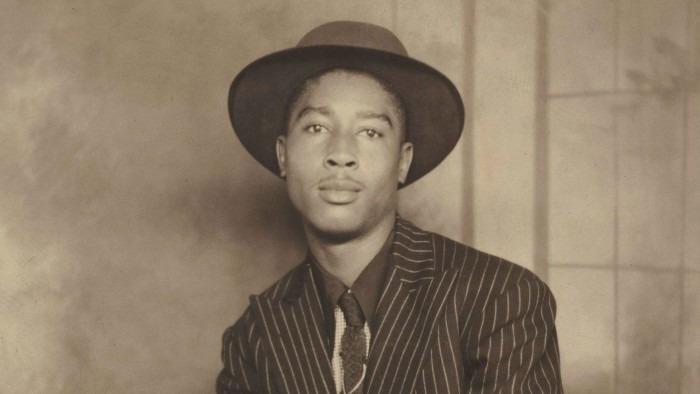
“Dandy” is a word that’s being thrown around a great deal at the moment. It crops up to describe various male celebrities and clothes horses for fashion houses — Colman Domingo, Donald Glover, A$AP Rocky. It’s used in reports around flashy men’s fashion shows. And it features in the forthcoming exhibition at New York’s Metropolitan Museum of Art Costume Institute, the first summer show dedicated to menswear. It’s titled Superfine: Tailoring Black Style and billed as “a cultural and historical examination of Black style over 300 years through the concept of dandyism”. The gala opening is on Monday night.
Costume Institute head curator Andrew Bolton says the genesis of this show came with the death of a great Black dandy, American Vogue’s former creative director André Leon Talley, in January 2022. An obituary described Talley as “a true dandy, like those in favourite novels by Balzac and Baudelaire”. That train of thought led Bolton to the 2009 book Slaves to Fashion: Black Dandyism and the Styling of Black Diasporic Identity by Monica L Miller, chair of Africana Studies at Barnard College, Columbia University, who has co-curated the Met show.
The catalyst for Miller’s book was the Black intellectual WEB Du Bois. “I came across Du Bois being caricatured as a dandy. And he was furious about this,” she says. “And yet there were many people in the world who actually had a sometimes disdainful, but sometimes a true appreciation for his style. So I realised in that moment that dandy means different things to different people in different contexts, and that there’s a politics to Black self-representation that has a very long history.”
The Met exhibition covers the period from the 18th century to today, and includes items worn by Du Bois and other significant individuals including pop musicians Prince and Sylvester and the 19th-century civil rights activist Frederick Douglass, as well as designs by Black creatives such as Grace Wales Bonner, Bianca Saunders, LaQuan Smith, Pharrell Williams and the late Virgil Abloh (the latter two respectively current and former creative directors at Louis Vuitton, a sponsor of the show).
“There is this sort of renewal and renaissance in menswear, which is very much being spearheaded by Black designers,” Bolton says.
But what actually denotes a “dandy”, historically speaking? The blueprint was George Bryan “Beau” Brummell, an Eton-educated Englishman of the Regency period who defined himself and his place in history not by any notable political or military career but through fastidious perfection in dress. Reflecting a general rejection of ornament in menswear at the turn of the 19th century, Brummell eschewed the decorated silks and brocades of 18th-century court life for sober wools, perfectly fitted. His knotted fine-linen cravats were of particular note — he sent them away, at great expense, to be washed in country water, to avoid soot spots.
Later, discussing the dandy in his essay “The Painter of Modern Life” in 1863, French writer Charles Baudelaire stated that “perfection in dress consists in absolute simplicity”.
However, Bolton and Miller’s definition of dandyism moves beyond the severely stripped-back styles favoured by Brummell and Baudelaire. “On the one side, you have the restraint of dandies like Beau Brummell,” says Bolton. “But then you have this flamboyance, and theatricality, and exaggeration of people like Count d’Orsay and Oscar Wilde. There is an intent and a deliberateness of dress that they both share and, I suppose, a self-conscious display. Because even if you’re being restrained, there’s a consciousness there. And in both situations, there is a . . . search for perfection.”
Self-conscious display is, of course, very much of our time — it’s difficult to imagine modern dandies adhering to Brummell’s maxim that “If John Bull turns round to look at you, you are not well dressed; but either too stiff, too tight, or too fashionable.” But there can also be deeper meanings attached to dandyism.
“Dandyism offers the possibility of social mobility on one’s own — albeit restricted — terms,” says dress historian Caroline Evans. “Within dandyism the whole idea of social marginality becomes dynamic.” Even Brummell himself benefited from that: although undoubtedly privileged (his father was private secretary to the prime minister), he was no landed gentry, and his fashion-forged friendship with royalty marked 19th-century social climbing at its finest and highest.
Miller characterises the dandy as “a figure who is pushing the boundaries of what’s acceptable in a number of identity categories”, such as class or gender. Often, Black dandies of the past used their clothes to suggest a level of wealth that exceeded their socio-economic realities. The wide-shouldered, generously cut zoot suits worn by African-Americans in the 1930s and 1940s, for instance, semaphored wealth through a profligate use of fabric. The same is true of many white working-class dandies, like the Teddy Boys of the 1950s, who aped Edwardian finery.
An obsessive interest in clothing is a measure of both outward display and control of image. “I think there’s a facet of dandyism that’s really about protection,” Miller says, describing the suit — which features heavily — as “armour”.
Away from the specifics of clothing, there is also a wider idea of reclaiming the title of dandy, which is often used pejoratively. Says Miller: “We’re not interested in actually calling people dandies and having them say yes or no. It’s more of ‘what is dandyism as a strategy, as a tool’? What does it make possible for different people in different contexts across time?” In short, what can your clothes not only say about you, but do for you, too?”
‘Superfine: Tailoring Black Style’, May 10 to October 26 at the Metropolitan Museum of Art, New York
Follow us on Instagram and sign up for Fashion Matters, your weekly newsletter about the fashion industry
Read the full article here