

Some cities lean into their history; Madrid isn’t one of them. Builders are famous for smashing out period features. Tourists can leave without learning the name of a single Spanish monarch.
Madrid’s whole brand is to live in the present. Come for the mornings in the gallery, the afternoons in the plaza, the evenings in the stadiums and the bars. Previous centuries have too many complications: the city’s history museum ends abruptly in 1930, just before the civil war can make anyone uncomfortable.
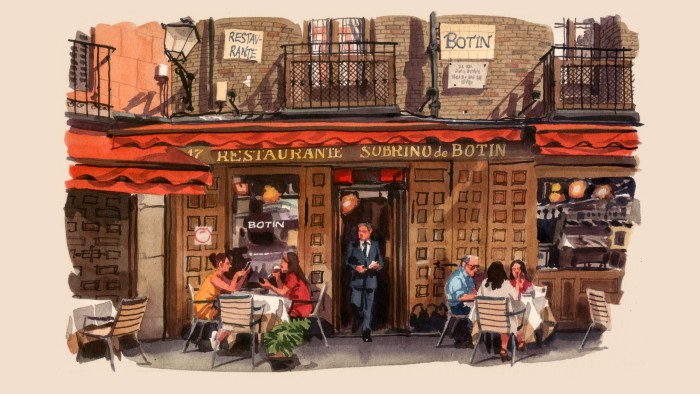
Which makes Botín incongruous. This restaurant, a few steps from Madrid’s Plaza Mayor, is recognised by the Guinness Book of Records as the world’s oldest. This year it celebrates its 300th anniversary. Its façade is dotted with enough Guinness certificates that you might mistake it for a peculiarly quaint Irish pub.
The accolade is clearly good for business: the website told me that the next available table was in three weeks. But I wondered whether the title of “world’s oldest restaurant” might be like the title of “world’s oldest person” — the harbinger of bad news. Could any restaurant sustain such weight of tradition without being consumed by it?
Botín, the story goes, was set up as an inn in 1725 by the nephew of a French cook Jean Botín (its full name is Sobrino de Botín — Botín’s Nephew). This was a time when Madrid lacked sewage disposal or street lights; the Prado Museum wasn’t built, the boulevard where it now stands was just a gully; Atocha was a monastery, not a world-beating railway station. On old maps, you can see Botín’s home, Calle de Cuchilleros (Cutlers’ Street), curving just as it does today: it’s too central to have been bulldozed.
Restaurants go bust because of wars and pandemics, because of private equity and public abuse, because their food doesn’t fit or their owner doesn’t stick. If they avoid these pitfalls, their leases expire, or their ambitions grow: they move. But Botín has operated on the same site in Madrid even as Napoleon, Franco and Covid-19 came and went. Goya allegedly did a stint cleaning the dishes circa 1765, thankfully long before his dark period.
For Botín’s first century, Spanish law dictated inns could only cook food that visitors themselves brought. The stone oven — big enough to fit 14 suckling pigs — has supposedly never been extinguished. During the pandemic, a cook would come to place firewood in there every day: the owners fear that, if it were to cool, it would fall apart.
The restaurant is set across four floors, including the wine cellar that dates back to 1590. My companion and I were seated on the first, alongside blue-and-white tiles, thin wooden beams — and a lot of tourists. Spanish diners do come to Botín, but we didn’t see any. It is the tourist’s dilemma: in our urge to find authentic Spain, we end up in places with very few actual Spaniards. Botín lacks the spontaneity that locals might bring; the diners are almost playing a role.
The spring/summer menú del día is gazpacho followed by suckling pig and ice cream, served with a drink for €59. There are baby eels for €180, but otherwise the menu is Spanish classics: roast lamb, roast chicken, fried squid. There is also sangría, the tourist nectar. This is Spain in capital letters.
Later, when I spoke to the genial head of the cramped kitchen, Rubén Manzaneque, he admitted that Botín was not a place for novelty: “It was a challenge when I started. I had to replace my creative instinct.” In his decade in charge, “I think we’ve changed two dishes and one garnish!” But, he insisted, the processes had modernised, as had the health and safety.
What’s more, the ingredients were good, and the coal stove — of a type no longer allowed to be installed — gave the meat a smokiness. Botín wasn’t here to win prizes, he said, although I later noticed one framed certificate by the bar: a 1991 prize from the Madrid Association of Public Relations.
Let’s not be cynical. The suckling pig has moved people. When Colombian politician Ingrid Betancourt was held hostage in the 2000s, a fellow prisoner regaled her with tales of Botín; once they were free, they had a joyful evening here.
We found the service had the brusque urgency of a battlefield. An occasional tradition in Spanish restaurants is to give diners what they should have, not what they ask for. A young waiter — white-blazer, black bowtie — offered us wine: when we said yes, he asked no further questions but simply brought a 2020 Viña Salceda Rioja. After Brexit, some Europeans know better than to give an Englishman a choice.
All Botín’s waiters, by the way, are men. Female chefs are allowed, but the last one left recently. She enjoyed the work but found hauling huge pots physically demanding, Manzaneque told me. Tradition cuts both ways.
My gazpacho, the colour of mild sunburn, was undistinguished. But the garlic and egg soup was better, my companion assured me, and the dessert — a variation on Basque cheesecake — was well-made. Overall, the box was ticked.
Botín’s ruling family since 1930, the González, once opened branches in Miami, Mexico and Puerto Rico; all failed, and you can understand why. Without the history and décor, Botín would lose its charm.
The restaurant may not hold its title forever. Located in Madrid’s northern outskirts, on the old road to France, Casa Pedro claims to be older than Botín — founded in 1702 by the same family that runs it today. Sadly any records were burnt in the civil war. It has hired a historian. For now, its location means that it attracts few tourists. “We have to fight every day,” its current manager Irene Guiñales told me.
Back at Botín, I stepped out onto the pavement, and heard a tour guide explaining that Ernest Hemingway himself had visited the restaurant. “OK, he went everywhere,” the guide added, laughing. Opposite us was a shop selling official Real Madrid shirts — each one more expensive than our meal for two. In the market for hype and authenticity, Botín did not seem an unreasonable option. If it prods Madrid’s many visitors to consider the past, it deserves at least some of its fame.
Sobrino de Botín is at Calle de Cuchilleros 17; botin.es
Find out about our latest stories first — follow FT Weekend on Instagram and X, and sign up to receive the FT Weekend newsletter every Saturday morning
Read the full article here