

Unlock the Editor’s Digest for free
Roula Khalaf, Editor of the FT, selects her favourite stories in this weekly newsletter.
This story opens in an apartment building in Paris’s 17th arrondissement. It is the 1960s, and the narrator, Coline — then still a child — is often kept off school by her mother Lucie, after her siblings and father have departed for the day. As soon as her husband leaves for work, Lucie’s female relatives — who all live in the same block — descend on the apartment: her morphine-addicted mother, her aunt Zizi and Zizi’s daughter Hedy. Coline describes these gatherings as taking place “in an atmosphere that resembled a gynaeceum, the women’s quarters in a house in ancient Greece”. The maid is banished to the kitchen while the women try on each other’s clothes and gossip.
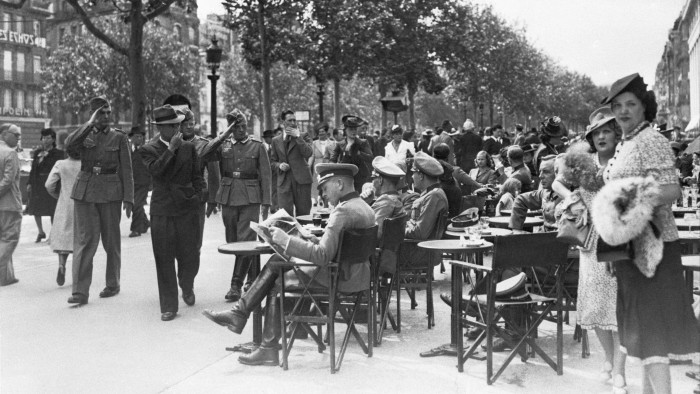
Coline watches; a “silent witness” to these performances. She also listens, even though she doesn’t understand much of what’s being discussed. The women’s language is coded and alien, its meanings obscured. All she knows is that they’re talking about the past. About how good it once was. About how wonderful their lives once were. It’s only later, when she grows up, that Coline realises that the “fairy-tale period” the women were always harking back to was that of the occupation during the second world war — and the good life they’ve mourned the loss of ever since the direct result of their collaboration with the Nazis: “Enigmatically, they said, ‘We didn’t miss out on anything.’ It took me many years to understand what they meant.”
The Propagandist is written as a novel, but it cleaves closer to fact than fiction in that the story that unfurls therein is that of its author Cécile Desprairies’s own family. A celebrated historian of Vichy France, Desprairies has written extensively about what she terms the “larger History” of the French collaboration. But now, through the fictionalised Coline, she’s able to explore the “personal history” of this period too: the shameful culpability of her closest family members.
Although the entire family was rabidly antisemitic, some were more avariciously than ideologically opportunistic. Lucie, however, was deeply invested in the Nazi regime. The “propagandist” of the book’s title, she “became known as the Leni Riefenstahl of the poster”. She was also married to a young Alsatian biologist and Josef Mengele-in-the-making. His death, shortly after the Liberation, was a loss she never recovered from. “She had already lived her life,” her daughter explains. Everything that came after the war, including the “whitewashing” of her past, her second marriage to Coline’s father and the four children she bore him, was “halfhearted”.
Longlisted, with good reason, for the 2023 Prix Goncourt — France’s most prestigious literary prize — and now beautifully translated into English by Natasha Lehrer, The Propagandist is a harrowing but elegantly constructed rot-riddled family romance. But it’s also a book about translation and interpretation; about how language can be used to both conceal and reveal. She rarely names specifics, but as the mistress of “analogy, transposition, metaphor, displacement, syllepsis, metonymy, synecdoche”, Lucie spent her entire life talking about the collaboration. It took her daughter that same lifetime to become fluent in her mother’s tongue.
The Propagandist by Cécile Desprairies, translated by Natasha Lehrer Swift £14.99/New Vessel Press $17.95, 208 pages
Join our online book group on Facebook at FT Books Café and follow FT Weekend on Instagram and X
Read the full article here