

Venture into Paris’s 13th arrondissement and the city of popular imagination — the one with elegant boulevards and grand Haussmannian architecture — gives way to a small pocket of Asia, humming to its own frenetic rhythm. Cafés transform into bubble tea shops. Sunday farmers’ markets become massive Asian grocery stores. Plat du jour chalkboards are replaced with hotpot menus. It is a fusion of Hanoi, Phnom Penh and Guangzhou.
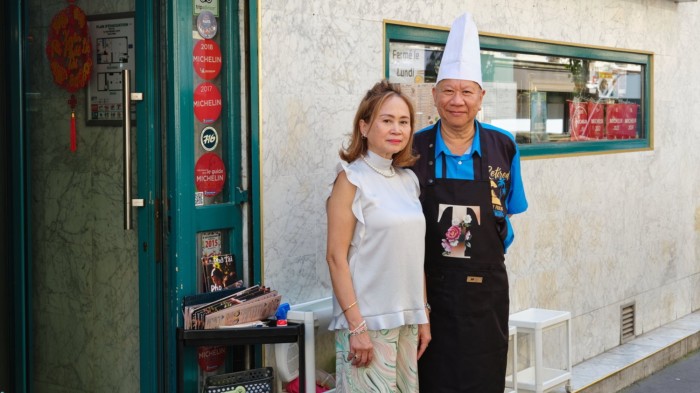
For the average visitor, this is off the beaten path. For Parisians, it is a favourite haunt for authentic, homely Asian food. What brought me here is Pho Tài, a humble Vietnamese soup bar that is run by chef Te Vepin and his wife and co-manager Te Aline. The understated restaurant has quietly become one of the top culinary gems in the French capital.
As I visit on a sunny Sunday, I first smell the fragrance of beef broth from a distance away. Pho Tài’s outdoor patio is packed with Parisians slurping steamy bowls of pho, luscious bún bò hué (a Vietnamese rice noodle dish) with pork trotters (€13.80), and gobbling through plates of papaya and grilled beef salad (€12.80). Te Aline greets me as I enter her low-key, no-frills establishment, its exterior adorned with just simple signage of the restaurant’s name. Inside holds a mish-mash of memorabilia representing the place’s multicultural roots, with traditional Vietnamese art, decorative pan-Southeast Asian instruments and hats and Guan Yu shrines, a traditional Chinese symbol of wealth and loyalty.
At Aline’s behest, I order the house speciality: beef pho (€13.80), which has earned legions of fans for high-quality raw beef and meatballs from the local butcher, so tender they almost melt in your mouth, and a broth rich but not too fatty. Chef Te spends hours cooking the broth each day, tending to it as it gently simmers away, allowing for the flavours to develop.
“Its four to five hours of cooking every morning from 7:30am,” the chef says. “And then we do it again in the afternoon. We keep it fresh for the diners, and we make sure we finish the pho broth by the end of the day — absolutely no leftovers.”
The owners pride themselves on using ingredients directly from Asia as much as possible, religiously adhering to the original recipe from Hué, the coastal city in central Vietnam where Te is from. “You have to fry the onions and ginger first for just the right amount of time before adding water and herbs to make the broth. That’s the most important part. You fry even a bit too long and your broth is ruined.”
Chef Te, who is Chinese-Vietnamese, comes from a family of soldiers; his father was a member of the South Vietnamese Airborne division, who worked at the French embassy. When Te moved to Paris in 1968, to enrol in a military academy just as the Vietnam war escalated, his journey turned out to be a one-way ticket. “I started wondering what else I could do,” he says. “I was cleaning dishes and wasn’t paid. I couldn’t spend. Those were tough days.” He started training under other Vietnamese chefs who had settled in Paris. “I was even arrested once for avoiding the French military service so I could work and cook,” he says.
In 1981, Vepin decided to start his own restaurant, first in the 19th arrondissement before relocating the business to its current location in the early 2000s. Starting with classic pho, he later introduced satay beef pho (€14.50) to the menu, now another Pho Tai speciality. Then other signature dishes like bun bo hue (spicy pork knuckle noodle soup, €13.80) and goi bo nuong (grilled beef and papaya salad, €12.80) followed. By then, Aline had also arrived in Paris from Cambodia as a refugee escaping the wars and coups in Indochina. The two met in Paris and became partners in life and business.
“When I first started, I was selling a bowl of pho for 50 francs,” the chef says. “Back then, Parisians didn’t know how to eat pho. It took a while before people started knowing what I was making and liking it.”
Today, French families and pensioners sit next to international students from mainland China and couples from Cambodia at Te’s place. As she serves the various tables, Aline effortlessly switches between French, Mandarin, Cantonese, Vietnamese and Cambodian. Still, different groups have different preferences. “We love the quality of the beef here,” says the middle-aged French couple sitting next to me. “So we like it quite raw.”
“French diners like the meat raw,” Aline adds. “The Asians want it pretty cooked.”
Pho Tài has seen a surge in popularity in recent years, and has earned a Michelin Bib Gourmand almost every year since 2017. Those familiar with Asian cinema and pop culture will recognise the myriad celebrities in photos plastered along the restaurant’s walls. “Tony Leung, Donnie Yen, Rosamund Kwan,” Vepin says, gleefully listing the Chinese A-listers that have paid his restaurant a visit over the years. “Lots of stars, flying from all over the place to come.”
The couple’s most prized photograph, however, is with Alain Ducasse, the multi-Michelin-starred French chef who reportedly called Te the “Chinese [Joël] Robuchon.”
“We really started getting a lot of attention after Ducasse’s visit. He especially praised the freshness of our ingredients,” Vepin says with a smile.
On Aline’s suggestion, I try their signature dessert — pandan sticky rice milk (€5) — a dish that is her creation, one that she spends hours creating every day, first steaming the rice, then combining it with taro and drenching the mixture in sweet, thick coconut milk (either warm or chilled, per the customer’s preference). Like most of the offerings here, it is a seemingly simple and unfussy recipe but it takes hours of loving preparation to come to life.
The work that goes into each dish underscores the reality that many places like Pho Tài are facing. The restaurant business is difficult, requiring immense dedication in tough environments. With Mr Te in his seventies and his children reluctant to take over, the fate of this celebrated neighbourhood joint is uncertain. “Our kids are all too successful in their careers to take over,” says Aline. “Plus, they’re all married to French people. They’re not doing this type of work. We might retire in a couple years and sell the place.”
When that happens, what worries her and Vepin the most is that they will disappoint their customers. “Where can you find such a filling, massive bowl of noodles for such low prices in Paris these days?” Vepin says. “It’s all about making everyone coming here happy.”
This article is part of a new series on neighbourhood favourites: the understated restaurants that combine excellent, relatively affordable food with a sense of community. Tell us about your favourite spot in the comments below. And follow FT Globetrotter on Instagram to find out about our latest stories first
Read the full article here