

Unlock the Editor’s Digest for free
Roula Khalaf, Editor of the FT, selects her favourite stories in this weekly newsletter.
What do we mean when we call someone a “friend”? As Tiffany Watt Smith notes in Bad Friend, English is oddly impoverished when it comes to defining the different boundaries and obligations of non-romantic, non-familial relationships.
In Russian, she writes, drug/podruga (m/f) describes someone to whom you will be eternally loyal; prijatel/prijatel’nitza (m/f) is used for someone you meet up with a few times a year because you enjoy each other’s company. Znakomiy/znakomaya is someone you’ve met with just a few times — you like them, but don’t know much about them.
Perhaps for the latter we might say “acquaintance” in English; but there’s little room for development in that word. To use “friend” — as really, we must in each of those contexts — invites confusion.
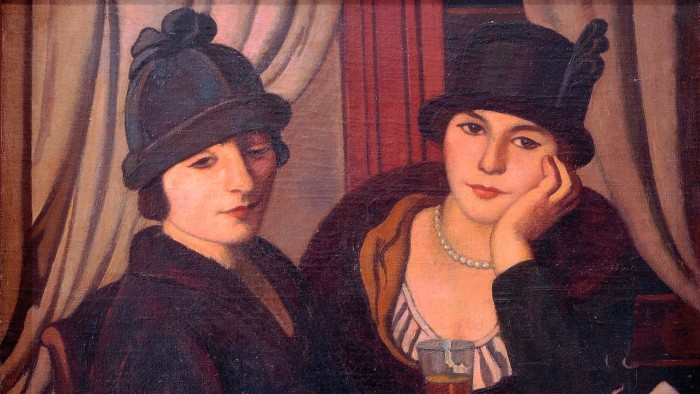
It is this confusion that Watt Smith wishes to unpick and elucidate in her thought-provoking, open-hearted book. Its focus is on female friendships, and how they have been portrayed and perceived across the past century, but her observations are of value to both sexes.
Watt Smith is the author of The Book of Human Emotions and Schadenfreude: The Joy of Another’s Misfortune, and reader in cultural history at Queen Mary University of London. In Bad Friend, she combines a degree of memoir with social history: her own experiences provide examples that the reader will recognise with both relief and consternation. Setting these against a historical framework, she shows the extent to which our interactions are shaped by society’s expectations.
It is startling to discover that the idea of female friendship is relatively new. The French essayist Michel de Montaigne (1533-92) believed that women were incapable of “this holy bond of friendship, nor do their souls seem firm enough to withstand the clasp of a knot so lasting and so tightly drawn”.
A century later, the great scientist and poet Margaret Cavendish agreed: women’s brains were simply too weak to support such complex bonds. It was not until the 20th century — and the societal upheavals wrought by two world wars — that female friendship became entrenched as a kind of cultural ideal. Watt Smith quotes the historian Mark Peel, who called the 20th century “the age of female friendship, or perhaps the age when friendship became female”.
In attempting to get to the heart of what makes female friendship distinctive, the author begins with an example from her own life: her intense bond with Sofia, with whom she shared a flat in her twenties. Watt Smith calls her “my great romance, my proudest achievement”. When she thinks of Sofia now, “I see her in the Italian café she loved best, the chocolate on her coffee growing dark and sticky as she leans over and tells me her secrets. I drink her in.”
If you were to read those quotes without context, might you not assume that this was a sexual, romantic relationship? The intensity of female friendship can make this delineation elusive. What the author describes is almost an ensorcellment, one that rang true to me when I recalled some of my early friendships, girls who were my age but seemed older, whose sophistication I admired. Suzie, who taught me to drink coffee, get my legs waxed, eat sushi. Coffee and sushi were disgusting and waxing was eye-wateringly painful but I persisted, and here I am decades later with all three practices embedded in my life, though that friendship imploded long ago.
It took me years to get over the pain of losing that friendship — Watt Smith’s trajectory with Sofia echoes mine. Such suffering can be called “disenfranchised grief”, she writes, because friendship is not held in as high regard as our other relationships.
This relative disregard means that records of female friendship are scarce; but Watt Smith is assiduous in her research. She discovers an early 20th-century “friendship” between a white prison reformer and a Black inmate of a New York women’s prison; but the inmate, Minerva Jones, did not know her “friend” was undercover in the prison, and not an inmate herself. Friendship, or exploitation?
Watt Smith explores different levels of transactionality. She looks also to co-housing communities, where friends live together in a way we more commonly expect of families. She believes she will encounter a type of superhuman in these settings, women who were “so evolved they knew instinctively how to deal with conflict”.
But of course, no one is superwoman; what she finds is a careful intentionality. She comes to understand that friendship “requires willingness. Willingness to attempt to find a solution, willingness to try again, willingness to look for connection, willingness over and over again.”
Bad Friend is an arresting title; I hope it helps this book fly off the shelves — but I’m not sure it’s an accurate one. Certainly, Watt Smith examines her own friendships and often finds herself wanting: but at some level all relationships will have an inbuilt fracture point. Her book doesn’t provide a recipe to preserve or enhance our friendships: in 1929 Virginia Woolf wrote that women’s relationships with one another were “a vast chamber where nobody has yet been”. Watt Smith can’t illuminate the shadows in that chamber completely: but she holds a bright light to the subject, and that is a worthwhile start.
Bad Friend: A Century of Revolutionary Friendships by Tiffany Watt Smith Faber £18.99/Celadon Books $29.99, 336 pages
Join our online book group on Facebook at FT Books Café and follow FT Weekend on Instagram and X
Read the full article here