

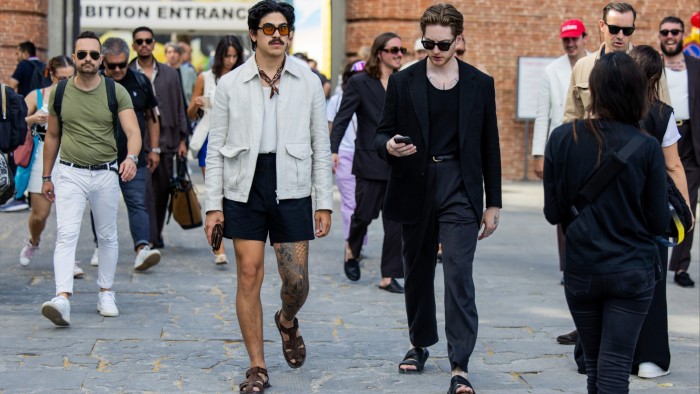
Few style debates are more polarising than the question of whether or not sandals can ever be acceptable in the workplace. And certainly, when I asked two friends of mine, both lawyers, whether sandals make an appearance in their respective offices, they were unequivocal.
“Anyone who reveals his toes must be comfortable having the door to career progression closed in his face. It really is the thin end of the wedge,” said one. “I am not sure what would be worse for my career: wearing sandals to the office or getting into a fist fight with my boss,” said the other.
Perhaps this was to be expected. But if corporate London remains a bastion of brogue-toting traditionalism, there are signs outside the Square Mile that smart sandals are migrating into office wear.
“Wearing sandals to the office is totally doable,” says designer Scott Fraser Simpson, who’s rarely seen wearing anything else come summer. “They’re extremely liberating and a nice nod to the season. I prefer closed-toe designs for a smarter look.”
Fraser Simpson’s go-to is the fisherman’s sandal, a traditional style originally worn in the Mediterranean. Its caged construction encloses the toes with interlocking strips of leather — a choice that offered both protection and ventilation to the fishermen at work. If you want to try a pair, the Quincy from Grenson is Fraser Simpson’s choice (£195, grenson.com).
The key, he says, is to pair them with tailored trousers, ideally with a high-rise, wide legs and pleats. Easy-going, drapey fabrics also help the look to gel. “Then, you can opt for a really neat polo or fitted shirt on top, and that creates a contrast between your top half and bottoms,” he adds. And, believe it or not, “wearing socks can help to formalise the look” too.
For styling inspiration, look to those “quiet luxury” brands that are known for low-key sophistication. Hermès sent dozens of pairs of sandalled models down its spring/summer 2025 catwalk, in a range of both smart and casual office-appropriate looks. The Row’s SS25 collection lookbook pairs relaxed, tailored separates with dark leather thong sandals, while Brioni’s spring/summer campaign pairs luxe black croc sandals with navy chinos and a seersucker blazer for a surprisingly chic “creative professional” look.
Crockett & Jones makes its traditional fisherman’s sandals (£550, made-to-order) from top-quality European leathers with a Goodyear-welted construction, so they can be resoled when needed. Brand director James Fox has his own thoughts on the style debate. “I hate them, but I appreciate the work that goes into them,” he says. “Retailers from Japan, South Korea and Hong Kong buy them as a fashion item for their warmer summers, in suede and soft calf.”
To stylist Benedict Browne, the fashion-forward appeal of luxe sandals gives them an edge in a modern office. “Brunello Cucinelli offers a great pair in woven brown suede that expose minimal skin but still have sandal sensibility — you could easily dress them up with a suit. Or, for a more contemporary, design-driven option, Lemaire offers a chic pair of cross flat sandals, which hide most of your toes.”
The prevailing advice, so far, has been to minimise the amount of toe on show, which leads us to an embarrassing confession. I work in a posh co-working office on Chancery Lane and, when the mercury rises, can often be seen in a pair of open-toed Birkenstocks in black or dark brown calf leather with polished brass buckles, paired with breezy black or dark brown linen trousers.
In my defence, said Birkenstocks are old pairs from the brand’s premium 1774 range, so benefit from a dressier finish than classic “Birkeys”. This season, for any peacocks out there, you can find a similar model available in glossy red leather with python embossing (£330, birkenstock.com).
Luckily, luxury footwear veteran Manolo Blahnik approves of open-toed sandals — in casual offices, at least. “In the warmer months, a beautifully crafted sandal can be a perfectly elegant solution — especially in a more creative or relaxed professional setting. I particularly love leather or woven raffia styles,” he writes over email.
Blahnik’s Otawi sandal (£545, manoloblahnik.com), with its crossover construction, leaves your toes on show, but remains supremely stylish in either chocolate brown raffia or croc-effect leather. As with Fraser Simpson and Browne, Blahnik says it’s important to team them with the right bottoms: “A well-tailored linen trouser paired with an unstructured blazer can make even the most relaxed footwear feel intentional.”
Context, of course, is also important. I am not suggesting you turn up in Bermuda shorts and sandals to your next client meeting. But with a pair of pleated trousers and a breezy linen shirt on a quiet Friday when half the team are WFH? Sure, why not.
John Lobb chief executive Philippe Gonzalez agrees. “The way we dress to go to work is evolving,” he says. “It’s all about finding the right balance between casual and chic. It’s also about how to style sandals and wear them in a more versatile way . . . A large dark pair of pants with a white shirt would seem like an elegant option for more casual moments at work.” Lobb’s interlaced Seaford sandals (£880, johnlobb.com) — with their intricate woven constructions — walk that line between “casual and chic” comfortably, especially in black calf or dark brown suede.
Of course, not everyone is going to be ready to bare sole — literally or metaphorically. For every fashion-forward creative blithely wafting around in suede cross straps, there’s an accountant somewhere in the Home Counties curling his toes in horror at the idea.
It’s important to realise, though, that smart sandals aren’t a lazy option — they can be as considered as any other piece of footwear. And, in the right office environment, a discreet sandal, well made and thoughtfully styled, offers something quietly subversive on a balmy summer’s day.
So go on — dip a toe in. Just maybe get a pedicure first.
Follow us on Instagram and sign up for Fashion Matters, your weekly newsletter about the fashion industry
Read the full article here