

Our small plane banks and I look down at an island like a fish hook rusting in a perfect sea. A sunken aircraft lies in the bay, while on the highest point rests the wreck of a boat.
“Welcome to Norman’s Cay,” says a sign when we land. According to the books I’ve been reading, that used to mean either being greeted by men with guns or, if you were expected, Land Rovers driven by naked prostitutes.
But that was a while ago. Now I’m met by an immaculately dressed Herbie Dean, airport manager for Fort Partners, which owns much of the island — one of the Exumas, a chain of 365 small islands and cays that are part of the Bahamas. An immigration officer is there to stamp my passport despite the fact there are no commercial flights and we are only a 20-minute hop from Nassau. She’s needed, though: a sleek black private jet from Greece follows us in.
“It’s the only place you can land a Gulfstream and in a minute be on a 190ft boat,” Dean says as gives me the 60-second buggy ride to a marina housing several such superyachts. A small launch picks me up, and soon I’m cutting through a blue-glass sea to the far end of the cay, skirting a smaller island belonging to the film producer Luc Besson.
Norman’s is less than five miles long but has a notoriety far exceeding its dimensions: it was once the central hub for flying Colombian cocaine into the United States. Carlos Lehder, a co-founder of the Medellín cartel alongside Pablo Escobar and several others, bought the majority of Norman’s in the late 1970s and for four years flew in cocaine from Colombia, transferring it to smaller aircraft which then landed it on hidden strips in Florida, just over 200 miles away.
The chequered history goes back far further. The Exumas were the home to pirates who preyed on Spanish galleons in the 17th and 18th centuries. They were a centre of arms smuggling during the US civil war, and rum-running during prohibition. Most recently, Billy McFarland used the Exumas for his disastrous Fyre Festival, shooting the promo on Norman’s before the new owners sent him packing.
Now, though, this former drug baron’s hide-out is about to start an unlikely new incarnation as an outpost of one of America’s smartest hotels. The Surf Club in Miami was second only to New York’s Carlyle among the US properties on the 2024 World’s 50 Best Hotels list. Norman’s Cay is to become its first of five or six properties in an international rollout of the brand; the next will be the Castello di San Giorgio in Italy’s Portofino, where renovation work is already under way.
The boat is taking me from the marina at the island’s southern tip to the “Whale’s Tail”. This strip of volcanic rock — the tail — lies at the end of a spit edged on each side with honeyed sand (look at a satellite picture on google maps and the name makes perfect sense). Manicured fir pine dot the beaches, and between them are low-slung villas, designed by the architect Joseph Dirand.
Removing my shoes, I jump down and am greeted by an enthusiastic toy doodle called Gingi. It leads me up a path to where Fort Partners’ chief executive, Nadim Ashi, and his Venezuelan wife, Marlene, are lounging. Pitch apple, Jamaican caper and silver buttonwood surround us.
Their villa is beautiful, wood-built and single-storey, with a pale bedroom separated from a pale living room by the trellis-covered terrace with its long sofa. I’ll discover, though, that it’s much the same as the 20 others the Ashis have so far built around the island. There are six bungalows, six cottages and 11 cabanas too — ultimately there will be about 100 properties, 70 of which will be available to buy (and several heads of multinationals have already done so) but can be rented out when not in use by the owners. The needs of the temporary guests will sustain a fleet of fine boats, several restaurants and a spa, making the permanent owners’ island lives more lovely.
One of the issues both Lehder and the Ashis faced is that there are a few other independent homeowners on the island. Lehder took a direct approach — the boat I saw on the hill belonged to a couple he didn’t like. “They went to Nassau for groceries,” a resident will tell me. “When they came back their boat was on top of the hill.” (The sunken plane was crashed by a pal of Lehder’s called British Andy, who had been drinking and misjudged his landing.)
The Ashis have been calming things down, up to a point. Nadim, born in Liberia of Lebanese parents, made his first fortune in IT but with money in his pocket, he felt the lure of Florida. “The Miami of [the 1990s] was fun,” he says. “The gays, the models, the cars.”
He turned to property, and snowballed his fortune following the 2008 crash by buying unfinished developments from banks and completing them. Then he renovated the waspy old 1930s Surf Club on the beach north of Miami, keeping the original building, while cantilevering a Four Seasons on top and placing a Michelin-starred Thomas Keller restaurant to the side. The Ashis are fast becoming one of the biggest owners of Four Seasons-operated hotels — they currently have four with another six in development, including one beside the Vatican.
Just as the Ashis were buying The Surf Club, the Bahamian government, which had confiscated Lehder’s properties on the island, was looking for someone to clean up the mess. It was May 2012 and development projects had come and gone. The Ashis put $50mn in escrow to show intent and a deal was done; then came lengthy groundworks — extending the runway, building the marina, bringing water and power — before work could start on the new villas, the first of which was completed last year.
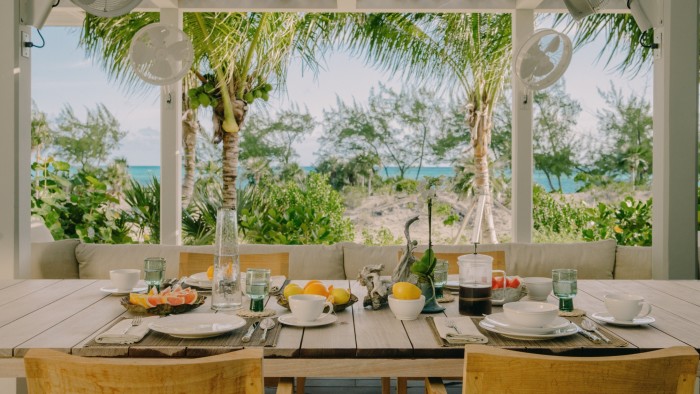
Nadim and Marlene tell me all this as we walk along the sand to their Beach Club. A terrace that faces the sea, it feels like a stage. We settle around a table where Spanish plates and Murano glasses pop with colour, and are soon facing excellent hummus and baba ghanoush, perfectly cooked snapper and mahi-mahi.
My villa is back down the island next to the marina, and I wake in a cloud-soft bed to a view of seven superyachts on a dawn-streaked sea. I’d always wondered if there was a mysterious island where the owners took their vast toys and now I know.
Mike Osborn, who runs the Ashis’ fleet of fast boats, picks me up and we run north, weaving between islands. He points to places where guests can feed big rock iguanas on the beach (“watch your fingers”), sharks in the shallows (“don’t snorkel afterwards”), and the Exumas’ famous swimming pigs. He has hidden beaches for barbecues and famous reefs for snorkelling. I’m chasing bonefish and so he takes me to his secret fishing spots.
The Ashis dug the marina out of a swamp. It currently has 37 slips, which cost $7 a foot a night (minimum 50ft). Villas sleeping two start from $5,000 per night (not including food); cabanas from $1,000. This is pricing to exclude, but if you have the money, there’s now grid electricity, a freshwater system producing 90,000 gallons a day, and a high-speed internet cable run in from Nassau. And there’s the hilltop Yacht Club, where superyacht owners wash down crab claws with margaritas in a series of rooms decorated in luxuriant style by French tastemaker Cathy Vedovi.
The Ashis own all the island’s restaurants. One sunset, I head to MacDuff’s, a classic Bahamian worn-board waterside bar that was once run by nudists — it’s named after their Scottie dog — for conch fritters and Kalik beer.
Nadim told me he plans to “shut it down and entirely renovate” which has spooked some who love it. I also hear a complaint that the burger recipe, which once drew boaters from across the Exumas, has been changed.
I discover a Norman’s local in Carla McCombe who offers island tours. She first visited in 1960 when her father was building the first dock, road and runway, and holidayed here until she bought her home in 1992. During what she calls the “druggie years” she’d stay on the nearby Pyfrom’s Cay, seeing the gun-toting patrols across the water.
She takes me to Volcano, Lehder’s old house. Its ruins sit at the edge of the wildest section of sea, and I poke around, wondering, as everyone does, what lies beneath. The Ashis plan to turn the house into a bar called Carlito’s. “A friend suggested Esco Bar,” Nadim had told me.
We head down a quiet lane where most of the independent owners have their places, and I see what an off-grid paradise it must have been. The feeling is only mildly undermined by a crumbling wall with a gun emplacement that Lehder had built amid the poisonwood and seagrape.
Later, I cycle back to an as-yet untouched bit of beach Carla showed me where the sand falls away into a deep channel along which manta rays, hammerhead and nurse sharks cruise. I look for toothy traffic, then swim across to step out on to a vast sandflat speckled by pink conch. It’s Good Friday and the island is full to capacity, but I see no one.
Meanwhile Lehder, who spent 33 years in US jails, returned to Colombia at the end of March and was immediately arrested, only to be freed again after a few days. I try to reach him, to see what he thinks about what the Ashis have done with the old place, but he doesn’t return my calls.
I walk from my villa to the Beach Club, the setting sun throwing my shadow across the sand. Villa owners are settling in for a barbecue and a waitress, Towanna Romer, is singing someone happy birthday in a voice as sweet and pure as a songbird. It’s very beautiful, and as discreet as such a development could be.
A new owner, a couple of cocktails in, tells me she loves Norman’s because her family can get away from other people. She’s not thrilled by singing, nor by the group of young Latin Americans, here doing a fashion shoot for a Colombian designer, who are having a carry on at the bar. She asks, only half humorously, “Who are these people?”
I’m struck again by how the Beach Club is like a stage. And here we are, playing our parts. This villa owner who has spent millions to escape to a pirates’ island. The singing waitress, dancing Latinos and me, who have managed to sneak in. There’s no audience though, just a wild sea that has seen everything but remembers nothing.
Find out about our latest stories first — follow FT Weekend on Instagram and X, and sign up to receive the FT Weekend newsletter every Saturday morning
Read the full article here