

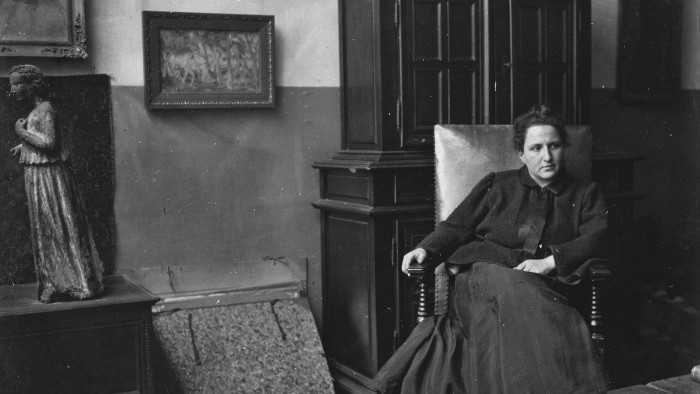
When Gertrude Stein’s friend and Paris neighbour Pablo Picasso completed her portrait in 1906, she was 32 and yet to be celebrated as the American expatriate avant-garde author, salon-leader, art collector and lesbian heroine we know her for today. In her roguishly titled memoir, The Autobiography of Alice B. Toklas, published in 1933, Stein quoted Picasso’s responding to complaints that the painting did not resemble her with the quip, “That does not make any difference, she will.” And, indeed, it is that painting, prominently on view in New York’s Metropolitan Museum of Art since 1947, that has become emblematic of her multi-faceted career and enduring cultural legacy.
Francesca Wade explores the substance of that legacy in her invigorating biography, Gertrude Stein: An Afterlife. In her previous book, Square Haunting, Wade wove together the stories of five female authors — including Virginia Woolf and Dorothy L Sayers — who pursued their art in rented rooms of their own in Bloomsbury’s Mecklenburgh Square.
Here, as her title suggests, Wade connects the lived life of the effervescent if enigmatic Stein, who never ceased composing her abstract texts despite being regularly ridiculed as a gibberish-writing charlatan, with what the author calls her afterlife. That saga focuses on the posthumous reclamation of Stein’s reputation as an artistic innovator. The bulk of her work “defies traditional ways of reading”, Wade writes. Yet especially when read aloud, her “surreal mutations of language” reveal a playful, rhythmic, poetic stream of consciousness. And her work remains influential today, primarily among avant-garde artists, musicians and dancers.
Wade may oversell Stein’s literary influence, but her beguiling revaluation demands we take renewed notice of a figure too often relegated to the margins. “Afterlife” can therefore be read in equal parts as a wish-fulfilling literary fairy tale for the always fame-hungry Stein and as a biographical detective story that fills in once-taboo blanks.
It also makes for juicy if at times unsettling reading, featuring newly available research from archived papers at Yale University. These reveal Stein’s troubled early life, her tense and ultimately toxic relationship with her possessive brother Leo, and the dynamics of her decades-long partnership with Alice B Toklas. (The latter also became a cultural figure as the author of the 1954 bestseller The Alice B. Toklas Cookbook, with its notorious recipe for hashish brownies.)
The bare facts of Stein’s earliest years can seem relatively sunny. She was born in Allegheny, Pennsylvania (now part of Pittsburgh), in 1874, the fifth and youngest child of well-to-do Jewish parents who took the whole family to Europe for a year before settling in Oakland, California. But Stein’s meek, self-sacrificing mother, who died when Gertrude was 14, could not contain the domineering temperament of her husband, whose death three years later cast the family adrift.
“Gertrude hated her own past,” Wade quotes Toklas saying. “She referred to it as little as possible.” But her years in Oakland did inspire one of Stein’s best-known sayings, “There is no there there.”
But “where” would her future lie? Stein’s oldest brother Michael arranged for her to move in with her maternal aunts in Baltimore. There she befriended the art collector sisters Claribel and Etta Cone, whose weekly salons provided a model for the informal Paris get-togethers where Stein would later welcome Picasso, Matisse, Hemingway and many others. In the meantime, to escape her aunts’ matchmaking intentions, she enrolled at Radcliffe College in Cambridge, Massachusetts.
She so impressed faculty member William James that he invited her to join his seminar at the Harvard Psychology Laboratory and encouraged her to attend Johns Hopkins medical school to train as a psychologist. Her professional path seemed clear until she bailed on her medical degree with one semester to go. Was it because, as she claimed, she was “bored”? Or did it have to do with the emotional fallout from a messy same-sex love triangle that, Wade reveals, led to even more dramatic repercussions years later when Stein finally divulged the details (and the novel she had written about it) to an irately jealous Toklas?
Both and more, Wade suggests. Stifled by the misogyny of the Hopkins faculty and shackled by conventional constraints on female sexuality, Stein needed to escape. In 1902, she joined Leo, an aspiring artist two years her senior, in Europe. Before long, their shared quarters in Paris at 27 rue de Fleurus would become a showcase for their presciently selected modernist art collection (featuring Gauguin, Cézanne and Matisse when their names were barely known) and a fashionable gathering spot for progressive art lovers.
Yet, Wade relates, the years with her brother were hardly a bohemian idyll. Leo, whose temper could be as aggressive as their father’s, routinely belittled Stein and her ambitions in public. His disdain for her writing, Stein wrote, “destroyed him for me and it destroyed me for him”. For his part, Leo blamed Toklas for disrupting their household by quickly enmeshing herself in Stein’s life as lover, reader, secretary, housekeeper and gatekeeper almost from the moment of her arrival in Paris from San Francisco in 1907. After brother and sister parted ways in 1913, they never spoke again.
By contrast, from Toklas, Stein wrote, she received “perfect joy”. They were inseparable until Stein’s death in 1946, and afterwards a despondent Toklas declared, “I am nothing but the memory of her.”
But it’s equally clear from the now open archive of papers at Yale that, without Toklas, Stein would not have been whole either. The full story of their love affair can only now be told, uncensored, in an afterlife that Wade captures so vividly here.
Gertrude Stein: An Afterlife by Francesca Wade Faber £20, 480 pages
Join our online book group on Facebook at FT Books Café and follow FT Weekend on Instagram and X
Read the full article here