

Unlock the Editor’s Digest for free
Roula Khalaf, Editor of the FT, selects her favourite stories in this weekly newsletter.
What a joy it is to be at the birth of a really good play. Ava Pickett’s 1536 is one such: a simple yet super-smart concept, a wonderfully vibrant script and a host of resonant themes. It’s delivered so well by an outstanding cast in Lyndsey Turner’s riveting production that the air seems to crackle around it.
Pickett takes one of the most famous events in British history — the beheading of Anne Boleyn — and looks at it through its impact on three ordinary women. And although the year might be 1536, many of the issues raised remain relevant nearly 500 years later, a point emphasised by the fact that, while the actors wear Tudor costumes, their Essex vernacular feels more 2025. Unequal power structures, news manipulation and misogyny are still very much with us. Above all, it’s a play about who controls the narrative — then, now and throughout history.
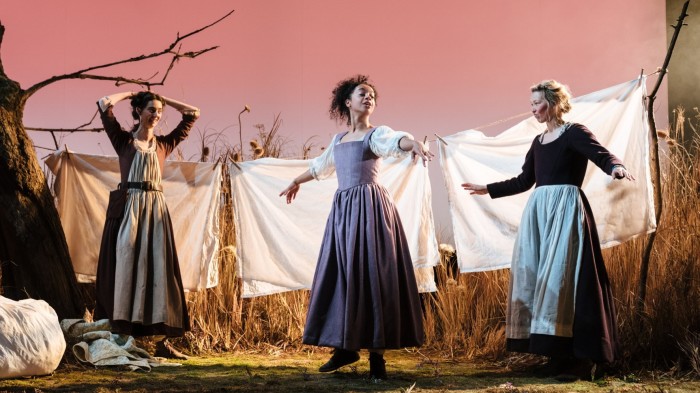
It begins, however, with a delightfully light touch. We’re in a scrubby Essex field where the trio of young women have been meeting since childhood. Anna (Siena Kelly) works in service, Mariella (Tanya Reynolds) is a midwife and Jane (Liv Hill) is about to make a decent match in marriage. They meet up to gossip, tease and quarrel and their early conversations hum with the spice and tenderness of close friendship. “Oh my God. She’s washed her neck!” cries Mariella as evidence that Jane is engaged.
Events at court seem remote in the extreme — Jane struggles even to remember the king’s name. But when she reports the rumours that the queen has been imprisoned, a chill seems to run through the sultry heat.
Pickett refracts the famous royal story through the women’s lives, all three trapped by their gender and class. Jane, sweet and naive (a wonderfully warm and funny performance from Hill) will marry Richard (Adam Hugill), a man who doesn’t love her and who will punish her for that. Mariella must tend to the pregnant wife of William (Angus Cooper), the man she loved but couldn’t marry because of her social station — Reynolds deftly suggests a deep well of heartbreak behind Mariella’s bright, watchful demeanour.
Meanwhile Anna, forthright and beautiful, is both desired and despised by men, who can’t tolerate her independent, headstrong spirit. She’s had a vigorous affair with Richard, a fact that will prove catastrophic, but Kelly plays her with a fabulous edge of recklessness, refusing to conform for a society determined to judge her (but not him).
As the mood in the country shifts, in line with the king’s actions, the women realise that they are in danger. In nearby Colchester, two wives are burned in public by their suspicious husbands. “Colchester is not here,” says Anna, staunchly. But the skies darken over Max Jones’s set, as do the friends’ prospects.
The play’s complex personal entanglements amplify the way love and desire can be warped by power. But they come to a head in a frantic final section that feels rushed and unbalances the production — it seems to end several times. These drawbacks aside, however, this is a cracking debut, gorgeously acted.
★★★★☆
To June 7, almeida.co.uk
Read the full article here