

Unlock the Editor’s Digest for free
Roula Khalaf, Editor of the FT, selects her favourite stories in this weekly newsletter.
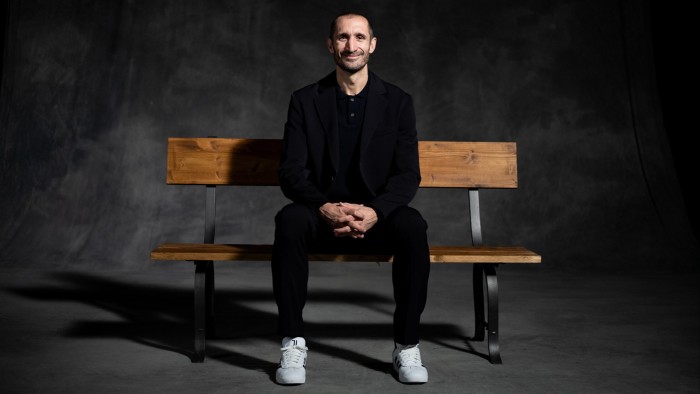
As a boy growing up in Livorno, a gritty Tuscan port town better known for its anarchist humour than corporate ambition, Giorgio Chiellini never imagined he would one day be working behind a desk at Juventus, one of Italy’s leading football clubs.
Instead he pursued his childhood dream of playing the game to become one of the best defenders of all time, winning titles for club and country along the way as captain of both the Old Lady, the nickname of Turin-based Juventus, and the Italian national team.
But Chiellini’s second act is not a story of faded glory or aimless punditry. It is about intention, preparation, and a quiet, affable ambition that belied the on-pitch ferocity of his playing days. At 40, Chiellini finds himself exactly where he hoped to be: inside the engine room of one of Europe’s biggest football clubs, helping to steer its future not from the touchline, but from the front office.
“I always knew I wasn’t going to be a coach,” says Juventus’s head of football institutional relations, the club’s point person with the sport’s governing bodies like Uefa and Fifa, with his usual broad smile. “Even during my playing career, I was always more fascinated by the management and business side of the club than just the sporting aspect. I also knew I didn’t want to spend the next chapter of my life scouting the new Ronaldo or Messi.”
While still playing at the highest level, Chiellini began plotting his next move. In his early twenties, he enrolled for an economics and commerce degree, an unconventional decision for a young footballer in Italy, where training schedules and national team call-ups rarely allow room for exams. But Chiellini found a university flexible enough to accommodate his playing commitments and spent much of his time between matches or on trips to away games reading management textbooks and writing papers.
His masters degree dissertation was a financial analysis of Juventus, comparing the club’s business model to Real Madrid, the gold standard in global football when it comes to monetising the game. Like anybody who has transitioned from a classroom to a real office job, Chiellini admits that there’s a big gap between theory and reality: “You can plan and study as much as you want, but when you actually start, it’s always different. You have to learn on the field, just a different kind of field now.”
If that sounds like boardroom-speak, it is but delivered with Chiellini’s trademark humility. There’s a gentleness to his manner that disarms, especially in someone known for once snapping a tendon mid-game and playing on. “I’m very lucky,” he says often. “I’m not saying I didn’t deserve it. But I’m grateful every day.”
He is the rare former player who speaks comfortably about environmental, social and governance (ESG) goals, start-up investing, and horizontal organisational charts and does so without pretence.
At Los Angeles FC, the US Major League Soccer club where he spent the final playing years of his career, Chiellini also took on a kind of internship within the club’s front office. He sat in on commercial and strategy meetings, built relationships with team executives, and learned how an American club balances sports and entertainment. “It gave me a totally different perspective from Europe,” he says. “They treated me like family but also like a student. I asked a lot of questions.”
Chiellini credits his longtime mentor, Andrea Agnelli, the former Juventus president and member of the family that owns the club, for helping him think early on about life after football. “Andrea and I had so many conversations,” he recalls. “He would ask me: where do you see yourself? What do you want to do after? Those chats helped me form a vision.”
That vision is now taking shape. Chiellini is back at Juventus in an executive role, contributing to the club’s broader organisational direction while continuing to sharpen his business instincts.
Alongside his football executive duties, he has also launched a consortium for early-stage investors, partnered with a former teammate on a media venture, and says he has backed several start-ups in AI and fashion. Still, he insists his energy is focused: “Seventy per cent of my time is for Juventus. Twenty for my family. Ten for everything else, maybe less.”
The biggest change between being a player and an executive is his experience of pressure in his day-to-day life. “On the sports side, the pressure is constant and immediate. You’re focused on the result, and sometimes that keeps you from seeing the bigger picture. In the front office, the pressure is different. We’re still affected by what happens on the field, but we have more balance.”
His ultimate ambition? To be the Karl-Heinz Rummenigge of Juventus, he says without hesitation, referring to the former German footballer, one of the finest forwards of his generation, who helped transform Bayern Munich into a global commercial juggernaut. “He did everything, the playing career, the leadership, the vision. I don’t want to copy him, but I admire the way he made that transition.”
That Chiellini admires someone else’s path speaks volumes about his character. He could easily rest on the laurels of his career — nine Serie A titles, a European Championship with his national team, and recognition that he is up there as one of the best defenders of all time — but instead, he carries himself like a humble apprentice. “It’s like I’m 25 again, starting my second career,” he says. “The only difference is now I bring experience from the field. But I still have so much to learn.”
For Chiellini, the journey from player to executive is not about hanging on, it’s about building something lasting. And for Juventus, it may just be the best signing they have made in years.
Read the full article here